Why the XRP Ledger Is Winning the RWA Race: Tokenized Treasuries, Real Estate, and Enterprise Adoption
Summary
Executive snapshot: XRP Ledger’s RWA moment
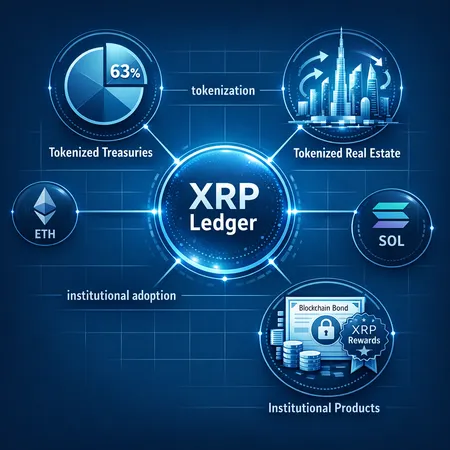
Tokenization of real‑world assets (RWAs) is no longer an experiment; it’s a procurement and balance‑sheet tool. Recently published market data attributes about 63% of tokenized U.S. Treasuries market share to the XRP Ledger — a lead that demands attention from corporate blockchain strategists and tokenization product teams. That figure reflects not just volume but the emergence of tailored products and on‑ramps that prioritize settlement speed, deterministic finality, and cost efficiency for institutional workflows. See the underlying market analysis for context on that 63% figure here.
This piece unpacks the data, showcases live product examples (retail and institutional), explores custody and regulatory traps, and contrasts XRP with ETH and SOL so teams can decide where to build now.
The data: what the 63% claim actually means
The 63% statistic is a snapshot of market share in tokenized U.S. Treasuries activity and should be interpreted with nuance. The underlying report aggregates issuance and secondary‑market volumes attributed to ledgers and finds that the XRP Ledger accounts for a majority share relative to Ethereum (ETH) and Solana (SOL) in that category. Factors that can drive such concentration include: the choice of a small number of large issuers or trading venues that standardized on XRP Ledger tooling; lower per‑transaction costs that favor high‑frequency secondary trading; and developer stacks optimized for tokenized‑asset lifecycle management.
That doesn’t automatically translate to universal superiority. Ethereum offers richer smart‑contract expressiveness and a vast ecosystem of tooling; Solana brings high throughput for certain DeFi primitives. But for tokenized treasuries—where deterministic settlement, throughput for trading, and predictability of costs matter as much as programmability—the XRP Ledger’s design economics can be compelling.
How ledger design maps to treasury tokenization
Three technical traits help explain why treasuries gravitate to ledgers like XRP Ledger:
- Deterministic settlement times and low latency, which reduce counterparty exposure during secondary trading.
- Very low and predictable fees, helping markets with tight spreads.
- Simple token primitives and built‑in compliance hooks, which can be extended into the legal wrappers financial institutions require.
These characteristics are often more important to institutional treasury desks than maximal Turing‑complete flexibility.
Real products: institutional and retail use cases
Concrete product deployments explain why market share matters. A few representative examples:
SBI Holdings launched a ¥10 billion blockchain bond that included XRP rewards aimed at retail investors—an example of how retail‑facing RWA products can combine tokenized securities with native ledger utility to broaden distribution and engagement. This is not an abstract pilot; it shows how distribution, yield mechanics, and token incentives can be packaged for everyday investors (report here).
The Dubai Land Department recently enabled secondary trading of tokenized real estate on the XRP Ledger, moving beyond single‑sale registries to active markets where ownership shares can circulate. This operational step is a major endorsement of the ledger’s ability to support compliance and secondary liquidity in a regulated jurisdiction (coverage here).
Taken together, these deployments show both institutional (bond issuance, tokenized treasuries) and retail (bond distribution with token rewards) pathways for RWA productization on the ledger.
Product and business-model implications for builders
If you’re building tokenized treasuries or real estate products, these examples imply several practical design choices:
- Prioritize ledger features that reduce operational risk: fast finality and low, predictable fees can materially lower margin erosion in secondary markets.
- Design custody, settlement and reconciliation workflows that mirror legacy finance. Many buyers still expect custodial segregation, audit trails, and offline dispute resolution.
- Consider hybrid models: on‑chain token ownership coupled with off‑chain legal entitlements and registrar services.
Retail‑centric models (like SBI’s bond) add another axis: customer engagement. Reward mechanics using native ledger tokens or utility (e.g., XRP rewards) can increase takeup, but they also introduce token‑economy design and regulatory considerations.
For on‑chain DeFi integrations and composability, teams will weigh how much native programmability matters versus the benefits of optimized settlement rails. RWA products often interact with DeFi primitives for secondary liquidity and collateralization—so builders should plan integration layers rather than assume all activity stays siloed.
Regulatory, custody, and compliance: what changes with RWA on‑chain
Tokenized RWAs collapse technical and legal layers, producing both opportunities and obligations. Key issues enterprise teams must solve:
- Custody models: Institutional players will insist on regulated custodians or bank‑like custody that supports multi‑party controls, insured cold storage, and clear governance for token recovery. Custodian integration is often a gating factor for institutional adoption.
- Legal wrappers: Most jurisdictions treat tokenized instruments as representations of off‑chain rights. Issuers must maintain legal documentation (ISINs, prospectuses, transfer restrictions) that map to on‑chain tokens.
- KYC/AML and transfer restrictions: Ledgers must support permissioning layers, allow whitelisting or on‑chain attestations, and integrate with compliance APIs.
- Regulatory clarity and enforcement risk: Retail incentive features (like XRP rewards) intersect with securities and consumer rules in many markets and will attract regulator scrutiny.
The ledger you select should make these enterprise integrations straightforward: APIs for custodians, tooling for whitelisting, and predictable on‑chain behavior that maps cleanly to legal processes.
XRP Ledger vs Ethereum vs Solana — the competitive trade-offs
Choosing a ledger is an exercise in tradeoffs. Here’s how XRP Ledger, Ethereum (ETH), and Solana (SOL) compare for tokenized treasuries and real estate:
XRP Ledger (XRP): Strengths are deterministic settlement, low fees, and a growing roster of RWA use cases and issuers. The ledger’s simplicity leads to operational predictability—valuable for institutional settlement cycles. The recent market concentration in tokenized treasuries and Dubai’s real‑estate activity suggest a practical momentum.
Ethereum (ETH): Offers unparalleled tooling, composability, and developer ecosystem. It’s ideal where complex on‑chain logic, programmable compliance layers, and broad DeFi integration are required. But higher gas costs and variable finality can complicate high‑frequency secondary trading unless you use L2 solutions.
Solana (SOL): Provides high throughput and low costs, useful for high‑frequency trading and certain DeFi rails. However, network outages and validator centralization concerns are considerations for institutional risk teams that require high availability and predictable settlement.
In short: if your product prizes deterministic settlement and low marginal cost for large volumes (e.g., tokenized treasuries), XRP Ledger’s design economics may outweigh Ethereum’s expressiveness or Solana’s raw throughput. If deep composability and on‑chain derivative logic are core to your product, Ethereum and L2s remain compelling.
Practical checklist: evaluating which ledger to build on, now
If you’re on the product team deciding where to deploy, use this checklist:
- Regulatory fit: Does the ledger support whitelisting, attestations, and custodian APIs that map to your jurisdictional requirements?
- Settlement profile: Do you need deterministic, low‑latency settlement for tight spreads? If yes, XRP Ledger looks attractive.
- Ecosystem services: Are custodians, market‑makers, and legal service providers already integrated with the ledger?
- Composability needs: Will your product require complex on‑chain logic or cross‑protocol composability? If so, Ethereum or L2s may be better.
- Operational resilience: Evaluate historical uptime and recovery models—Solana’s outages, for example, have been a talking point for risk teams.
Mentioning market infrastructure: builders should check rails like bank APIs, token registrar services, and platforms such as Bitlet.app for how fiat on/off ramps, installment products, and P2P exchange flows can plug into tokenized offerings.
Recommendations for enterprise strategists
- Pilot quickly but legally: run parallel pilots with legal wrappers to prove settlement workflows and custody integrations before scaling issuance.
- Design for hybrid custody: offer regulated custodial options and multi‑sig attestations to satisfy institutional counterparty requirements.
- Focus on liquidity: RWA projects fail on poor secondary liquidity more than on issuance mechanics. Design incentives and market‑maker relationships early (retail incentives can help bootstrap liquidity, as SBI’s example shows).
- Plan interoperability: even if you launch on XRP Ledger for settlement efficiency, plan for bridges or wrapped token strategies to access Ethereum DeFi when needed.
Conclusion
The XRP Ledger’s recent share of tokenized U.S. Treasuries and live deployments in retail bonds and Dubai’s tokenized real estate mark a pragmatic turn: institutional and retail participants are choosing ledgers that reduce operational friction, lower costs, and align with existing legal practices. That doesn’t make XRP Ledger universally superior—Ethereum and Solana retain important advantages—but it does shift the calculus for teams focused specifically on tokenized treasuries and real estate.
For product teams, the question is less about which ledger is the most fashionable and more about which one reduces execution risk for your particular RWA use case. If deterministic settlement, low transaction cost, and growing institutional integrations are priorities, the XRP Ledger deserves a close, practical evaluation.
Sources
- CoinPaper — XRP Ledger dominates tokenized U.S. Treasuries (63% market control): https://coinpaper.com/14813/xrp-ledger-dominates-tokenized-u-s-treasuries-with-63-market-control-outpacing-ethereum-and-solana?utm_source=snapi
- Bitcoin.com News — Dubai Land Department advances tokenized real estate trading on XRP Ledger: https://news.bitcoin.com/ripple-secures-xrp-ledger-position-as-dubai-land-department-advances-tokenized-real-estate-trading/
- CryptoNews — SBI Holdings launches ¥10B blockchain bond with XRP rewards: https://www.cryptonews.com/news/sbi-holdings-launches-10b-yen-blockchain-bond-with-xrp-rewards/