Can XRP Reach $2.70 After 54 Days of ETF Inflows? A Liquidity-First Assessment
Summary
Executive snapshot
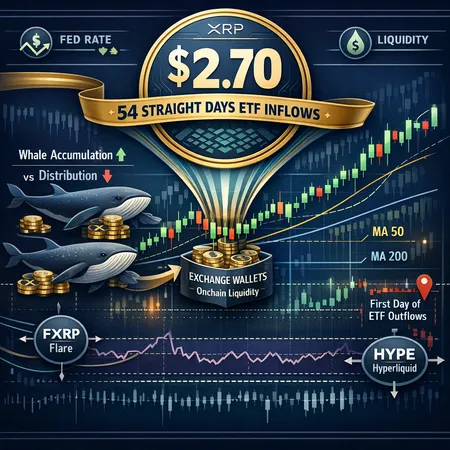
A recent thread of headlines — 54 straight days of ETF inflows and a bullish $2.70 price projection — has reignited debate about XRP’s next phase. On one hand, persistent ETF demand and renewed whale activity can compress supply and lift prices. On the other, spot liquidity depth, exchange reserves, and an early ETF outflow day point to fragile momentum.
This piece unpacks the mechanics behind each driver: ETF flows, on‑chain whale behavior, new spot markets such as FXRP on Flare/Hyperliquid, and short‑term liquidity signals. The goal: an evidence‑based view on whether the XRP price target of $2.70 is realistic over the medium term for traders and investors.
What $2.70 even means in market terms
Before diving into signals, put the target in perspective. At roughly the current circulating supply (low‑to‑mid tens of billions), a $2.70 XRP equates to a market capitalization in the low‑hundreds of billions of dollars. That’s a substantial jump from today’s levels and requires sustained capital inflows, a re‑rating of relative value, or meaningful supply reduction into illiquid hands.
That basic math is why liquidity matters: without deep, stable order books and a diversified buyer base, price is vulnerable to reversals even if headline inflows continue.
ETF inflows: momentum driver — but how sustainable?
The narrative behind the $2.70 projection leaned heavily on an extended streak of ETF inflows. Continuous ETF demand can act as a near‑automatic liquidity sink: authorized participants buy spot, remove coins from exchanges or custodial inventories, and that reduces available supply. This mechanical buy pressure helps explain quick, large moves in other markets.
However, flows can reverse. Indeed, US spot XRP ETFs recorded their first day of net outflows recently, a reminder that investor appetite can switch quickly when headlines or macro conditions shift (Invezz). One day of outflows doesn’t invalidate the inflow streak, but it does inject the possibility that the ETF channel is more fragile and sentiment‑sensitive than proponents assume.
Key questions for ETF sustainability:
- Are inflows retail‑led, institutional, or a mix? Institutional allocations tend to be stickier.
- Do APs and ETF issuers have incentive to source liquidity off‑exchange or via new spot venues (which changes where price discovery happens)?
- How correlated are ETF flows with broader crypto risk appetite and macro rates?
If inflows are primarily short‑term tactical capital, the path to $2.70 is narrow; if they are part of longer‑term allocations, the case brightens.
Whale accumulation vs distribution: what on‑chain shows
On‑chain metrics offer an unfiltered look at supply dynamics. Recent reporting notes whale transactions for XRP hit three‑month highs, signaling active accumulation dynamics among large holders (Cryptopolitan). That matters because whales control a disproportionate share of tradable supply; sustained buying or hodling by them can amplify upward moves.
But a spike in large transactions is ambiguous by itself. Are whales accumulating into ETFs and new product launches, or reallocating between custodial providers and exchanges? High‑volume transfers to exchanges typically precede selling, while transfers to cold wallets or custodial ETF flows suggest accumulation.
Practical takeaway: monitor exchange inflows/outflows and large wallet clustering. If whale flows coincide with declining exchange reserves and rising ETF balances, that supports the scarcity story necessary for a $2.70 price.
FXRP, Flare/Hyperliquid and the changing spot landscape
The launch of FXRP — the first XRP spot market on Hyperliquid via Flare — is a structural development worth watching because it expands where price discovery and settlement can occur (Cryptopolitan — FXRP launch). Cross‑chain spot liquidity enables new arbitrage paths and can relieve bottlenecks on traditional exchanges, but it also fragments liquidity across venues.
Two implications:
- New venues increase total accessible liquidity, which is bullish for price discovery transparency and for institutional arbitrage strategies that can support higher valuations.
- Fragmented liquidity means order‑book depth at any single venue might still be thin. Markets with many small venues often experience higher slippage on large trades.
HYPE and FLR tickers now enter the ecosystem not just as protocols but as plumbing for XRP’s tradability. If APs and market makers integrate FXRP into their ETF sourcing, that could lower friction for inflows. But adoption and depth take time.
Short‑term liquidity warning signs: the first ETF outflow day
While inflow streaks are compelling headlines, the reality of ETF flows is dynamic. The first reported day of net outflows from US spot XRP ETFs is a concrete warning sign: ETFs are not a one‑way valve. Outflows can coincide with profit taking, rebalancing, macro drawdowns, or headline risk, and each can create liquidity vacuums.
When ETF demand slows or reverses, price must be supported by other buyers: retail, OTC desks, or whales. If those groups are not active, prices retrace quickly—especially in an asset with concentrated holder distributions.
Traders should therefore watch: net ETF daily flows, AP activity, and exchange order‑book depth. A $2.70 path requires inflows to outpace outflows for an extended period while on‑exchange liquidity tightens.
Technical and macro overlay: what could accelerate or impede a rally
Accelerants:
- Renewed institutional allocations to crypto or sector rotation into XRP specifically.
- Further integration of FXRP and other spot venues into ETF sourcing and AP strategies, lowering settlement friction.
- Continued whale accumulation coinciding with falling exchange reserves, creating a genuine supply squeeze.
- Positive product or regulatory developments that expand utility (payment rails, stablecoin partnerships, or yield products).
Impediments:
- ETF flow reversals and broader risk‑off in crypto markets.
- Thin order books on primary exchanges and nascent venues causing slippage on large buys.
- Large holders choosing to distribute into rallies rather than hold—common when gains are large and concentrated.
- Regulatory or legal developments that introduce uncertainty around token utility or custody.
How product and corporate moves shift fair value
Beyond flows and whales, Ripple’s work on payments infrastructure, stablecoins or yield-type products can change real utility and therefore longer‑term valuation. New on‑chain use cases (for example, settlement corridors or tokenized yield products) can increase natural demand for XRP as a utility token.
Utility-driven demand differs from speculative ETF‑linked demand: it can be more persistent and less correlated with macro swings. Yet product launches must reach adoption thresholds to matter. For traders, these are long‑tail positives rather than immediate catalysts.
Scenario analysis: where $2.70 becomes plausible — and where it doesn’t
Plausible path (bull case):
- ETFs resume consistent inflows backed by institutional allocations; APs integrate FXRP liquidity; large whales move coins off exchanges into custodial or cold storage; exchange reserves fall materially. Combined, these create a supply squeeze and continuous buy pressure. Under this path, a move toward $2.70 becomes progressively more realistic.
Fragile path (base case):
- ETF inflows slow or intermittently reverse (as the recent outflow day suggests), whales rotate rather than hold, and spot venues remain fragmented with limited depth. Price spikes on headlines but lacks follow‑through; $2.70 requires an outsized, sustained demand shock.
Unlikely without major catalyst (bear case):
- Broad market risk‑off or regulatory setbacks trigger large redemptions; selling pressure from concentrated holders overwhelms sporadic ETF buys; liquidity evaporates.
Practical signals traders and investors should monitor
- Daily net ETF flows and AP creation/redemption activity.
- Exchange wallet balances and large outflows to cold storage or custodians.
- Whale transfer sizes and destination patterns (custody vs exchange).
- Order‑book depth on major centralized venues and FXRP liquidity on Hyperliquid.
- Macro risk indicators and momentum across larger crypto markets like Bitcoin.
Also consider monitoring broader DeFi and cross‑chain adoption trends; integrations with DeFi rails can increase utility‑led demand.
Bottom line: possible but conditional
Is $2.70 realistic? Technically yes — under a coherent scenario of sustained ETF demand, continued whale accumulation, and deeper spot liquidity enabled by venues like FXRP/Hyperliquid. Practically, that scenario requires more than headlines: it needs durable, diversified demand and clearer signs of supply being locked away.
Short‑term signals such as the first ETF outflow day and the still‑nascent depth on new spot venues counsel caution. For traders and investors, the prudent approach is to treat $2.70 as an upside target dependent on persistent liquidity improvements, not as an inevitable outcome of a headline inflow streak.
Bitlet.app users watching XRP should therefore prioritize liquidity metrics and ETF flow tracking in their watchlists, and be ready to size positions as order‑book depth confirms sustainable buying pressure.
Sources
- Analysis suggesting a $2.70 target amid 54 days of ETF inflows: Coinpaper
- Whale activity and accumulation dynamics: Cryptopolitan — XRP whale activity
- Launch of FXRP spot market on Hyperliquid: Cryptopolitan — FXRP launch
- First day of net outflows from US spot XRP ETFs: Invezz