What Cardano’s LayerZero Integration Means for Interoperability, DeFi, and ADA
Summary
Quick snapshot: why this matters
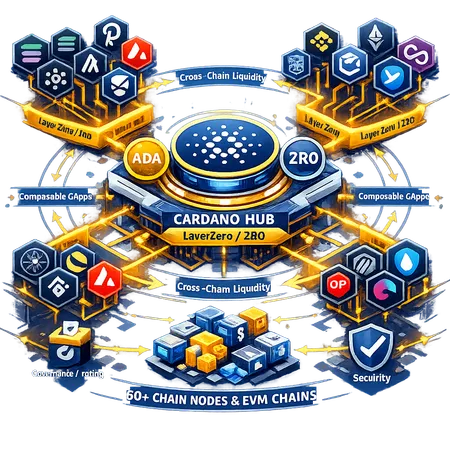
Cardano’s connection to LayerZero — which links it to 80+ chains — is not just another bridge announcement. It replaces a long-standing barrier: the inability for Cardano smart contracts to participate in native cross-chain messaging at scale. The integration, announced recently, signals that Cardano can now be part of multi-chain execution flows rather than only being a holder of wrapped assets or an isolated L1. See the integration announcement for details on the supported chains and scope.
For developers and investors this is significant. For developers it expands the design space for composable dApps and cross-chain UX; for investors it reshapes how ADA could capture value from growing cross-chain activity — but not automatically or overnight.
How LayerZero technically connects Cardano (high-level)
LayerZero offers an omnichain messaging layer that eschews the classical lock-and-mint pattern in favor of message passing. At a high level the architecture runs like this:
- Each chain runs a small on-chain endpoint contract to send and receive messages. Those endpoints verify incoming proofs.
- Off-chain there are two cooperating parties: an oracle that submits a transaction proof (block header or proof-of-finality reference) and a relayer that supplies a proof payload. The endpoint verifies the combination rather than downloading entire chain state on-chain.
- The model is often called an Ultra Light Node — it minimizes on-chain gas by trusting canonical data from the oracle + relayer pair to carry a verified message across chains.
That design yields high composability: endpoints can pass arbitrary messages (not only token transfer instructions), enabling cross-chain function calls, state sync, and richer dApp interactions. LayerZero’s native token, ZRO, is used within its fee model and to incentivize relayers in certain contexts.
There are a few Cardano-specific wrinkles. Cardano’s extended UTXO (eUTxO) model differs from account-based EVM semantics; cross-chain messaging must be mapped into cardano’s transaction-construction model. Expect middleware libraries and SDKs that transform incoming LayerZero messages into valid Plutus script actions or queued transactions on Cardano.
(For the official integration announcement, read the Cardano+LayerZero write-up.)
What this unlocks for DeFi composability on Cardano
LayerZero’s message-passing approach directly addresses the core requirement for composable DeFi: the ability to call, combine, and sequence logic across chains. Practical examples:
- Cross-chain liquidity pools and AMMs that can route orders between Cardano and EVM venues in one user flow, improving price execution for ADA holders.
- Cross-chain lending and collateralization where assets on other chains are used as collateral without wrapping them on Cardano first — enabling true multi-chain credit markets.
- Composable orchestration for yield aggregators: a single strategy can rebalance positions across chains atomically (or near-atomically), increasing capital efficiency.
- Cross-chain NFTs and meta-contracts that hold logic across multiple execution environments.
Developers should note that implementing these patterns on Cardano will require careful handling of eUTxO transaction determinism and re-entrancy equivalents. There will be an SDK and best-practice patterns emerging quickly; early adopters can capture product-market fit if they solve UX and atomicity edge cases.
For many building on Cardano today, the ability to tap external liquidity pools and oracles via LayerZero will feel like opening a new distribution channel. Expect collaborations between Cardano protocols and multiservice aggregators that already use LayerZero on EVMs.
Governance and security: trust assumptions you must audit
LayerZero’s oracle+relayer model reduces some classical bridge risks (like single-bridge mints), but it introduces new trust surfaces:
- Oracle/relayer collusion: If both the oracle and relayer behave maliciously or are compromised, they could deliver fraudulent messages. Decentralizing these services and requiring multi-party attestations reduces risk.
- Endpoint vulnerabilities: the on-chain endpoint contract becomes a high-value target. Proper formal verification or audits for those endpoints (especially Cardano-specific bindings) are essential.
- Finality assumptions: cross-chain ordering and finality differ by chain. A message assumed final on one chain can be reorganized on another, so the design must include safe confirmation thresholds.
- Fee and incentive alignment: relayers must be economically incentivized to act honestly long-term. LayerZero’s ZRO token plays a role in fee models; however, ZRO utility is not directly the same as ADA’s economic model.
Historically, bridges attracted the largest losses in crypto because of composability and high-value message flows. The LayerZero model reduces some risk vectors but requires robust decentralization of off-chain actors, slashing/staking mechanics for relayers, and transparent governance over endpoint upgrades.
Competitive positioning vs EVM chains
EVM chains benefit from decades of composability by design — the account model lets one contract call another in a single transaction. Cardano’s eUTxO model was historically a hurdle: it’s safer in many ways (predictability, formal reasoning) but harder for cross-contract atomic flows.
LayerZero narrows that gap. By enabling cross-chain messages into Cardano, developers can stitch Cardano-native safety and formal verification with liquidity and composability that still lives on EVM rails. That hybrid advantage could be decisive for projects that value provable correctness and low-cost settlement but need cross-chain customers and liquidity.
That said, macro market conditions matter. Recent commentary shows strong sell-pressure on major altcoins that could constrain short-term liquidity flows into interoperable projects, including Cardano. Even the best tech can face adoption headwinds if liquidity and sentiment are low.
Concrete developer playbook: patterns to implement now
If you’re a Cardano developer thinking about LayerZero, consider these practical steps:
- Prototype a messaging handler: implement an endpoint consumer that transforms LayerZero payloads into valid Plutus transactions and test edge cases like message replay, out-of-order delivery, and partial failures.
- Build or adopt a queuing/mempool layer: because eUTxO transactions must be constructed deterministically, incoming cross-chain messages often need to be scheduled or batched.
- Design idempotency and reconciliation: ensure repeated messages don’t cause double-spends or duplicate state changes — use nonce schemes and on-chain receipts.
- Integrate cross-chain oracles and price feeds with safe confirmation policies: avoid single-point price inputs.
- Harden endpoint contracts and run extensive audits and fuzzing; consider multi-party relayer setups and social recovery or governance timelocks for critical upgrades.
These are not optional; composability depends on robust message semantics and predictable behavior across chains.
Adoption hurdles and timeline (realistic view)
Technical integration is only part of the story. Short-term adoption will likely be gated by:
- Tooling maturity: SDKs, wallets, explorers, and developer infra that abstract eUTxO friction will take months to mature.
- Liquidity gravity: EVM chains still hold the bulk of TVL. Projects will only bridge if there’s clear user and liquidity upside — a factor complicated by macro sell-pressure across altcoins. See analysis on cross-market sell pressure and how it affects allocation decisions.
- UX and custodial risk perceptions: users still distrust bridges; seamless, audited flows and insurance primitives will be key.
- Regulatory and compliance clarity: cross-border value transfer raises compliance questions for some teams and liquidity providers.
Given these factors, expect a 6–18 month runway for visible DeFi flows to meaningfully grow on Cardano via LayerZero, with faster movement for niche use-cases (NFTs, messaging-heavy apps) and slower adoption for capital-intensive infrastructure.
Investor lens: how to re-evaluate ADA and ZRO
For investors the integration changes the narrative but not overnight price mechanics:
- ADA as an infrastructure exposure: LayerZero improves Cardano’s composability, which can increase developer activity, TVL, and on-chain fees. That could increase demand for ADA over time if native settlement and staking usage rise.
- ZRO’s role: ZRO is important for LayerZero’s economic model (fee mechanics, relayer incentives). Growing cross-chain messaging raises ZRO utility, but ZRO’s demand is logically tied to LayerZero usage — not ADA issuance. ZRO appreciation alone doesn’t guarantee ADA gains; the coupling is indirect.
- What to watch: track TVL on Cardano protocols that leverage LayerZero, cross-chain volume routed to/from Cardano, developer activity metrics, and relayer decentralization progress. These are leading indicators of value capture.
- Risk context: macro sell-pressure on altcoins and tight liquidity can mute any tech-driven re-rating. Keep position sizing aligned with adoption timelines and monitor security incidents in cross-chain systems.
For traders and mid-level investors, consider a layered approach: a core long-term allocation to ADA for infrastructure exposure, plus tactical positions in protocols that successfully bootstrap cross-chain flows. For onramps and P2P exchange needs, platforms like Bitlet.app make buying and splitting exposure easier for retail investors.
Final takeaway
Cardano’s LayerZero integration is a structural step toward true multi-chain composability for an ecosystem that has long been more isolated than many peers. Technically it opens a rich set of possibilities — cross-chain liquidity, composable dApps, and novel UX patterns — but success depends on reliable off-chain relayer decentralization, robust on-chain endpoint security, developer tooling, and market liquidity.
Investors should recalibrate expectations: the integration increases long-term optionality for ADA but is not an immediate valuation lever without clear adoption and measurable cross-chain flow. Developers who move early and solve Cardano-specific UX and atomicity challenges can capture outsized benefits in the coming 6–18 months.
Sources
- Cardano taps LayerZero: Cardano taps LayerZero ending island era with 80 chain bridge
- Altcoin market context and timing: Altcoins to watch in the final week of February 2026
- Macro sell-pressure analysis: BNB, Solana, Cardano, XRP sell pressure hits 5-year extreme
For protocols and developer references, also explore Cardano and emerging DeFi projects integrating cross-chain messaging.