ETF Outflows, Hashrate Swings and Mining Difficulty: BTC's Near-Term Risk Map
Summary
Framing the problem: two layers of risk converging
For institutional allocators, liquidity and price support are not abstract — they determine execution cost, margin availability and the ability to rebalance. Over the past several weeks, three dynamics have been overlapping: persistent US spot Bitcoin ETF outflows, macro shocks and extreme retail sentiment, and meaningful network-level events (notably hashrate volatility and a sharp difficulty adjustment). Together they change the odds for near-term BTC moves and the profile of downside risk.
This article synthesizes those signals into an operational checklist for traders and allocators: what to watch, why it matters, and how different scenarios can play out.
What the data says: ETF outflows, sentiment spikes and on-chain flows
ETF outflows — scale and persistence
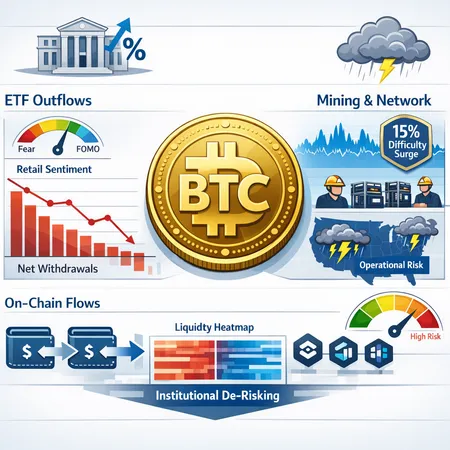
US spot Bitcoin ETFs have not behaved like a steady institutional bid in recent weeks. Industry trackers show a multi-week streak of net redemptions, with reported five-week net outflows approaching several billions of dollars. For example, Cointelegraph documents a five-week net outflow of roughly $3.8 billion, and supplementary coverage highlights fresh weekly outflows (including a recent $166 million read) that extend the negative run. These are not single-day blips — they're sustained and measurable de-risking from an investor base that had been a backbone of demand since ETF approvals.
Why this matters: ETFs aggregate institutional-sized inflows and, when they stop buying (or actively redeem), they remove a structural bid that had been supporting price floors. Even modest weekly redemptions can matter when combined with on-chain selling and low exchange depth.
Retail sentiment and forced liquidations
Sentiment measures — search trends, social chatter, and liquidation events — have also flashed extremes. Public-interest searches like "Bitcoin is dead" have spiked back toward post-FTX highs in windows around large liquidations, signaling heightened retail fear and knee-jerk selling. Coinpaper documents both the search surge and an episode of roughly $70M in liquidations that coincided with sharp moves.
These retail-driven events increase tail risk: when sentiment is already negative, any bout of volatility can cascade through stop-losses and funding-rate squeezes, deepening short-term drawdowns.
On-chain flows: large wallets and exchange inflows
Complementing ETF and sentiment data are on-chain flows. Over the same period there have been multiple large wallet movements toward exchanges — an on-chain proxy for potential selling pressure. While not all exchange transfers end in immediate sell orders (custodial rebalancing and OTC desks also use exchange rails), the timing and concentration of these flows increase the probability of transient liquidity stress in order books.
Taken together, ETF outflows, exchange inflows and retail panic can create a supply-demand mismatch that is visible in widening spreads, slippage and episodic liquidity blackouts during fast moves.
Network-level shocks: hashrate swings and the 15% difficulty surge
What happened and why it matters
Separately, Bitcoin's network experienced a notable operational shock: after storms in the US temporarily cut hashrate, the subsequent hashrate recovery produced a ~15% jump in mining difficulty. Coinpaper reported this rapid difficulty climb following an earlier sharp drop in February. In plain terms: miner capacity dropped during the storms, then came back online and the protocol-adjusted difficulty to maintain block cadence.
Why institutional risk managers should care: difficulty and hashrate swings affect miner economics and short-term supply. A sudden rise in difficulty compresses miner margins (all else equal), which can increase selling from marginal operations that rely on regular BTC payouts to cover costs. Conversely, an unexpectedly large hashrate drop (from weather, network outages, or regulatory events) can temporarily lower difficulty in future adjustments and raise short-term issuance risk if miners delay selling — the net effect depends on timing and miner behavior.
Network resilience vs operational risk
The 15% difficulty surge is evidence of a resilient protocol: difficulty does what it should — adapt to hashrate changes to keep blocks near target times. That resilience is a positive long-term signal. But resilience doesn't eliminate operational risk. Geographic concentration of miners, dependency on seasonal weather patterns, and the capital structure of mining firms (debt-servicing and hedges) mean that physical shocks can translate to market flows.
A storm-caused outage is a transient event; what matters for market risk is the interplay of recovery speed, miner liquidity needs, and timing relative to market stress (e.g., ETF redemptions or macro shocks). A rapid hashrate rebound leading to a difficulty spike can flip miner profitability in the short term and trigger incremental supply into markets when liquidity is already thin.
How these layers interact to shape BTC's near-term risk profile
Think of this as a three-way feedback loop: institutional flows set the baseline liquidity; on-chain exchange inflows and retail sentiment determine the marginal sell pressure; and network-level events determine miner supply elasticity.
- Institutional de-risking (ETF outflows) reduces the natural cushion of buy-side demand. When that cushion is thinner, the same volume of sell-side pressure creates larger price moves and deeper slippage.
- Retail panic and forced liquidations amplify volatility on the margin; liquidation cascades can widen spreads and empty order books at key levels.
- Miner economics (influenced by difficulty and hashrate) govern a portion of available supply. If difficulty spikes compress margins, marginal miners may be forced to sell into a weak market — especially smaller, debt-levered operations.
The combination raises the probability of sharper, shorter-duration liquidity crises rather than long-drawn bearish trends. In other words: expect amplification of intraday and multi-day drawdowns, not necessarily a permanent regime shift — unless ETF outflows persist long enough to structurally change liquidity curves.
Practical signals and thresholds for institutional allocators
Below are actionable signals you can operationalize in trading and risk systems. These are not binary triggers but indicators to weight exposure and liquidity buffers.
ETF flows: Treat sustained multi-week net outflows (weekly redemptions repeated three-to-five times, or cumulative outflows measured in hundreds of millions to billions) as a medium-term de-risk signal. The recent five-week net outflow of roughly $3.8B is the scale at which market microstructure effects become material. (See reporting from Cointelegraph and Zycrypto.)
Exchange inflows: Watch for clusters of large transfers (>5–10% of average daily exchange inflow over 24–72h) from known cold wallets or unknown addresses. Persistent elevated inflows increase short-term sell risk.
Miner outflows and treasury behavior: Track miner-to-exchange flows and hashprice changes. If hashrate recovery drives difficulty up and hashprice drops materially, expect marginal selling from smaller miners.
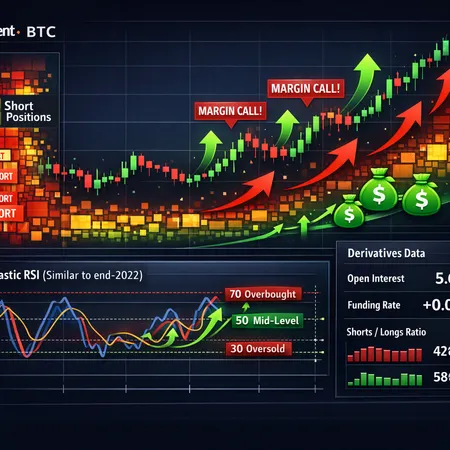
Funding rates and open interest: Rapidly rising negative funding or sudden unwind of perpetual positions are precursors to liquidity squeezes. Use these to time defensive cuts or liquidity provision windows.
Sentiment and retail signals: Elevated “fear” proxies (search spikes, social sentiment indexes) combined with realized-volatility upticks increase the chance of forced liquidations. The Coinpaper-reported spike in "Bitcoin is dead" searches and ~$70M in liquidations is a reminder that narratives can flip quickly.
Scenario planning: three near-term outcomes
Base case (probability-weighted): ETF outflows continue at a reduced pace, miners absorb temporary margin compression, and on-chain flows cause episodic volatility but price finds support near prior institutional entry zones. Allocators maintain smaller, staggered exposure and widen execution windows.
Stress case: ETF outflows accelerate, exchange inflows spike and miner selling increases after a difficulty-driven margin shock. Liquidity dries across order books, fuelling a sharp multi-day drawdown and elevated tail risk. Tactical hedges and liquidity reserves prove valuable.
Relief case: ETF flows reverse or stabilize, hashrate variance normalizes, and miner capitulation risk subsides. With the structural ETF bid returning, liquidity improves and short-term volatility contracts.
Tactical recommendations for traders and allocators
Monitor blended indicator dashboards (ETF flow rolling windows, exchange inflows, miner flows, difficulty and hashprice, funding and open interest). Treat divergence between ETF flows and on-chain selling as a red flag.
Size positions with liquidity corridors in mind. If ETF outflows persist, assume higher slippage and widen limits or use TWAP/limit ladders.
Use options and futures for tail-hedging around known network events (difficulty adjustments, major miner reboots) and macro windows (central bank announcements). Hedge cost is insurance against asymmetric liquidity shocks.
Keep a close eye on miner health: public miner balance sheets, debt maturities, and geographic heat maps. Operational outages (weather, grid issues) have market consequences, as the recent storm-driven hashrate drop illustrated.
Consider staggered accumulation or automated dollar-cost strategies via custodial platforms; for staged exposure or structured buys, services like Bitlet.app can be part of a practical execution toolkit when paired with robust risk limits.
Final thoughts — integrate macro, on-chain and network signals
Sustained ETF outflows are a clarifying event: they turn an otherwise diversified market structure into one where execution and liquidity management matter as much as directional conviction. Network-level shocks like hashrate swings and the recent 15% difficulty jump are a reminder that Bitcoin's supply mechanics are not just theoretical — they're driven by physical and operational realities that can feed back into market liquidity.
For institutional traders and allocators, the key is integration. No single metric tells the story. Combine ETF flow trends, exchange and miner flows, funding/open-interest dynamics, and sentiment indicators to build a composite risk score. That composite — not price alone — should drive sizing, hedging and contingency planning.
Sources
- Five-week net outflows from US spot Bitcoin ETFs that signal institutional de-risking — Cointelegraph
- Bitcoin ETFs record fresh $166M outflows as five-week negative streak nears $4 billion — Zycrypto
- Bitcoin mining difficulty climbs 15% after sharp February drop — Coinpaper
- "Bitcoin is dead" searches hit post-FTX high as $70M in liquidations rock BTC — Coinpaper
(Also referenced internal context around Bitcoin market dynamics and broader DeFi liquidity considerations.)