Injective (INJ) Bull Case: Upgrade Approval, ~2M Accumulation, and $3.50–$4.00 Targets
Summary
Executive summary
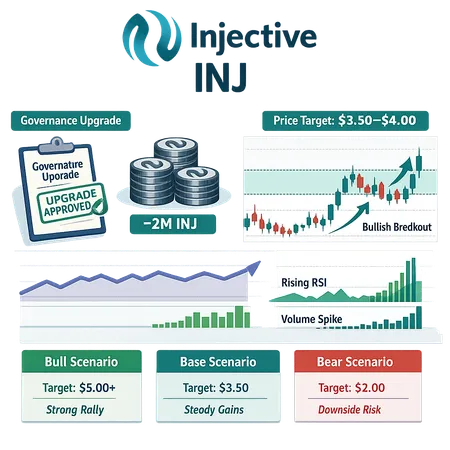
Injective (INJ) just cleared a meaningful governance hurdle: the community approved a network upgrade, and on-chain trackers show roughly 2 million INJ moved into accumulative addresses around that event. Together these two developments form a classic upgrade-driven altcoin narrative — planned protocol improvement plus supply-side tightening. Technical analysts have reacted by placing near-term price targets in the $3.50–$4.00 band, a range we'll reconcile with on-chain flow and momentum below.
For many traders, Bitcoin remains the primary market bellwether, but upgrade-driven narratives in the DeFi layer can produce outsized altcoin moves when on-chain dynamics and momentum align. This piece is written for altcoin traders and speculative allocators who want a practical, risk-focused view of the INJ setup.
What the upgrade and governance outcome mean (mechanics and market implications)
A governance proposal to push a scheduled software upgrade through is more than a technicality — it signals community coordination and reduces uncertainty about protocol direction. In Injective’s case the proposal passed, clearing the path for the code changes to move from proposal to activation. That sequence typically does three things for a token:
- It reduces execution risk uncertainty: once governance finalizes a plan, the market prices in the work that follows (deployment, node upgrades, activation windows).
- It focuses attention: validators, stakers and speculative holders monitor the event window and often reallocate capital into the token if the upgrade is perceived to improve product-market fit or infrastructure.
- It can change token utility or incentives: even modest tweaks to staking economics, governance parameters, or cross-chain integrations can materially alter demand over time.
The governance victory is therefore a necessary — not sufficient — bullish input. Execution details (rollout schedule, validator coordination, and any follow-up proposals) still matter, but the approval removes a key gating item that many traders treat as a precondition for higher conviction.
The ~2M INJ accumulation: size, sources, and why it matters
On-chain observers flagged about 2 million INJ accumulating on wallets and exchanges-related addresses in the wake of the governance vote. That accumulation is the near-term supply-side story: when large sums of token move into accumulation wallets (whether cold storage, staking addresses, or long-term holders), available float for active trading contracts is effectively reduced.
Why this accumulation is important:
- Liquidity compression: Large accumulation windows remove sell-side liquidity and can amplify upside on positive momentum if buy-side pressure resumes. That effect is especially pronounced in mid-cap altcoins where daily traded volume is relatively modest.
- Signal of conviction: Sustained accumulation by on-chain entities (whales, funds, staking participants) is often interpreted as a belief that the upgrade will be value-accretive.
- Timing synergy: When accumulation overlaps with governance approval it compounds the narrative — not just “upgrade approved,” but “actors are stocking up post-approval.”
CoinPedia covered the accumulation and linked it directly to the upgrade narrative — their piece is a useful summary of how on-chain flows and governance outcomes can reinforce a bullish structure (CoinPedia report on INJ surge).
Caveats: accumulation does not guarantee price discovery — actors could be preparing to stake, hedge, or supply liquidity later. Always check transaction counterparts (are tokens going to custodial wallets or cold-stores?) and watch for coordinated sell-side liquidity re-provision after upgrade activation.
Reconciling technical momentum with analyst targets ($3.50–$4.00)
Technical analysts have taken a bullish view since the governance outcome and accumulation trend. A recent technical price piece placed near-term targets in the $3.50–$4.00 window, arguing that breaking a string of resistances and improving on-chain demand make those levels reachable in the short term (technical target piece).
How to reconcile that with on-chain dynamics:
- Momentum fuel: Liquidity compression from the ~2M INJ accumulation reduces available sell pressure, so a continuation of buy-side inflows can result in outsized moves versus the pre-upgrade liquidity regime.
- Trigger points: Analysts typically rely on clear resistance breaks and volume confirmation. If INJ closes and holds above key intraday resistance and volume expands, the $3.50–$4.00 band becomes a realistic near-term target on momentum alone.
- Time horizon: The analyst targets are short-to-medium term; expect volatility. If buyers are patient and accumulation continues, the market may approach those levels in a few weeks. If momentum fades or macro risk spikes, those targets will be harder to reach.
A disciplined way to think about the target: treat $3.50–$4.00 as a plausible technical objective that is conditional on follow-through volume, no major sell-offs from large holders, and clean upgrade execution.
Risk-adjusted scenarios and what they imply for traders
Below are three scenarios with actionable signals, rough probabilities (subjective — calibrate to your view), and suggested trade approaches for speculative allocators.
Bull case (20–30% probability): Upgrade succeeds, accumulation continues
- Outcome: Upgrade activates cleanly, developers deliver the changes on schedule, accumulation holders remain patient, and retail/algorithmic buyers chase momentum.
- Price path: Strong breakout with expanding volume; $3.50 hit and volatility pushes toward $4.00 as stop-hunts and FOMO drive short-covering.
- Trade approach: Add on a confirmed breakout above key resistance with a volume spike. Target $3.50 first, partial take-profit, then trail stops to capture move to $4.00. Maintain stop-loss 12–20% below entry depending on timeframe.
- Position sizing: Use smaller sizing if you’re entering before proof of upgrade activation; increase after successful activation and sustained volume.
Base case (40–50% probability): Upgrade approved but execution or momentum is mixed
- Outcome: Upgrade passage is priced in; activation is slow or has minor hiccups. Accumulation reduces available float but buying interest is intermittent.
- Price path: Range-bound action with periodic attempts to retest higher resistances. $3.50 becomes a medium-term target, but retests of lower support are common.
- Trade approach: Favor scaled entries on pullbacks to high-conviction support levels. Use tighter position sizing and set stop-losses near support invalidation points. Consider shorter holding periods (swing trades, not full allocation shifts).
- Position sizing: Moderate — allocate a speculative tranche (e.g., 1–3% of portfolio depending on risk tolerance).
Bear case (20–30% probability): Failed execution or large profit-taking
- Outcome: Upgrade implementation problems, a large holder reintroduces supply to the market, or a macro sell-off drags alts down.
- Price path: Sharp retracement that tests pre-accumulation ranges; $3.50–$4.00 becomes unrealistic in the near term.
- Trade approach: Use tight stop-losses or hedges (inverse exposure or options if available). Avoid adding to positions during execution risk; wait for clear stabilization before redeploying.
- Position sizing: Small or zero new allocation until the narrative stabilizes.
Practical trade checklist and tactics
- Confirm the timeline: track the upgrade activation date and watch validator/client upgrade announcements. A governance approval without a smooth activation window still carries risk.
- Watch on-chain distribution: follow where the ~2M INJ went (staking wallets vs. exchange custody). Tokens flowing to long-term staking are more bullish than tokens moving to exchange hot wallets.
- Volume confirmation: insist on expanding volume on breakout candles before committing significant size. Momentum without volume can be a false breakout.
- Entry tactics: prefer scaled buys — initial small entry on signs of demand, add on confirmation (volume/resistance flip), and keep a portion of position for a possible momentum leg.
- Risk controls: set stop-losses by structure (below recent swing low or support band), size positions so the dollar downside equals your pre-determined risk allocation, and consider trailing stops once in profit.
- Time horizon: short-term traders can target the $3.50–$4.00 band; medium-term allocators should decide if they believe the upgrade changes long-run token economics enough to justify a larger position.
Bitlet.app and other execution platforms can help with order layering and managing exposures if you trade this setup, but platform choice should match your risk management needs.
Final take — balanced view
The combination of a governance-approved upgrade plus roughly 2M INJ of accumulation is a classic constructive setup for an altcoin: removal of uncertainty with simultaneous supply-side compression. Technical targets in the $3.50–$4.00 range are plausible if momentum and volume confirm. That said, execution risk and holder behavior post-activation are the two clearest failure modes.
If you’re a speculative allocator, approach this as a signals-driven trade: small early exposure, add on confirmation, use structural stop-losses, and be ready to scale out if price reaches analyst bands. Respect the volatility — upgrades can catalyze quick moves in both directions.
Sources
- CoinPedia — Injective INJ price surge after upgrade approval and ~2M accumulation: https://coinpedia.org/price-analysis/injective-inj-price-surges-as-upgrade-approval-and-2m-accumulation-reinforce-bullish-structure/
- Blockchain.News — Technical price prediction, INJ targets $3.50–$4.00: https://blockchain.news/news/20260221-price-prediction-inj-targets-350-400-by-march-amid