Why Bitdeer Sold Its Entire BTC Treasury: Miner Pivot, Capital Stress, and Market Signals
Summary
Executive summary
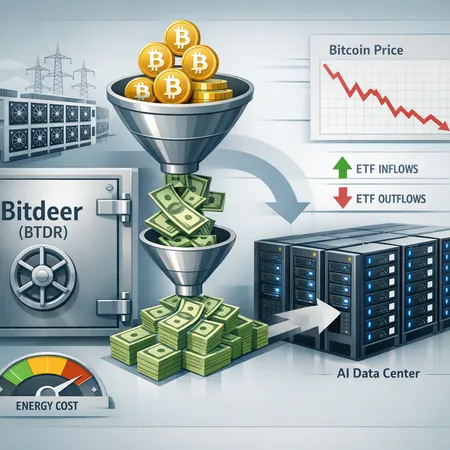
Bitdeer’s recent disclosure that it has sold its entire Bitcoin treasury to fund an expansion into AI and compute services is a watershed moment for mining capital allocation. The company publicly framed the sale as a strategic pivot to higher-margin, less cyclical revenue streams, but the transaction also highlights pressing liquidity and revenue pressures facing miners after an extended BTC drawdown and volatile flows into and out of spot ETFs. Institutional investors and analysts should treat this as both a short-term liquidity event that affects available BTC supply and a longer-term signal that some miners will reallocate capital away from pure BTC accumulation toward diversified infrastructure plays.
What Bitdeer said — rationale and mechanics
Bitdeer told markets it emptied its BTC treasury to raise funds for a business pivot into AI-driven compute and data-center capacity, positioning this as a proactive capital redeployment rather than a distress sale. Coverage summarized the company’s announced reasons and market reaction, noting the treasury drop to zero and the stated goal of funding growth beyond proof-of-work mining. See Bitdeer’s public explanation and market reaction in reporting by CoinDesk and Finbold for the direct quotations and immediate market context.
Why the message matters
There are two readings of Bitdeer’s narrative. The optimistic reading: management is reallocating capital toward higher-margin, longer-duration projects that reduce exposure to BTC price swings. The pragmatic reading: selling reserves was necessary to generate liquidity now — either because operating cash flow is insufficient, debt maturities loom, or margin pressures left few alternatives. Both readings can be true simultaneously; the distinction matters for investors when assessing management credibility and future capital discipline.
Macro drivers forcing miner balance-sheet sales
Three macro vectors have amplified pressure on miner cash flows and balance sheets.
BTC price weakness and market volatility: A drawn-out or sharp drop in BTC compresses miners’ USD revenues (BTC mined times price), increasing reliance on either sales of mined BTC or on-circuit treasury holdings to fund operating expenses and capex.
ETF flows and capital-market dynamics: The growth of spot BTC ETFs has changed intraday and institutional liquidity patterns. While ETFs can increase demand, sudden outflows or volatility in ETF flows can amplify sell-side pressure in OTC markets. Analysts have pointed to BTC-driven sector stress and target revisions for mining-related equities as evidence that market expectations are resetting.
Energy margins and operating cost pressure: Mining remains capital- and energy-intensive. Rising energy costs or constrained low-cost power contracts compress operating margins and shorten cash runways, particularly for miners with less efficient rigs or larger exposure to peak-price grids.
Together, these factors leave miners with three blunt choices: sell BTC reserves, raise equity/debt, or reduce operating footprint. Bitdeer’s treasury liquidation is a clear example of the first option in action.
How miner balance-sheet sales affect short-term BTC supply and price
When miners sell treasury BTC, the immediate effect is an increase in available BTC liquidity entering spot and OTC markets. A few points to consider:
Magnitude and route-to-market matter: Sales executed via OTC desks to institutional buyers are less disruptive than exchange-based dumps, but any sizeable transaction can widen spreads and absorb market depth. Reporting on Bitdeer’s sale framed it as comprehensive — the most straightforward takeaway is that one company’s net on-balance BTC moved to the market.
Counterparty absorption: If buyers are long-term holders (institutions, ETFs, or exchanges), the BTC may be parked and muted in price impact. If absorbed by speculators or market-makers, it can create short-term price pressure.
Signal effect: Beyond the mechanical supply change, such sales send a signal that miner balance sheets are under pressure — and markets often price that signaling value into BTC and miner equity prices. A wave of similar sales could exacerbate downward momentum.
In short, treasury sales are both a direct supply shock and a psychological event. For many traders, Bitcoin remains the primary market bellwether; miners exiting BTC positions therefore matter as both flows and sentiment.
Comparative strategies across the miner universe
Not all miners react the same to market stress. Broadly, we see four archetypes:
- Treasury hoarders: Hold mined BTC as a reserve asset and only sell opportunistically — typically larger, cash-rich miners with access to low-cost capital.
- Steady-sellers: Establish sale schedules tied to operating budgets (e.g., dollar-cost average to fund OPEX and capex).
- Balance-sheet liquidators: Sell reserves to meet liquidity needs or to pivot business models — Bitdeer fits this profile now.
- Financial engineers: Use hedges, credit facilities, or equity raises to avoid selling BTC into weak markets.
Benchmark revisions and earnings pressure across the sector have forced many management teams to reconsider strategy; as one analysis noted, earnings and target downgrades have already begun to reshape expectations for miners and mining adjacencies. The strategic choice depends on each company’s cost base, access to capital, and appetite for dilution or leverage.
What this means for investors in mining equities (BTDR and peers)
Institutional investors should recalibrate how they evaluate miner solvency and upside.
Key metrics to monitor
- Cash runway and debt maturities: Understand how long a miner can operate if BTC prices remain depressed. Bitdeer’s sale implies a shorter runway without the treasury cushion.
- BTC per share and treasury policy: Track changes in BTC inventory disclosure and explicit treasury-management policies.
- Energy cost per TH and rig efficiency: These drive long-run operating margins more than short-term strategy shifts.
- Capex commitments vs. realignment: Is management buying more rigs, or shifting to data-center/A.I. assets? The asset type alters valuation multiples.
Valuation implications
- Re-rating risk: If miners reclassify as infrastructure/compute providers, they may trade to different comps (data center vs. energy infrastructure) — but transition risk and execution uncertainty often warrant a discount.
- Event risk from treasury sales: Sales to fund pivots can depress equity prices in the near term if investors view the move as liquidity-driven rather than opportunistic.
What this means for BTC holders and market structure
From BTC-holder and market-structure perspectives, miner treasury liquidations alter the landscape in subtle ways:
- Short-term downward pressure is possible, but not guaranteed: The market impact depends on execution, counterparty absorption, and concurrent flows (e.g., inflows into ETFs).
- Structural change: If multiple miners pivot away from pure BTC accumulation toward other compute uses, the long-run supply cushion that miners provide (through holding vs selling) may shrink.
- Behavioral shift: Markets will increasingly watch miner treasury disclosures as bellwethers for both solvency and flow dynamics.
Practical takeaways for analysts and allocators
- Revisit liquidity stress scenarios: Model miner solvency under multi-quarter BTC weakness and higher energy costs — include treasury liquidation as a realistic leaver.
- Reweight metrics: Emphasize cash position, BTC reserves per share, and non-BTC revenue potential when valuing mining equities like BTDR. Keep a watchlist of miners with significant off-balance-sheet obligations or upcoming debt maturities.
- Monitor management credibility and execution: A pivot to AI or data centers requires different capabilities; investors should demand clear KPIs (utilization rates, contracted revenues, incremental gross margins).
Bitdeer’s move is a vivid reminder that mining is not only about hash rate and hardware; it’s a balance-sheet business. For those tracking miner solvency, capital allocation intentions now matter as much as terahashes.
Bitlet.app users and sector analysts should treat the Bitdeer episode as a case study in how capital allocation decisions can transform both company narratives and market flow dynamics.
Sources
- Detailed coverage of Bitdeer’s sale and rationale: Bitdeer empties Bitcoin treasury as miners accelerate industry-wide AI pivot
- Market reaction and treasury reduction to zero: Bitdeer dumps all Bitcoin as treasury drops to zero
- Sector-level pressure and earnings/target revisions context: Benchmark slashes Metaplanet target as BTC slump drives losses