SBI’s $64.5M On‑Chain Bonds and Ripple’s 1B Escrow: Institutional Implications for XRP
Summary
Executive summary
SBI Holdings’ $64.5M on‑chain bond that pays investors in XRP marks a step toward institutionalizing Ripple rails as execution and settlement infrastructure. At the same time, Ripple’s routine monthly escrow unlocks (commonly ~1 billion XRP) produce recurring supply events that can amplify downside pressure. Technical signals are flashing higher near‑term volatility. For asset managers and crypto strategists this means balancing an improving institutional narrative and efficient rails against deterministic, calendar-driven supply risk and tactical hedging needs.
SBI’s on‑chain bond: mechanics and why the payout matters
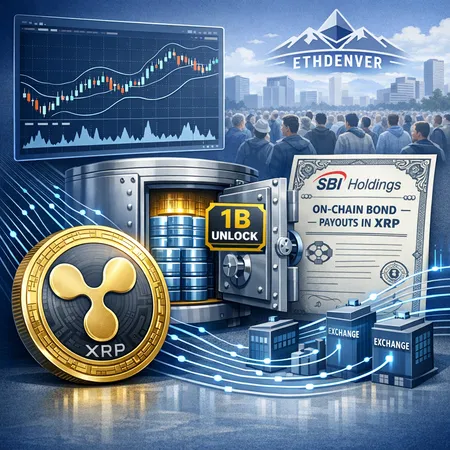
SBI’s product is a conventional bond issued on a blockchain where coupon or principal repayments flow in XRP rather than fiat. According to the announcement, the $64.5M issuance uses on‑chain settlement and rewards investors with XRP, demonstrating a concrete payout use‑case for the token. See the full report from SBI Holdings here for transaction specifics and institutional framing.
Mechanically, the bond operates in three simple layers: the legal/credit layer (bond terms and issuer obligations), the custody/settlement layer (on‑chain ledger transfers and custodian wallets), and the economic layer (how coupons/principal are denominated and converted). SBI’s structure implies counterparties accept counterparty credit and market risk on the token payout — or they hedge that exposure immediately in derivatives or OTC — which is common for institutional adopters.
Why this matters: institutional product design solves two problems simultaneously. It creates real demand for XRP as a settlement medium, and it normalizes institutions taking and managing token‑denominated exposures rather than only buying spot for appreciation. For asset allocators, that changes the flow profile from purely speculative buys to contractual, recurring demand that can be modeled into cash‑flow forecasts and liquidity planning.
Why institutions are using Ripple rails to "buy the dip"
Several practical reasons make Ripple rails attractive for institutions executing purchases or settlements during dips:
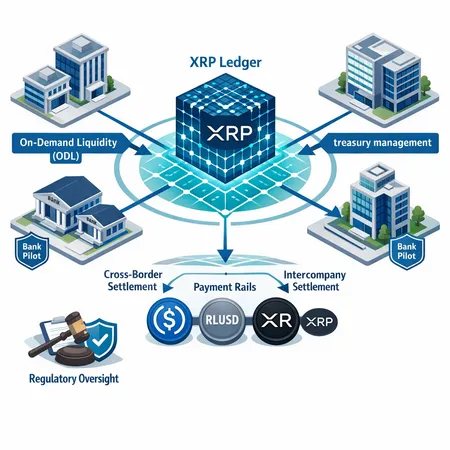
- Settlement speed and cost: Ripple’s payment rails (on the XRP Ledger) offer faster on‑chain settlement versus traditional cross‑border rails, reducing counterparty and settlement risk during volatile windows.
- Operational simplicity: On‑chain bonds and tokenized products remove multiple reconciliation steps found in legacy systems, appealing to treasury desks and asset managers seeking certainty in settlement timing.
- Hedging and OTC markets: Institutional counterparties increasingly pair on‑chain exposure with OTC desks and derivatives to neutralize immediate market risk, effectively using Ripple rails for execution while hedging price.
That combination explains why institutions sometimes step in during retracements — they can execute efficiently and then hedge price exposure if they are not outright buyers. The SBI bond is a clear example where the institution both uses the rails and accepts token payout as part of the product design. For mechanistic context on institutional rails and trading flows, see the SBI announcement.
Note: narrative momentum from community and developer activity also matters for medium‑term allocations — more on that below. Also, platforms like Bitlet.app are beginning to factor such institutional rails into liquidity forecasts used by structured products teams.
Ripple escrow unlocks: mechanics, history, and market impact
Ripple placed a large portion of XRP into escrow in 2017 to create predictable monthly releases. Typically, Ripple releases about 1 billion XRP from escrow each month; these tokens may be returned to escrow or sold into the market depending on corporate needs and market conditions. Recent reporting highlights that Ripple’s routine monthly unlocks — the typical 1B figure — continue to be a visible calendar event for traders.
Historically, escrow unlocks have coincided with periods of increased sell pressure, both because of direct corporate sales and because market participants preemptively price in potential supply. A recent report summarized expectations around a routine 1 billion XRP unlock and the market’s sensitivity to these monthly cadence events. Over time, the net impact has varied: in some months tokens are funneled back into escrow or used in liquidity deals and institutional arrangements, limiting sell pressure; in others, more supply hits the market and depresses price.
For asset managers this creates a deterministic, calendar‑driven risk factor: one can forecast a likely supply outflow window each month and either size positions accordingly or use execution/hedging to neutralize the risk. Pricing models should therefore include escrow schedule scenarios (full sale, partial sale, or redeposit) with empirical probabilities derived from historical behavior.
Technical picture: Bollinger Bands, expanding risk, and what traders should watch
From a technical perspective, a recent analysis flagged expanding Bollinger Bands as a signal of rising volatility while XRP tests the lower band. Bollinger Bands widen when volatility increases, and a price approaching or breaking the lower band can indicate transient oversold conditions or the start of a stronger downtrend depending on volume and market structure.
Key technical readouts for strategists:
- Expanding bands + declining price = higher short‑term volatility risk; momentum may accelerate the move if liquidity is thin. The Bollinger Bands note offers a practical short‑term technical lens.
- Confirm with volume and order‑book depth: a band squeeze/breakout without volume confirmation is more likely a false move. Conversely, high sell volumes into a break increase the odds of continuation.
- Use multi‑timeframe checks: if weekly bands remain intact but daily bands expand, the move may be a short‑term dislocation rather than a regime change.
Technicians will therefore want to watch the lower band interactions, intraday liquidation levels on major exchanges, and cross‑asset risk sentiment. Combine technical observations with the escrow calendar and corporate flow intelligence (e.g., scheduled unlocks and institutional sales) to build a probabilistic view rather than relying on a single indicator.
Hedging playbook for asset managers and strategists
Institutional players have several hedging and execution tools available to manage the joint risks of on‑chain institutional flows and calendar unlocks.
Tactical hedges
- Futures and perpetual swaps: Take short futures or reduce net spot exposure ahead of a known escrow unlock. Be mindful of basis and funding costs; perpetual funding can be punitive in trending markets.
- Options collars and puts: Buying downside protection via puts or structuring collars can cap downside while preserving upside. Over several months this is often more capital‑efficient than spot liquidation.
- OTC forward/structured sales: Negotiate forward sales or fixed‑price OTC blocks to lock in exits for a portion of exposure; this is especially useful for larger blocks where market impact matters.
Execution and liquidity management
- Staggered execution: Break purchase or sale into tranches around the escrow calendar to avoid trading into a known liquidity trough.
- Use limit and hidden orders: When liquidity is thin, use limit or iceberg orders to reduce signaling risk.
- Algorithmic execution: TWAP/VWAP algorithms reduce market impact in large fills; pair algorithms with liquidity‑aware parameters around expected unlock windows.
Risk sizing and scenario modeling
- Stress test with escrow scenarios: Model outcomes for full sale, partial sale, and redeposit and compute expected returns and drawdowns under each.
- Correlate with funding and macro risk: In high‑risk macro windows, escrow sales can have outsized impact as much larger liquidity pools flee risk assets.
Practical example: If holding a multi‑month token allocation, an asset manager might buy a protective put position covering 25–50% of notional through the next escrow date, stagger remaining exposure across the following two months, and run TWAP execution for any mandated sell program.
Community activation at ETHDenver — narrative counterweights to supply risk
Community events and developer engagement matter for adoption narratives. Coverage of the XRP community convening at ETHDenver and attention from Ripple’s leadership show active builder and ecosystem activity. That matters because recurring liquidity shocks from escrow unlocks are a supply‑side phenomenon; demand-side narrative — from on‑chain products like SBI’s bond to developer momentum — can mitigate negative sentiment over medium horizons.
In practical terms, developers and builders deliver two benefits: they create optionality for the token (new use‑cases and liquidity sinks) and generate investor confidence that supply is not just being offloaded into illiquid markets. The ETHDenver presence and Ripple CEO commentary are signals that the ecosystem narrative remains active, even if it won’t eliminate short‑term technical risks.
Putting it together: scenarios and recommended actions
Scenario 1 — Mild unlock, institutional absorption: Many escrow tokens are redeposited or placed into institutional arrangements (e.g., bonds, liquidity lines). Price impact is modest. Action: opportunistic accumulation with small protective puts; staggered execution.
Scenario 2 — Significant sell pressure: A larger-than-expected portion of the unlock enters the open market, triggering a technical break and widening bands. Action: activate hedges (futures/puts), tighten position sizing, and shift execution to algorithmic VWAP/TWAP to avoid slippage.
Scenario 3 — Positive adoption surprise: Institutional flows (like SBI‑style products) and developer activity outpace sell pressure, resulting in a relief rally. Action: harvest part of hedge and add to long exposure selectively.
Recommended baseline: include escrow schedule in risk models, size exposures relative to market depth and institutionally committed flows (e.g., known on‑chain bond demand), and maintain flexible hedges (options or short futures) that can be scaled down if positive adoption catalysts appear.
Conclusion
SBI’s $64.5M on‑chain bond that pays in XRP is a concrete institutional use‑case that showcases how token‑denominated products can create predictable demand. That bullish adoption narrative coexists with a structural, calendar‑based supply risk from Ripple’s monthly escrow unlocks; asset managers must model both. Technical indicators like expanding Bollinger Bands point to higher short‑term volatility, so pragmatic hedging and liquidity‑aware execution are essential. Combine corporate flow intelligence, technical confirmation, and scenario‑driven hedges to manage XRP exposure effectively in the coming months.
Sources
- SBI Holdings launches $64.5M on‑chain bonds rewarding investors with XRP: SBI on‑chain bonds report
- Report on Ripple’s routine monthly 1B XRP unlocks: Finbold coverage of Ripple unlocks
- XRP community event and Ripple CEO commentary at ETHDenver: Community convenes at ETHDenver
- Technical note on expanding Bollinger Bands and risk for XRP: Bollinger Bands analysis
For broader context on on‑chain productization and market structure, see coverage of institutional rails like XRP and industry tools that integrate liquidity signals into structured product design such as Bitlet.app.