Sui’s Move Toward Mainstream Finance: Grayscale’s Spot Trust and the First 2x SUI ETF Explained
Summary
Executive summary
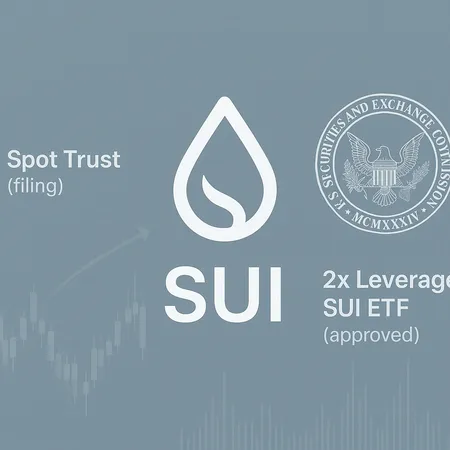
Grayscale’s S‑1 filing to launch a spot Sui trust and the SEC’s approval of the first 2x leveraged SUI ETF (tickered as a leveraged product) together signal that SUI is moving from pure on‑chain utility toward packaged, regulated investment channels. These product introductions change the access path for both institutional allocators and retail investors: spot trusts offer a custody‑based, compliant route to hold SUI exposure off‑chain, while leveraged ETFs introduce amplified risk and day‑to‑day rebalancing that can widen short‑term volatility and change liquidity patterns. For asset managers and product strategists evaluating SUI, the near term will be defined by increased exchange liquidity, stronger arbitrage windows, and the need to manage custody and execution risk. Developers and token holders should anticipate both higher passive inflows and more episodic supply pressure as ETFs and trusts interact with on‑chain liquidity pools.
Timeline: filings and approvals that matter
Grayscale’s move to file an S‑1 for a spot Sui trust is a formal step toward a regulated vehicle where an asset manager holds the underlying SUI and issues shares to investors. That filing, reported by Cryptopolitan, is the starting pistol for a product that, if approved and launched, will behave like Grayscale’s earlier spot trusts in terms of custody and redemptions (Grayscale files S‑1 to launch a Sui trust).
Around the same moment the market also saw regulatory progress in leveraged retail products: the SEC’s approval of the first 2x leveraged SUI ETF (covered by Coinpedia) demonstrates demand for derivatives and retail‑facing instruments that amplify SUI’s returns — and its losses. That approval creates a distinct segment of product that will trade differently than a spot trust and can materially affect daily liquidity and volatility behavior (SEC approves first 2x SUI ETF).
Taken together, the filings and approvals compress a typical multi‑year maturation path into a shorter window: custody‑based spot exposure and retail‑oriented leveraged derivative access are arriving nearly simultaneously, which intensifies the speed at which SUI will be integrated into mainstream portfolios.
Spot trusts vs leveraged ETFs: how they differ and why it matters
Mechanics and custody
A spot trust (the Grayscale model) buys and holds the underlying token in institutional custody and issues shares that reflect the trust’s NAV. Creation/redemption windows are usually periodic and often limited to accredited or institutional buyers; retail exposure comes via secondary market trading of trust shares. Spot trusts improve custody, reporting, and compliance for institutional investors who cannot or will not custody tokens themselves.
A leveraged ETF seeks to deliver a multiple (e.g., 2x) of daily returns through the use of derivatives, swaps, and leverage. It rebalances daily to maintain its target multiple, which means it buys into an asset when prices rise and sells when prices fall — a mechanical process that can exacerbate intraday moves and produce path‑dependent returns.
Liquidity implications
Spot trusts tend to concentrate liquidity on regulated exchanges and custodial networks: the trust holds the tokens off‑chain, so primary market token demand flows from the manager’s purchases on spot venues. That can increase exchange order book depth as managers source SUI for the trust, but it also pulls tokens out of on‑chain circulating supply into custody.
Leveraged ETFs, by contrast, generate continuous hedging and derivative flows. Market makers and counterparties dynamically hedge their exposures, often using futures, swaps, or the underlying token. That creates a steady source of trading volume and can improve quoted liquidity while simultaneously increasing realized volatility — especially in thin markets.
Volatility and path dependence
Because leveraged ETFs rebalance daily, they introduce volatility drag and path dependency: in volatile sideways markets a 2x ETF can underperform a simple 2x multiple of long‑term returns. The hedging activity also amplifies intraday swings — on sharp down days, forced deleveraging and margining can trigger cascade selling. Spot trusts lack that mechanical leverage, so their direct volatility impact is more about gross buying or selling pressure during creation/redemption events.
Access paths for institutional and retail investors
Institutional access
Spot trusts are often the first compliant route for institutions. They minimize KYC/custody friction, allow investment via familiar broker/dealer channels, and fit within many institutions’ operational frameworks. For CIOs and allocator teams, a Grayscale Sui Trust will likely be interpreted as a low‑friction way to add SUI exposure without custodying keys, which can accelerate institutional inflows.
Meanwhile, leveraged ETFs attract quant shops and active managers focused on short‑term trading strategies and yield capture. Because these ETFs trade on exchanges like equities, they’re accessible through prime brokers and broker‑dealers that already support ETF trading — lowering the barrier for retail and professional traders.
Retail access and distribution
Retail investors gain two ways into SUI: buying trust shares on OTC/secondary markets or trading leveraged ETFs through standard brokerages. The leveraged ETF will likely be more visible to retail audiences due to broker screens, margin access, and marketing — and that visibility can drive rapid, concentrated flows that move price more aggressively than gradual trust purchases.
For many market participants, comparisons to mainstream crypto benchmarks are useful: while Bitcoin often serves as the primary bellwether for institutional flows, new products for SUI place it on a distinct path where both custodial and derivative demand can coexist.
Short‑term market impact: what to expect
Expect three interacting dynamics in the short term:
Increased exchange liquidity: Managers sourcing SUI for spot trusts will lift on‑exchange liquidity as they buy from order books and OTC desks; this typically tightens spreads and improves market depth at first. However, because these buys are concentrated, they can also produce step moves.
Amplified intraday volatility: The 2x leveraged ETF will introduce mechanical rebalancing and hedging flows that can magnify intraday price moves. In thin markets, that can lead to exaggerated spikes and deeper troughs.
Stronger arbitrage and market‑making activity: Authorized participants (APs), market makers, and hedge funds will arbitrage price differences between spot venues, trusts, ETFs, and futures, which improves price efficiency but can concentrate liquidity around specific venues or instruments.
Net effect: more tradable market, but also more episodic volatility. Asset managers should model the potential for larger bid‑ask swings around rebalancing times and ETF creation/redemption windows.
What Sui developers and token holders should anticipate
On‑chain flows and liquidity migration
If a large spot trust starts accumulating SUI, expect tokens to move from exchange hot wallets and AMM liquidity pools into institutional cold custody. That reduces on‑chain circulating liquidity and may widen spreads on DEXs and smaller CEXs. Developers maintaining DEX‑based incentives should anticipate a temporary need to boost on‑chain liquidity if stable on‑chain activity is a priority.
At the same time, leveraged ETF dynamics will pull in derivatives liquidity: futures open interest may rise, and options markets could develop to hedge ETF exposures. Token holders should expect that liquid supply becomes more segmented — some locked in custody, some used as collateral in lending desks, and some tradable in the spot market.
Price behavior and holder risk
Short term, holders may see price appreciation as buy pressure mounts from trust purchases and retail excitement. But with leveraged products live, downside moves can be sharper: forced deleveraging and margin calls can cascade through shallow order books. For longer‑term holders and protocol teams, the key risk is not just volatility but the concentration of holdings — custodial warehouses can create single points where large inflows or redemptions matter more than before.
Listing liquidity and market structure implications
Exchanges will respond to demand by deepening order books and listing derivative products (futures, perpetual swaps) for SUI. That improves discoverability and execution options for traders, but it also means liquidity becomes more fragmented across venues. Project teams should coordinate with major custodians and market makers to ensure adequate listing liquidity and to avoid unintended slippage during token sourcing by trusts.
Practical checklist for asset managers and product strategists
- Model two scenarios: a gradual trust accumulation path and a spike scenario driven by retail ETF flows. Include margin‑induced sell pressure in downside cases.
- Assess custody partners and AP networks early. Spot trust demand will be sensitive to custody reliability and insurance.
- Prepare for concentrated on‑chain outflows and coordinate with exchanges/market makers to manage sourcing impact.
- Monitor derivatives markets closely — funding rates, futures OI, and options skew will show where hedgers are positioned.
- Educate clients on path dependence of leveraged ETFs: understand that a 2x leveraged ETF multiplies daily returns, not buy‑and‑hold returns.
Conclusion
The near‑simultaneous arrival of a Grayscale spot trust filing and an SEC‑approved 2x leveraged SUI ETF accelerates SUI’s integration into mainstream finance. These products create complementary but different demand channels: spot trusts bring custody, compliance, and slow, substantial flows; leveraged ETFs add retail engagement, hedging activity, and amplified intraday dynamics. For asset managers and product strategists, the opportunity is meaningful — but so are the operational and market‑structure challenges. Teams considering adding SUI to client offerings should move quickly on custody, AP relationships, and execution plans while preparing for episodic volatility. Platforms like Bitlet.app that bridge retail channels and institutional workflows will be watching how these products reshape distribution and liquidity.
Sources
- Grayscale files S‑1 to launch a spot Sui trust: Cryptopolitan
- SEC approval of the first 2x SUI ETF: Coinpedia