Why Central Banks Are Quietly Testing Bitcoin: Lessons from the CNB and Taiwan Pilots
Summary
Introduction: a discreet turn toward Bitcoin among central banks
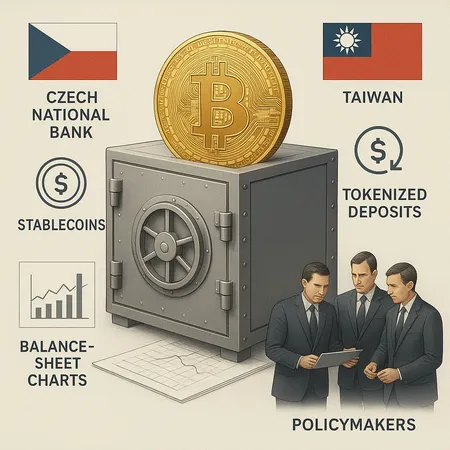
Over the last year a growing number of central banks have shifted from rhetorical curiosity about crypto to actual pilot projects. Two high-visibility examples — the Czech National Bank’s modest $1 million BTC test purchase and Taiwan’s reported investigation into creating a national Bitcoin reserve — encapsulate what policymakers now describe as small, purposeful experiments rather than regime change.
These moves matter beyond headline-grabbing novelty. They are an operational probe: testing custody, market liquidity, accounting, legal boundaries and the interaction between crypto and traditional reserve assets. For policy-minded readers and institutional researchers, the pilots offer a rare window into how sovereigns might cautiously integrate BTC into their playbooks without undermining macro stability.
Why central banks are running Bitcoin pilots
Central banks have several overlapping motives for tiny BTC exposures. None of these motives argues for a wholesale pivot away from established reserve assets; rather, they explain why measured experiments make sense.
Reserve diversification and hedging
At the simplest level, a small allocation to Bitcoin is a diversification experiment. Some central bankers view BTC as a long-duration, non-sovereign asset with limited historical correlation to fiat bond markets. By buying a very small amount, a central bank can observe whether this theoretical hedge holds under stress without meaningfully impairing liquidity.
Learning about market mechanics and operational risk
Central banks must understand the plumbing: custody models, settlement risks, price discovery and market depth for meaningful positions. A $1M test purchase (or similarly scaled pilot) is a low-cost way to run rehearsals for custody arrangements, multisig governance, and interaction with regulated custodians.
Signaling and strategic posture
Even small purchases send signals — domestically and internationally. A pilot can demonstrate openness to fintech innovation and support for developing domestic custody or tokenization ecosystems without committing reserves at scale. That signaling can be important for small, export-driven economies trying to attract fintech investment.
Contingency thinking and geopolitical risk
For some policymakers the calculus includes geopolitical tail risks: sanctions, cross-border payment restrictions, or sudden capital-account frictions. Holding a tiny, legally and operationally controlled amount of BTC is a way to test options should traditional channels deteriorate.
Experimental design and risk controls central banks are adopting
Central bank pilots typically combine multiple design features to keep risk contained while maximizing learning value.
Very small allocations and staged escalation
The dominant pattern is conservative sizing: allocations that are immaterial to overall reserve composition. Pilots often start with sums measured in the hundreds of thousands to low millions of dollars, with predefined stop-loss rules and governance thresholds for any scale-up.
Paired stablecoin and tokenized deposits
A common structure emerging in pilot proposals is a layered reserve model: tokenized deposits on a regulated ledger and high-quality stablecoins used for settlement and liquidity management, sitting alongside small BTC holdings. Tokenized deposits allow central banks to model digital liabilities and experiment with on-chain settlement while stablecoins provide a low-volatility, programmable medium for liquidity operations. This combination reduces operational friction and provides a controlled environment to test BTC’s interactions with more stable tokenized assets.
Custody, legal wrappers and multisig governance
Operational controls are front-loaded. Central banks insist on regulated custodians, insurance agreements, segregated wallets, multisignature policies and independent audits. Legal work is substantial: establishing whether BTC holdings qualify as foreign reserves under existing statutes and how gains/losses should be accounted for under public-sector accounting rules.
Stress testing and scenario playbooks
Pilots include scenario analyses for rapid price swings, exchange outages, and cybersecurity breaches. By simulating adverse events, central banks refine liquidity contingencies and determine how BTC positions would be unwound or insulated from other reserve assets.
Geopolitical and monetary-policy implications
Even tiny BTC portfolios have outsized signaling power when deployed by sovereigns. They intersect with geopolitics and monetary policy in several ways.
FX reserve composition and perceived independence
A BTC allocation changes headline reserve composition, affecting perceived currency risk profiles and, in some narratives, a central bank’s policy independence. Adversaries or markets may read such moves as a bet against certain fiat regimes — whether justified or not.
Sanctions, capital controls and cross-border payments
Bitcoin’s decentralized rails can be framed as resilience against payment system exclusion, though in practice on-chain censorship resistance is uneven and regulatory tools are evolving. The mere prospect that a country has a tested BTC reserve may alter negotiation dynamics in crisis scenarios, regardless of the pilot’s size.
Monetary policy transmission and balance-sheet volatility
BTC’s price volatility complicates the central bank’s balance-sheet management. Gains or losses on holdings flow through profit-and-loss and can affect remittances to the treasury or accounting reserves. Policymakers must also decide how BTC interacts with domestic liquidity operations and whether tokenized deposits or stablecoins become policy tools themselves.
How pilots could alter sovereign balance sheets and institutional adoption
Small pilots are not just learning exercises; they can catalyze structural changes.
Balance-sheet composition and accounting practices
If pilots show operational feasibility, central banks may create explicit accounting categories for crypto assets or standardized valuation rules. Over time that could normalize BTC holdings in sovereign portfolios and drive private-sector institutions to offer compliant custody and hedging services at scale.
Market infrastructure and institutional demand
Central-bank pilots validate service providers: custodians, tokenization platforms and settlement rails. That validation lowers counterparty risk perceptions and encourages pension funds, insurers and commercial banks to build institutional-grade BTC exposure, accelerating adoption.
Liquidity and market depth feedback loops
As sovereign demand becomes a known factor — even if small — market participants will price that into liquidity provisions. The result could be tighter spreads and deeper OTC markets for large-ticket transactions, making it practical for other institutional actors to enter.
Practical risks and limitations to keep front of mind
Pilots are instructive but also limited.
- Scale mismatch: Small pilot successes do not automatically imply that large positions are feasible without market impact.
- Accounting and legal ambiguity: Public-sector accounting standards may lag, creating fiscal volatility implications absent clear rules.
- Reputational risk: Losses or governance failures can undermine trust in monetary institutions.
- Geopolitical misreading: Signaling can backfire if interpreted as an adversarial posture.
What to watch next
For researchers and policymakers tracking this space, several indicators are especially informative:
1) Pilots that move from experiment to policy
Watch for central banks that publish formal frameworks or accounting guidance after initial tests. That transition signals institutionalization beyond an isolated pilot.
2) Governance and custody standards
Which custodians and legal structures pass central-bank vetting? The emergence of a handful of globally accepted models will accelerate institutional uptake.
3) Interaction with tokenized deposits and CBDCs
Pilots that explicitly pair BTC with tokenized deposits or CBDC testbeds reveal how sovereign crypto policy could integrate monetary liabilities with reserve assets — creating new operational architectures.
4) Cross-jurisdiction coordination
Look for multilateral dialogue among monetary authorities on norms for sovereign crypto holdings. Coordination reduces the risk of negative spillovers from divergent approaches.
5) Market depth and institutional product availability
Growth in regulated custody, settlement networks, tokenized treasury services and hedging instruments (like institutional options and futures) will indicate that pilots are influencing the broader financial ecosystem.
Conclusion: cautious exploration, outsized implications
Central bank Bitcoin pilots — from the CNB’s $1M experiment to Taiwan’s investigative work — are pragmatic, low-footprint ways to learn about a disruptive asset class. They are not a repudiation of fiat or reserves orthodoxy; rather, they reflect a policy posture of informed experimentation.
For institutional researchers and policy-minded readers, the immediate takeaway is twofold: these pilots matter for signaling and infrastructure, and their main value is in revealing operational friction points and governance choices. If pilots scale or coalesce into frameworks, we should expect substantive changes to sovereign balance-sheet practices and a faster path to institutional adoption. Watch custody standards, accounting rules and how tokenized deposits and stablecoin layers are used — those design choices will determine whether central-bank Bitcoin holdings remain symbolic or become a durable element of sovereign finance.
Bitlet.app is among the platforms monitoring how tokenization and institutional rails evolve; for policy teams, the practical lesson is clear: design pilots to fail safely, document outcomes, and coordinate internationally before any meaningful scale-up.
Bitcoin and DeFi are becoming part of the vocabulary central bankers use — the next 12–24 months will show whether these are experimental footnotes or the start of a new chapter in sovereign asset management.