Shibarium’s Zama Privacy Upgrade: What Fully Homomorphic Encryption Means for Memecoin Security
Summary
Why Shibarium is talking to Zama: context and urgency
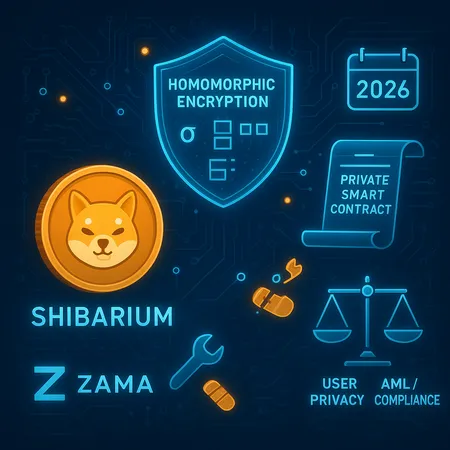
In the wake of a disruptive 2025 exploit on Shibarium, the project's roadmap now includes a high-profile privacy initiative with Zama targeted for 2026. The public announcement framed this as both a privacy enhancement and a security hardening step: Zama’s work on FHE libraries is meant to enable encrypted computation on chain while reducing some classes of attack surface exposed by plaintext state and logic (Cointribune report). For community leads and engineers focused on memecoin security, that combination of motivation—user privacy plus exploit remediation—is important to unpack before adopting or integrating these features.
Shibarium and its token holders (SHIB) are not alone in pushing major protocol changes; other ecosystems have recently upgraded to increase capacity and data availability rather than privacy. Those operational upgrades matter because FHE use in practice will be constrained by throughput and state-access patterns on layer-2 chains. A useful point of comparison is the Fusaka hard fork on Ethereum, which prioritized massive data-availability and throughput improvements to support richer application logic and large-scale rollups (Cryptopotato analysis).
The technical promise of fully homomorphic encryption (FHE)
At a conceptual level, FHE allows arbitrary computation on encrypted data and returns an encrypted result only the data owner can decrypt. That property unlocks two salient features for public blockchains:
- Private transactions: transaction inputs, amounts, and even counterparty identity can be encrypted while the network still enforces valid state transitions.
- Confidential smart contracts: contract logic could operate on encrypted state without revealing internal data to validators or observers, enabling private auctions, confidential token balances, or memecoin mechanics hidden from public view.
For memecoin ecosystems—where token distribution, tipping habits, staking, and on-chain games can reveal sensitive community behavior—encrypted computation is compelling. In practice, modern FHE stacks (including techniques pushed by Zama) aim to balance expressivity and performance by optimizing specific homomorphic operations, batching, and clever compiler toolchains.
What FHE does not magically solve
FHE is powerful but not a drop-in privacy panacea:
- Performance costs: homomorphic operations are orders of magnitude slower than native arithmetic; gas-equivalent costs and latency can balloon unless computation is offloaded or highly optimized.
- On-chain verification: verifying that an encrypted computation was performed correctly without exposing inputs often requires additional cryptographic scaffolding (e.g., succinct proofs), which themselves add complexity and cost.
- Key management: secrecy relies on private keys or key‑sharing schemes; designing secure, user-friendly key workflows is nontrivial for consumer memecoin users.
These limits shape realistic deployment options: full on-chain FHE for arbitrary contracts is likely years away at usable scale, while hybrid approaches (off-chain FHE compute + on-chain commitments or proofs) are the near-term pattern.
Exploit remediation: why the 2025 incident pushes privacy—and what it can't replace
The 2025 exploit on Shibarium exposed how plaintext state and predictable contract interactions can be weaponized: attacker reconnaissance, flash-bot orchestration, and interaction with off-chain services amplified a relatively small bug. In response, the move toward privacy via FHE is framed as a way to reduce observable attack surface (less public state = fewer trivially exploitable invariants).
That rationale is sensible but incomplete. FHE reduces information leakage but does not substitute for sound engineering practices such as formal verification, thorough audits, non-upgradeable-critical-contract patterns, and runtime monitoring. Designers should view FHE as one layer in defense-in-depth: it limits certain reconnaissance techniques but won't fix logic bugs, unsafe access control, reentrancy, or flawed economic design. Post-exploit remediation must therefore include classic security hardening alongside any cryptographic upgrade.
Deployment timeline and developer challenges
Shibarium’s 2026 target with Zama sets an expectation, but engineers should anticipate a multi-stage rollout:
- Library integration and SDKs: Zama's FHE libraries must be instrumented for on-chain use, with developer tooling that converts high-level contract code into FHE-friendly circuits.
- Hybrid primitives: early releases will likely expose primitives for private storage and discrete private functions rather than full confidential Turing-complete contracts.
- Off-chain compute + proofs: common patterns will offload heavy homomorphic computation off-chain and publish succinct proofs or commitments on-chain for verifiability.
- Pilot applications and audits: performance and security testing at scale, plus external audits and perhaps bug-bounty programs.
- Mainnet activation and education: developer docs, wallet support for encrypted keys, and UX flows for selective disclosure.
Key technical challenges include:
- Gas and throughput: homomorphic operations can expand calldata and computation—without DA boosts or rollup support, costs may be prohibitive for memecoin users.
- Tooling maturity: high‑level language support, compilers that turn Solidity-like code into FHE circuits, and debuggers for encrypted-state logic are nascent.
- Interoperability and composability: bridging encrypted contracts with public DeFi primitives (liquidity pools, oracles) requires well-defined interfaces and careful leakage analysis.
- Performance vs correctness tradeoffs: choosing which functions run homomorphically and which remain public is an architectural decision that affects security and UX.
Engineers should assume an iterative cadence, with constrained functionality first (e.g., encrypted balances for specific contract families) rather than immediate, full-scope private smart contracts.
Privacy gains vs AML and compliance tensions
Offering private transactions and confidential smart contracts introduces immediate regulatory and compliance questions. Privacy features can empower users—protecting donors, small traders, and community members from doxxing and front-running—but they also reduce on-chain observability that AML providers and exchanges rely on.
Possible mitigation strategies that preserve meaningful privacy while satisfying compliance needs include:
- Selective disclosure / view keys: users can selectively grant auditors or custodians access to decrypted activity.
- Compliance oracles: off-chain services that perform KYC/AML checks and attest to compliance without revealing full transaction graphs on-chain.
- Threshold decryption for regulated interactions: multi-party decryption for withdrawals to fiat rails, where an escrow of regulators and exchanges can decrypt under defined conditions.
- Audit-only modes: allow projects to enable privacy for peer-to-peer activity but require cleartext or auditable proofs for deposit/withdrawal operations tied to regulated endpoints.
None of these are perfect. Community leads and legal teams will need to map privacy primitives to jurisdictional obligations. Platforms and services like Bitlet.app that offer crypto payment or P2P flows will need to decide whether to support encrypted flows and how to integrate view-key or compliance hooks safely.
How this compares to throughput and DA upgrades like Fusaka
Cryptographic privacy and operational scaling are complementary, not alternatives. Fusaka’s recent hard fork focused on massive data-availability and throughput improvements to enable larger rollups and richer applications on Ethereum—an orthogonal improvement that reduces latency and cost for on-chain data-heavy operations (Cryptopotato coverage).
For FHE-enabled primitives, better data availability and higher throughput matter in two ways:
- Lower marginal cost of proofs/commitments: if off-chain FHE computations publish compressed commitments or zk-proofs, a DA-rich chain makes frequent on-chain anchoring affordable.
- Faster UX cycles: encrypted state machines may depend on multiple rounds of commit/verify steps; higher throughput reduces user-visible latency.
But Fusaka-style upgrades do not reduce the core cryptographic costs of homomorphic operations. They make hybrid architectures more viable by shrinking the on-chain anchor cost and improving end-to-end performance for systems that combine FHE compute with on-chain verification.
Practical recommendations for engineers and community leads
- Adopt a phased approach: pilot encrypted primitives in isolated contracts first—private balances, sealed bids, or masked oracle inputs—before extending to general-purpose confidential contracts.
- Prioritize auditing and verification: integrate formal methods and external audits before toggling privacy modes; FHE can hide signals that would otherwise reveal logic errors.
- Design for selective transparency: build view-key, threshold-decryption, and attestation flows into the UX so that compliance can be handled without permanently exposing users’ private data.
- Measure performance early: benchmark homomorphic operations on representative hardware and testnet conditions; account for gas, latency, and wallet constraints.
- Coordinate with DA/throughput efforts: combine cryptographic upgrades with DA improvements (or rollup integrations) to control costs and improve UX, similar to the goals behind Fusaka.
Conclusion: cautious optimism, not overnight transformation
FHE work with Zama gives Shibarium a credible route to real cryptographic privacy—not just obfuscation—but adoption will be slow and deliberately incremental. For memecoin ecosystems, the benefits (reduced front-running, private tipping, confidential in-game economies) are appealing; the costs (performance, tooling, compliance challenges) are real and measurable.
Engineers and community leaders should treat the 2026 target as the start of a multi-year transition: continue exploit remediation, strengthen core security practices, run pilots with clear audit trails, and coordinate privacy design with AML and DA improvements. In short: pursue privacy, but do so methodically and with the full stack in mind.
Sources
- Shiba Inu: Shibarium privacy upgrade targets 2026 (Cointribune)
- Fusaka hard fork goes live on Ethereum with massive data availability boost (Cryptopotato)
For further reading on privacy approaches and practical integrations, teams should follow Zama's technical updates and compare hybrid FHE+ZK architectures; and for infrastructure context, look at DA improvements in large-scale hard forks and rollup research. Remember that platforms participating in P2P and installments like Bitlet.app will need to map these primitives into user workflows and compliance models.
For community posts and deeper tutorials on related topics see Shibarium and the broader DeFi coverage on integrating privacy with scalable execution.