How Fed Liquidity, ETFs, Strategy Inc. and Goldman Will Shape Bitcoin Into 2026
Summary
Executive overview
In early December 2025, Bitcoin (BTC) sits at the intersection of short-term liquidity engineering, accelerating institutional product evolution, and tactical risk management by large allocators. The Federal Reserve’s recent overnight liquidity injections changed intraday funding dynamics, while spot and thematic ETF flows tell a mixed story of appetite and rotation. On top of that, documented contingency rules from a large institutional allocator (Strategy Inc.) create a predictable but potentially destabilizing supply program, and Goldman Sachs’ acquisition of Innovator materially expands a top-tier distribution chassis for Bitcoin-linked ETFs.
This note synthesizes those threads, translating them into how BTC liquidity, volatility, and price could evolve into 2026. For many traders, Bitcoin remains the primary market bellwether; reading the macro and ETF plumbing is now table stakes for institutional allocators and crypto PMs.
The Fed: short-term liquidity as a catalyst for risk-taking
In late Q4 2025 the Fed again added meaningfully to overnight liquidity, a move that has direct knock-on effects for marginal risk-taking across asset classes. The specific injection — broadly reported as a $13.5 billion overnight liquidity addition — reduced short-term funding stress and temporarily lowered the cost of carrying risk, which often shows up in tighter repo and futures basis conditions for BTC.
Why that matters for BTC: lower funding costs make leveraged long positions cheaper and widen the pool of market participants willing to provide liquidity. Practically, during these windows you tend to see: tighter spot/derivative basis, compressed funding rates, and thinner sell-side depth as market makers step away from wide quotes to lean into carry trades. The liquidity injection is thus a short-term catalyst for bid-seeking behavior, but it does not substitute for structural flows.
(Reference: coverage of the Fed liquidity injection is summarized in Cointelegraph.)
ETFs: evolving distribution channels and mixed flow signals
Spot ETFs remain the most important institutional on-ramp into BTC. The product ecosystem is maturing: consolidation, new entrants, and M&A are reshaping distribution and fee dynamics. Yet flow prints are mixed. Recent snapshots show rotation across crypto ETFs — some products seeing inflows (XRP-related strategies in a particular snapshot) while Ethereum-linked flows turned negative — which underscores heterogenous institutional mandates and short-term asset rotation dynamics.
Why ETF flows matter to BTC liquidity and price path: active inflows into spot BTC ETFs translate into actual market buys (or at least allocation to custodial spot exposure), reducing exchange float and tightening liquidity. Conversely, ETF outflows can either be absorbed by secondary liquidity or force liquidations/redemptions that add selling pressure into fragile markets. ETF flows therefore act as a structural demand gauge and as a real-time liquidity sink/source.
(See ETF flow snapshot reporting for mixed flows and the role of spot ETFs as an institutional appetite gauge.)
Strategy Inc.: a predictable seller with a contingency rule
A large allocator—publicly reported as Strategy Inc.—has prioritized a $1.44 billion cash reserve and established explicit triggers under which it may sell BTC from inventory to meet that reserve. The reporting suggests their contingency parameters could lead to a tactical sale program that, under certain market-stress conditions, is large enough to move the market and potentially trigger a ~15% drawdown if liquidity is thin at the time.
The significance is twofold. First, concentration risk: when a named allocator has a transparent selling rule, market participants can front-run or pre-position for that sale, which amplifies price moves. Second, timing risk: if Strategy Inc. decides to execute during a window of tight derivative basis and thin spot depth (for instance, coincident with an unwinding of leveraged longs), the result is dislocated prices and elevated volatility.
(Reference: reporting on Strategy Inc.'s $1.44B cash-reserve and possible sale triggers.)
Goldman Sachs + Innovator: distribution meets product scale
Goldman Sachs’ acquisition of Innovator for roughly $2 billion is a structural event for institutional crypto markets. It accelerates Goldman's ability to manufacture and distribute BTC-linked products at scale, marrying prime-brokerage capabilities with ETF issuance muscle. For institutional allocators, this lowers the frictions of onboarding and executing BTC exposures through regulated channels.
Implications: broader, bank-grade distribution increases latent demand and could materially deepen the long-term bid for BTC. But concentrated flows into Goldman-managed vehicles could also produce execution risk (temporary local liquidity stress) as newly distributed positions are hedged or monetized in the spot market. The acquisition signals a mainstreaming of institutional access — expect more customized solutions, leverage products, and cross-asset packaging.
(Reference: coverage of Goldman Sachs acquiring Innovator.)
Putting the pieces together: an integrated liquidity map
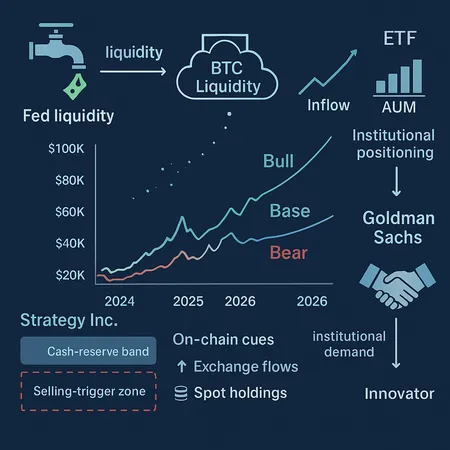
These four forces interact in predictable ways. Below I map the main transmission channels from macro to on-chain and market structure:
- Fed liquidity → funding environment: short-term injections lower funding costs and encourage leverage; that expands marginal liquidity but also raises convexity if liquidity is later withdrawn.
- ETF flows → structural demand/supply: steady inflows tighten exchange reserves and support a higher price floor; sudden outflows create supply stress.
- Strategy Inc. → event-driven selling: a concentrated, rule-based seller amplifies downside in low-liquidity windows.
- Goldman/Innovator → distribution scale: increases institutional demand channels, amplifying both cumulative purchases and concentrated execution risk during product ramps.
Net effect on BTC liquidity: more participants and product complexity generally deepen markets over the medium term, but the coexistence of large, deterministic sellers and episodic Fed actions creates clusters of liquidity risk where volatility can spike unexpectedly.
Scenarios into 2026 (probability-weighted guidance)
I outline three practical scenarios with market mechanics and indicators to monitor.
- Bull base-case (45%): Fed provides occasional easing of funding, ETFs see steady net inflows, Goldman-facilitated distribution ramps, and Strategy Inc. remains within capital comfort levels. Result: tighter exchange reserves, positive derivatives basis, lower realized volatility over months, and BTC moving higher in low-double-digit to mid-double-digit percent gains into mid-2026.
Indicators: continued ETF net inflows, falling exchange reserves, compressing futures basis, pickup in institutional custody flows, and muted liquidation events.
- Range-rotation (30%): ETF flows oscillate (some products netting inflows, others outflows), the Fed’s liquidity operations are tactical not structural, and Strategy Inc. performs ad hoc reallocations without an urgent sale. Result: BTC trades in a wide range, episodic volatility spikes around macro prints and ETF rotation, no sustained trend.
Indicators: choppy ETF flows across issuers, mixed on-chain reserve signals, stable-but-high open interest, and recurring funding rate swings.
- Stress event (25%): a confluence — a short-term withdrawal of Fed liquidity or a macro shock, ETF outflows in certain products, and Strategy Inc. executing part of its contingency reserve — produces forced selling into shallow orderbooks. Result: sharp drawdown (the reporting suggested the potential for a ~15% dip in an adverse scenario), brief liquidity vacuum, then eventual recovery as Goldman-enabled buyers step in.
Indicators: sudden spike in exchange deposits, ETF redemptions, widening repo/futures basis, and increased block sales from OTC desks. Watch order book depth during early Asian/European sessions as an early warning.
Tradeable signals and risk-management checklist
For macro traders and PMs, this section drills to actionable reads and hedges.
Primary signals to watch: ETF net flows (daily/weekly), exchange BTC reserves, futures basis (spot/quarter basis), funding rates, and large on-chain transfers from long-term holders or institutional wallets. Link these with macro prints such as Fed ops or surprising liquidity injections.
Tactical plays:
- Momentum with funding confirmation: enter leveraged long when ETF inflows are steady, exchange reserves fall, and funding rates are neutral to negative (indicating desire to pay to be long).
- Convexity hedge: buy protective put spreads or use options collars around policy meetings or known rebalancing windows for large allocators.
- Event shorts: small, targeted short positions ahead of reported pre-announced seller windows (if Strategy Inc. parameters suggest likely execution), sized to avoid forced deleveraging.
Execution hygiene: prefer working larger blocks through diversified liquidity venues (OTC, multiple exchanges) to avoid signaling. Institutions should coordinate custodial settlement timing to prevent concentrated market prints — a lesson that platforms like Bitlet.app increasingly emphasize when building allocation workflows.
Monitoring framework: what to watch weekly
- ETF flow tallies (net flows by issuer)
- Exchange reserves and large wallet transfers
- Funding rates and futures open interest across CME-style and perpetual venues
- News flow on major allocators (any hints Strategy Inc. is rebalancing)
- Product pipeline and distribution moves from custodians and banks (post-Goldman M&A announcements)
Combine these with macro calendar items — Fed meetings, treasury operations, and major risk-asset data releases — to construct a rolling liquidity heatmap.
Conclusion — balancing structural demand and episodic liquidity risk
The early-December 2025 picture is nuanced: structurally, institutional product maturation (accelerated by Goldman’s Innovator deal) and ETF adoption increase the long-term bid for BTC. Tactically, Fed liquidity injections lower near-term funding costs and foster risk-taking. But the emergence of transparent contingency sellers like Strategy Inc. introduces predictable event risk that can trigger outsized volatility when it collides with thin liquidity windows.
For macro traders and allocators, the appropriate response is not binary. Position sizing, diversified execution, and disciplined hedging around identified event windows will separate successful strategies from those that get run over. Use ETF flows, exchange reserves, and derivatives basis as your primary cross-checks; treat reports of concentrated sellers as potential catalysts, not mere headlines.
Sources
- Fed liquidity injection coverage: Cointelegraph — Fed adds $13.5B overnight liquidity
- Strategy Inc. reporting: CryptoSlate — Strategy Inc. contingency and $1.44B reserve
- Goldman Sachs acquisition coverage: CryptoNews — Goldman Sachs to acquire Innovator in $2B deal
- ETF flows snapshot: Invezz — Crypto ETF flows: Ethereum turns negative, XRP leads with $89.6M inflows