Dissecting 21Shares’ Renewed Dogecoin ETF Push: Amendments, Market Reaction, and Institutional Prospects
Summary
Introduction
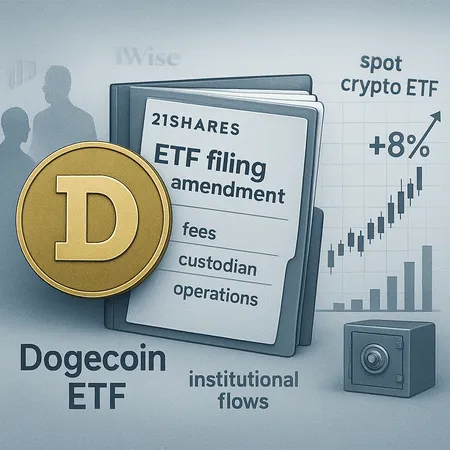
The renewed Dogecoin ETF push — led in public filings by 21Shares — has suddenly made DOGE part of an institutional conversation that looked improbable a year ago. An ETF filing amendment that clarified fees, custodians and operational mechanics triggered an immediate market reaction: a double-digit volume spike and roughly an 8% move higher in DOGE. For allocators, this is more than noise; it forces a practical question: can spot Dogecoin products sustain institutional flows or is this just another short-lived liquidity event?
What 21Shares changed in the filing
21Shares' recent amendments moved the filing from a conceptual wrapper to something operationally concrete. The updated paperwork disclosed the fee schedule and named custodial arrangements, plus clarified redemption and creation mechanics that matter to market-makers and compliance teams. Reports noted the changes specifically around fee disclosure and custodial names — details investors had been seeking before taking the product seriously as an institutional instrument (Coinspeaker, TokenPost).
Why these items matter: fees determine net-of-cost returns for large allocators and influence AP (authorized participant) economics; custodianship addresses counterparty and custody risk, a gating factor for many pension funds, endowments and insurers. By naming custodians and pinning fees in the filing, 21Shares reduced two big unknowns that previously made institutional allocation to Dogecoin awkward.
Market reaction — the immediate price and volume story
The market responded quickly. DOGE spiked roughly 8% and traded significantly higher volumes after the filing update, a reaction covered in market pieces that tracked both price and on-chain turnover Coinpedia. Short-term price action like this is predictable: filings that reduce uncertainty can compress risk premia and trigger flows from both quant desks and momentum traders.
But short-term all eyes are on whether the spike is an entry signal for long-term allocators or merely a reflex for retail and algorithmic liquidity. Volume surges after positive filings tend to include a mix of speculative buying and genuine accumulation by exchanges and OTC desks positioning for possible product launch.
How 21Shares’ move sits alongside Grayscale and Bitwise
21Shares is not alone in the broader institutional push into spot crypto ETFs. Grayscale’s product evolution and Bitwise’s ETF filings have signalled that mainstream managers are refining legal and operational playbooks for token-based ETFs. The difference with 21Shares here is the focus: Dogecoin is a niche asset in terms of market structure compared with Bitcoin or major altcoins, yet it enjoys outsized retail interest and abundant liquidity on spot venues.
For institutional allocators, the choice is both technical and narrative-driven. Grayscale and Bitwise target scale with familiar blue‑chip exposure; 21Shares is testing whether a memecoin with strong retail sentiment can be translated into a regulated, tradable vehicle that fits institutional portfolios.
Arguments for institutional adoption of Dogecoin
- Liquidity and market depth: DOGE regularly posts high spot volumes across exchanges, and the filing-driven volatility may attract market-makers who widen two-way liquidity for an ETF vehicle.
- Diversification and correlation: some allocators view DOGE as a low-correlation or idiosyncratic beta within crypto — a satellite allocation can potentially improve crypto sleeve diversification.
- Retail demand and distribution: a spot Dogecoin product could capture retail flows that currently sit on exchanges or custodians, converting fragmented OTC and on‑exchange demand into ETF AUM.
- Operational maturity: disclosing custody and fees lowers operational hurdles that have kept risk-averse institutions on the sidelines.
These are realistic tailwinds, especially if custodial guarantees and trading infrastructure meet institutional standards.
Arguments against institutional Dogecoin adoption
- Narrative and fundamental weakness: Dogecoin lacks the clear protocol fundamentals and development roadmap that institutions often prefer. Its utility case is thin relative to tokens with active developer ecosystems.
- Concentration and tokenomics: inflationary supply dynamics and concentrated holdings risk make long-term treasury or balance-sheet allocation challenging.
- Regulatory and reputational risk: institutions worry about regulatory scrutiny and the optics of holding a meme-driven asset. The Fool’s contrarian take highlights how retail psychology and speculative narratives can undercut a product’s suitability for long-term institutional allocation (Fool).
- Execution risk: an ETF needs tight physical arbitrage, dependable APs, and deep custody; any weakness in those areas could produce tracking error and liquidity mismatches.
These counterarguments are non-trivial and explain why some allocators will sit on the sidelines even after operational questions are answered.
Practical guidance for asset allocators
- Due diligence checklist: insist on named custodians, proof of insurance limits, AP agreements and concrete fee schedules before allocating. The very amendments 21Shares filed should be part of that checklist.
- Limit sizing: treat initial allocations as tactical — small allocation bands (e.g., 0.1–1% of risk assets) let you capture upside while limiting balance-sheet exposure if the narrative sours.
- Execution plan: prepare for liquidity events by setting rebalancing thresholds and execution algorithms to manage tracking error during large flows.
- Counterparty and custody review: validate custodial segregation, insured cold storage policies and disaster recovery plans; these are the operational linchpins that will decide whether institutional flows stick.
Practical guidance for retail investors
- Understand the product: a spot Dogecoin ETF is not the same as holding DOGE on an exchange; fees, tax treatment and redemption mechanics differ.
- Risk management: consider position sizing discipline, stop levels and the role of DOGE in your portfolio (speculative, satellite or core crypto exposure?).
- Cost awareness: disclosed fees matter. Even small fee differences compound over time and will reduce the net return relative to holding spot on low-cost venues.
- Use trusted platforms: custody and execution matter. Platforms like Bitlet.app and regulated brokers can simplify exposure but verify fee schedules and withdrawal terms.
Can spot Dogecoin products attract sustainable institutional capital?
Short answer: possible, but not guaranteed. The filing amendments 21Shares made are the kind of practical, operational building blocks institutions require. They reduce uncertainty around fees and custody, and that alone can unlock initial flows.
Long answer: sustainability depends on repeated proof — consistent inflows, tight ETF-market arbitrage, low tracking error and absence of repeated reputational or regulatory shocks. Institutional adoption isn’t just a checkbox on a filing; it’s an ecosystem: market-makers, custodians, auditors and legal clarity all need to work in concert. If those pieces align and firms continue to innovate on custody and compliance, a niche but stable institutional base for a Dogecoin ETF is plausible.
Final thoughts
21Shares’ ETF filing amendment moved the Dogecoin story from curiosity toward plausibility by naming fees and custodians. The market reacted immediately — DOGE rallied and volumes spiked — but the bigger test is whether these operational disclosures translate into ongoing institutional flows rather than a one‑time speculative jump. For allocators, the sensible path is cautious, process-driven engagement. For retail investors, understand the differences between ETF exposure and spot holdings and price your risk accordingly.