XRP at a Crossroads: Exchange Outflows, CoinShares Retreat, AI $3 Bets and ETF Headwinds
Summary
Why XRP’s latest price story feels conflicted
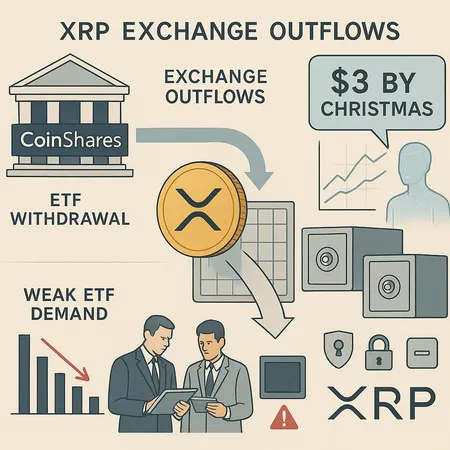
XRP’s market picture right now looks like two movies playing at once: on‑chain analytics show a material exodus from exchanges — a signal that effective supply available for quick selling could shrink — while institutional cues, like CoinShares pulling an ETF application and weak ETF flows, point the other way. Add an AI model projecting a return to $3 and the result is noise that rewards careful parsing rather than headline chasing.
For many traders, Bitcoin still sets the macro mood, but XRP’s narrative has its own mechanics: large holders, broker/dealer custody, and potential ETF demand all intersect with exchange supply to determine short‑term and tactical liquidity. Bitlet.app users managing installment or P2P positions have seen firsthand how liquidity mismatches can widen spreads and delay fills.
The exchange outflow: what the numbers mean for supply dynamics
Blockonomi reported a steep decline in exchange‑held XRP — a multi‑billion token drop in a coordinated withdrawal wave. That matters because exchange supply is the pool of tokens directly available for market orders, margin liquidations and programmatic selling. When exchange balances fall, the immediate effect is often shallower order books and higher slippage for large trades.
But the interpretation isn't binary. Outflows can come from several sources: retail withdrawals into private wallets, transfers to custodians for institutional custody, movement to OTC counterparties, or concentration into a few cold wallets. Each has different implications:
- Retail withdrawals reduce hot liquidity but can be bullish if they represent long‑term holding behavior.
- Transfers to institutional custody may signal genuine demand but also mean those tokens could be rehypothecated or sold depending on mandate.
- Movement into a small set of wallets concentrates sell pressure risk: if a whale decides to liquidate, markets can react violently.
So, the headline — billions of XRP left exchanges — increases the probability of higher price sensitivity to large orders even if it doesn't guarantee a sustained rally. Traders should watch not only the size of the outflows but also where the tokens land (custodial addresses vs. cold storage) and whether exchange inflows reverse quickly.
CoinShares withdrawing its XRP ETF filing: why that matters for institutional demand
CoinShares' sudden withdrawal of its XRP ETF application is an important institutional signal. ETF filings do two things: they create a clear conduit for passive and institutional money to deploy capital into an asset, and they act as a market narrative that draws allocation committees into considering the asset class.
CoinShares pulling the filing — covered in Coinpedia — weakens the narrative that ETFs will be a predictable source of large, recurring demand for XRP. For portfolio managers this is relevant because the prospect of ETF‑driven demand often justifies building overweight positions ahead of launch. Without a credible pipeline of ETF approvals, some allocators will rationally deprioritize onboarding large XRP exposures.
That said, withdrawal isn't the same as an outright denial. Firms adjust strategy, refile, or wait for clearer regulatory frameworks. But in the near term it does add friction to the institutional demand story.
ETF demand is soft — technical indicators add to the bearish case
Analysts tracking ETF interest and technical charts have flagged renewed bearish risks for XRP. FXEmpire summarizes concerns: weak ETF demand, the potential for a 'death cross' pattern on the charts, and muted inflows that undercut bullish narratives. When ETF flows disappoint, liquidity that was expected to be additive can fail to materialize, leaving prices vulnerable to downside catalysts.
From a technical standpoint, the combination of thinner exchange liquidity and absent ETF support can amplify downside moves. Markets that look tight to the upside can flip quickly when a sell event occurs and buyers step back, creating cascading liquidations.
AI price models vs. flow‑based realism: reconciling $3 forecasts with market mechanics
AI models — like the one reported by Finbold projecting XRP could reclaim $3 by December 2025 — are becoming more common and often grab headlines. These models can be informative: they may aggregate patterns, regime changes, macro variables and sentiment indicators to produce probabilistic paths.
But models are only as good as their inputs and assumptions. An AI model that projects $3 may implicitly assume favorable ETF approvals, renewed retail interest, or a macro environment that supports risk assets. If those assumptions don't hold — e.g., ETF demand stays weak or an outsized holder sells — the model's path breaks.
Compare the two perspectives:
- The AI projection is outcome‑oriented: it imagines a scenario where demand reasserts itself and price follows.
- The on‑chain and ETF flow analysis is mechanism‑oriented: it examines whether the plumbing (liquidity, institutional channels, custody) supports that outcome.
Both matter. Reliable trading and allocation decisions come from blending them: use model scenarios to set targets and timeframes, but use flow and custody signals to size positions and manage execution risk.
Trading and custody implications for holders and funds
For speculative traders and crypto portfolio managers, the current constellation of signals suggests a checklist approach rather than a binary bet.
Execution and market‑microstructure
- Monitor exchange balance trends in real time. Rapid outflows reduce available depth — adjust order slicing, increase TWAP/POV usage, and expect wider spreads. Large orders should favor OTC desks when possible to avoid front‑running and slippage.
- Use limit orders and staggered liquidity hunting. In thin books, market orders can create adverse fills.
- Watch for concentration risk. If outflows concentrate XRP into a few wallets, those addresses become systemic liquidity risks; track known custodians vs. private wallets.
Position sizing and risk management
- Adopt scenario‑based sizing. If you believe in the AI $3 scenario but recognize ETF risk, split capital: a core position sized for the long run and a tactical tranche that uses tighter stops or options to express conviction.
- Consider volatility budgeting: with these mixed signals, implied vol can lag realized vol — options can be used to hedge tail risk.
Custody and counterparties
- Institutional custody matters more than ever. Funds should prefer custodians with clear segregation, insurance, and transparent proof‑of‑reserves. Confirm operational readiness for block rewards, forks (where relevant), and rapid settlement.
- For large transfers off exchanges, verify counterparty practices when tokens move to OTC desks or custodians. Are those tokens truly locked away for long durations, or used as short‑term repo collateral?
- Maintain multi‑layered liquidity plans: primary exchange execution, vetted OTC desks, and a fallback to on‑chain DEX or P2P routes if centralized venues seize up.
Regulatory and settlement caveats
- Institutional players must also weigh jurisdictional and regulatory nuances around XRP. Changes in legal posture or enforcement can rapidly affect custody options and settlement timelines.
- Keep lines open with prime brokers and custodial partners. When markets thin, the ability to borrow, repo, or swap exposures quickly can be a differentiator.
Practical checklist for reconciling the signals
- Track exchange supply daily, not weekly. Sudden reversals matter more than slow trends.
- Treat CoinShares' filing withdrawal as a meaningful negative on the ETF timeline, but not a permanent barrier; watch for refiling or other issuers stepping in.
- Use AI models as scenario maps, not single‑point forecasts. Ask what must be true for the model to play out and stress‑test those assumptions.
- Size trades with liquidity in mind: smaller, repeatable fills beat one large block in a thinning market.
- Reevaluate custody and counterparty risk if inflows accelerate or if concentration into custodial addresses increases.
Bottom line
XRP's present crosscurrents — pronounced exchange outflows on one hand, and weaker institutional ETF signals on the other — demand nuance. The outflows reduce immediate exchange liquidity and can support sharper moves on limited flows, but the retreat of ETF momentum (exemplified by CoinShares' withdrawal) removes a key credible demand channel. AI forecasts that call for a run to $3 are interesting and potentially valid under an optimistic scenario, yet they must be weighed against technical warnings and real‑time flow data.
For traders and portfolio managers the pragmatic path is to combine scenario planning with microstructure awareness: use models to set targets, but let on‑chain flows and custody signals govern execution, sizing and hedging. In a market where supply and demand signals are pulling in different directions, the advantage goes to those who map the plumbing before placing the bet.
Sources
- XRP exchange balances drop by $6.5 billion amid mass withdrawal wave (Blockonomi)
- CoinShares suddenly withdraws XRP ETF application (Coinpedia)
- AI predicts XRP price could reach $3 by Christmas Day 2025 (Finbold)
- XRP: Soft ETF demand sparks fresh bearish risks (FXEmpire)
(For context on execution and P2P options, platforms such as Bitlet.app provide a range of retail and OTC‑style services.)