Solana ETF Cycle: CoinShares Pulls Staked‑SOL Filing, ETF Outflow, and the $170 Breakout Case
Summary
Quick market brief: two ETF shocks in 72 hours
Solana’s price momentum has been riding a narrative built around token‑led products and growing institutional interest in staked SOL exposure. That narrative hit two fresh speed bumps: CoinShares quietly pulled its U.S. staked‑SOL ETF filing, and major Solana ETFs recorded the first outflow after a 21‑day inflow streak. Together these events remove some of the structural demand assumptions that traders were using to justify an accelerated breakout toward $170 for SOL.
Why CoinShares pulled its U.S. staked‑SOL ETF filing
Blockonomi reported that CoinShares withdrew the U.S. filing for a staked‑SOL ETF, a move that matters because it suggests either regulatory friction or a strategic recalibration by an institutional issuer weighing on‑chain yield mechanics against U.S. SEC scrutiny. In short: a product that would have packaged liquid staking exposure for institutional investors is no longer a near‑term certainty, and that reduces a credible, recurring source of inflows tied specifically to staked SOL demand. Read the reporting on the withdrawal here.
CoinShares’ pullback isn't a death knell for institutional interest, but it is a signal. Issuers often redesign paperwork after regulatory conversations or pause to reassess market timing. For allocators this is a reminder: product filings matter because they convert latent demand into visible, trackable flows.
The ETF flow picture — why the first outflow after 21 days is important
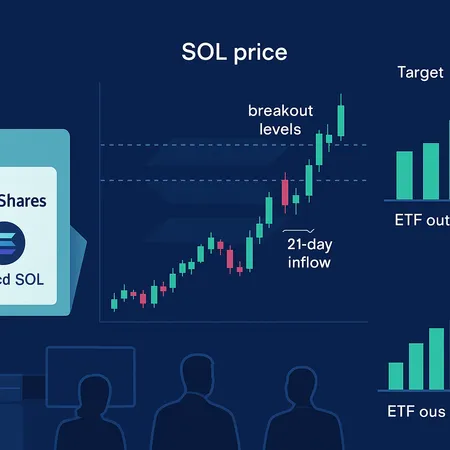
ETF flows act as a macro‑level thermometer for institutional appetite. After a 21‑day inflow streak that helped underpin SOL price action, Solana ETFs saw their first net outflow, as documented in recent market coverage. That end to the inflow streak highlights how momentum can be vulnerable to short‑term sentiment shifts — and how quickly a demand tailwind can neutralize.
Flows don't fully explain price moves, but they amplify them. When inflows are persistent, they create a steady bid that absorbs selling and allows rallies to extend. When outflows arrive, liquidity thins on the buy side and rallies can stall or reverse. The coverage of the outflow is here: Solana ETFs see first outflow after 21‑day streak.
Why ETF flows and staked exposure matter for SOL price
There are two mechanics at work. First, ETFs and similar pooled products create a predictable demand conduit: investors deposit capital and the issuer aggregates or acquires SOL (or synthetic exposure), which places upward pressure on price. Second, staked SOL introduces yield‑seeking demand because it promises token yields plus price exposure — a powerful combo for allocators hunting income and upside.
Removing or delaying a staked‑SOL ETF changes both the timing and composition of demand. Institutional buyers that preferred custody + staking via a regulated wrapper may either defer allocation or seek synthetic or derivatives exposure, which is less price‑supportive than direct spot buying and staking.
Technical road to $170: the breakout levels that matter
Technically, a credible path to $170 is conditional: price has to clear a sequence of resistances with follow‑through volume and hold them on re‑tests. Analysts and chartists are pointing to a multi‑layered resistance zone in the mid‑double digits into the low triple digits that acts as the make‑or‑break corridor for a sustained bull run. AmbCrypto summarizes this technical case and highlights the concept that SOL must clear a key intermediate pivot before the $170 thesis becomes probable; their writeup frames the scenario as contingent on clearing a decisive level and validating it on higher timeframe volume (read the piece here: https://ambcrypto.com/can-solana-hit-170-only-if-sol-clears-this-price-level/).
A practical trader map might look like this:
- Immediate hurdle: short‑term range resistance and moving averages where intraday sellers concentrate (watch for a decisive close above the daily MA cluster).
- Pivot zone to confirm breakout: a mid‑double to low‑triple digit band that has capped rallies in prior months — clearing and retesting this band on volume is crucial.
- Momentum confirmation: higher‑timeframe volume expansion, rising open interest in derivatives (if used), and renewed ETF inflows or product filings to re‑establish a structural bid.
Without clearing the pivot zone and without a return of steady ETF flows (or another institutional on‑ramp), rallies toward $170 risk being short‑lived or turning into a range‑bound chop.
Institutional appetite: signals to monitor
Institutional interest shows up several ways, and traders should monitor them collectively rather than relying on a single metric:
- Product filings and approvals (or withdrawals). CoinShares’ filing pull is an immediate red flag on the timeline that previously seemed to smooth the path for institutional staking exposure.
- ETF flows and custody flows. A return to persistent inflows would materially improve the risk/reward for a breakout thesis; conversely, sustained outflows flip the narrative.
- Custodial staking demand and liquid staking token issuance. Growth in liquid staking derivatives, or new custodial solutions tied to SOL, would mimic the structural demand that a staked‑SOL ETF would have provided.
- On‑chain adoption signals on Solana — active addresses, DeFi TVL shifts, and NFT/memecoin cycles — which influence retail and quant flows.
Institutional allocations often lag retail cycles but, once activated, can create durable support. Track filings, custody partnerships, and ETF flow data closely; those are the clearest forward signals of renewed institutional buying.
Trading takeaways and risk management
- Treat the current environment as conditional bullish: the $170 path exists but is contingent on clearing specific technical pivots plus a re‑establishment of steady inflows.
- Watch for a refile or a similar product filing from another issuer; filings can reappear quickly and change the flow outlook.
- Use layered position sizing: consider smaller entries before the pivot clears, add on a confirmed breakout above the pivot with volume, and keep a tight stop if ETF flows deteriorate further.
- Keep an eye on correlated risk (BTC moves, broad market liquidity) and on‑chain metrics. Abrupt macro shocks can turn ETF‑led narratives on their head.
Bitlet.app users and allocators tracking product flows should incorporate both on‑chain and product‑level signals into position sizing decisions — ETF headlines can move markets fast.
Sources
- CoinShares withdrawal coverage: https://blockonomi.com/staked-solana-etf-scrapped-as-coinshares-pulls-sec-filing/
- Solana ETF flow report: https://blockchain.news/news/20251129-solana-etfs-see-first-outflow-after-21-day-streak-as
- Technical level discussion: https://ambcrypto.com/can-solana-hit-170-only-if-sol-clears-this-price-level/