Dogecoin Rebound and New DOGE ETFs: Why $2M Inflows Matter and How Traders Should Size Risk
Summary
Quick take: why this matters
Dogecoin’s latest upswing isn’t just another weekend pump. The launch of nascent DOGE ETFs pulled in nearly $2 million in initial inflows, a meaningful vote of demand that changed liquidity dynamics and pushed price higher. For retail traders and meme‑coin speculators, that combination — product-led demand plus volatile narratives — creates both opportunity and a need for disciplined sizing.
What sparked the rebound?
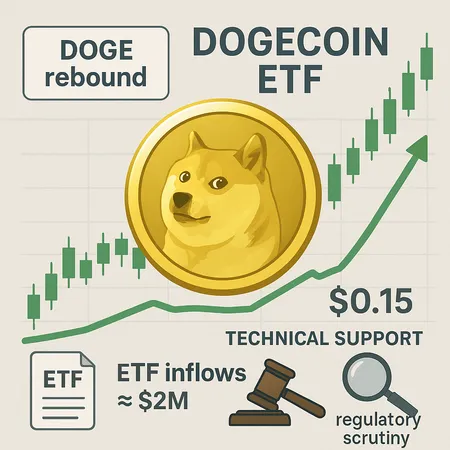
The immediate catalyst was clearly the ETF listings and their early subscriptions. New exchange-traded products act like demand vacuums: they need to buy underlying tokens to back shares, which pushes spot bids up quickly, especially in a market with shallow order books. According to reporting, the new DOGE ETF offerings attracted close to $2M in inflows shortly after listing, evidence that institutional or retail allocators are willing to channel capital into a regulated wrapper for DOGE (CoinSpeaker).
That buying is not infinite. ETF seed capital often creates an initial pop, followed by a breathing period where speculative flows, liquidity providers, and market makers rebalance. Expect spikes and quick retracements until the product stabilizes and secondary shares trade with smoother volumes.
ETF inflows and immediate price reaction
When ETF inflows arrive, price moves are generally compressed into short windows. In DOGE’s case, the inflows coincided with a push toward critical short‑term resistance, magnifying volatility. The takeaway: ETF inflows matter more in thin markets — a $2M bid for Bitcoin-sized markets would be noise, but for meme coins it can be catalytic.
For context, many traders still treat Bitcoin as the primary market bellwether. But meme‑coin dynamics are different: much higher sensitivity to concentrated inflows, and faster reflexive selling when headlines turn.
The regulatory backdrop: scrutiny and what it means for meme coins
Regulatory attention is the dark cloud over this rebound. Recent coverage points out intensifying scrutiny that could blunt or reverse gains if enforcement or policy guidance targets meme tokens specifically. One outlet noted that DOGE was testing the $0.15 support level while regulators stepped up oversight — a combination that could cap rallies or accelerate drops if negative rulings materialize (Blockchain.News).
Why regulators matter here:
- Enforcement clarifies which products are permissible and how funds must custody assets, which can affect ETF operations and associated buying/selling.
- Messaging or action targeting “meme coins” can trigger outsized sentiment moves because these assets rely heavily on narratives and social demand rather than fundamentals.
- Exchanges and custodians may react conservatively ahead of policy changes, creating liquidity squeezes.
Regulatory scrutiny increases policy risk — not a probability that something happens next week, but a persistent background factor that raises the cost of concentration and leverage.
Technical picture: $0.15 and the key levels to watch
Technically, $0.15 has emerged as a focal support in recent trading. If DOGE holds above that level with rising volume, the ETF-driven bid has a chance to sustain and revisit nearby resistance bands. If it fails, downside momentum could accelerate toward prior structural supports.
Key levels to watch (short term):
- Support: $0.15 (critical intraday pivot), then ~$0.12–$0.13 (previous consolidation zone).
- Immediate resistance: $0.18–$0.20 (where ETF-driven sellers and profit-takers likely cluster).
- Higher resistance: $0.24–$0.28 (recent multi-week highs that would require broader market confirmation).
Volume confirmation is essential. A break of $0.15 on strong volume suggests institutional or algorithmic liquidation; a hold above $0.15 with expanding volume signals accumulation. Use moving averages and on‑balance volume or VWAP intra-session to judge whether flows are truly supportive rather than headline-driven spikes.
Position sizing and risk‑adjusted trade ideas
The interplay of ETF inflows and regulatory scrutiny calls for conservative, structured sizing. Below are pragmatic approaches geared to retail traders and meme‑coin speculators.
Core rules before any trade:
- Never risk more than 1–2% of your trading capital on a single speculative DOGE position.
- Prefer staged entries: split your intended exposure into 2–4 tranches to buy into strength or weakness.
- Use stop-losses tied to technical levels, not arbitrary percentages.
Trade idea A — Defensive accumulator (for cautious buyers):
- Thesis: ETFs provide intermittent demand but policy risk is real.
- Execution: Buy 25–33% of target position near $0.15 support. Add another tranche if DOGE consolidates above $0.16 with improving volume. Final tranche only on a clear break above $0.20 on higher volume.
- Stop: Initial stop below $0.14; reduction and trailing stop once position is in profit.
- Risk: Keep max stake at 1% of portfolio.
Trade idea B — Short-term momentum swing (higher risk):
- Thesis: Capture rapid moves from ETF-driven windows or short-covering.
- Execution: Enter on a break above $0.18 with same-session confirmation (close above level and higher volume). Target near $0.24; tighten stops below $0.16 if momentum fades.
- Position sizing: 0.5–1% of capital; use tighter stops and smaller size due to volatility.
Trade idea C — Hedged exposure (for yield-minded or larger accounts):
- Thesis: Want exposure but protect against regulatory shocks.
- Execution: Take a long DOGE position and offset part of exposure with a short across correlated meme instruments or use options where available (puts) to limit downside.
- Positioning: Long = 1–2% of capital; hedge size = 30–60% of long notional depending on risk tolerance.
Practical tips
- Liquidity matters: execute larger orders via limit fills or over several blocks to avoid slippage.
- Keep an eye on ETF share issuance/redeem windows — early days often see discontinuous buying/selling.
- Avoid leverage unless you have strict timeframes and can manage margin calls; regulatory news can spike volatility overnight.
Behavioral and portfolio considerations
Meme coins live on narrative. That’s their strength and their Achilles’ heel. Treat DOGE trades as speculation with event-driven catalysts (ETF flows, social sentiment, regulatory headlines) rather than long-duration investments unless you accept extreme volatility.
If you use platforms like Bitlet.app for installments or dollar-cost averaging, consider allocating via small recurring buys rather than lump positions. That approach smooths entry and avoids being fully exposed when headlines flip.
Final thought
The near‑$2M ETF inflow is a real signal: it shows appetite for regulated DOGE exposure and it moved price because market depth is shallow. But this is not a one-way ticket to higher levels. The $0.15 technical support is the tactical fulcrum to watch, and regulatory scrutiny raises the odds of rapid reversals. Size positions small, stage entries, and always pair directional bets with explicit stops or hedges.
Sources
- CoinSpeaker — "Dogecoin DOGE ETF Rakes In $2M, Two Key Levels Emerge": https://www.coinspeaker.com/dogecoin-doge-etf-rakes-in-2m-two-key-levels-emerge/
- Blockchain.News — "DOGE tests $0.15 support as crypto regulatory scrutiny weighs on": https://blockchain.news/news/20251129-doge-tests-015-support-as-crypto-regulatory-scrutiny-weighs-on
For more context on macro crypto flows and product listings, see posts on DeFi and how institutional wrappers change orderbooks.