Can Solana’s Adoption Momentum Translate into Durable Value? Product Wins, Cross‑Community Signals, and What to Watch
Summary
Executive snapshot
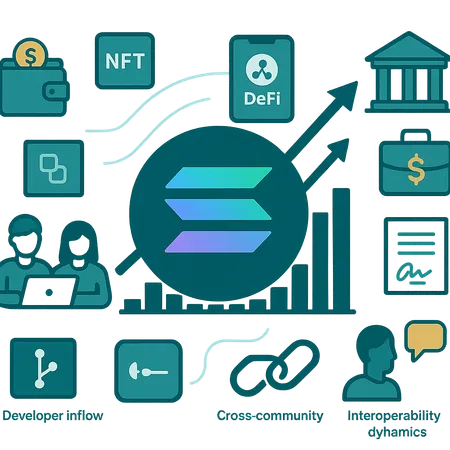
Solana’s ecosystem momentum over the past year looks materially different from earlier hype cycles: multiple product launches, rising institutional references, and public cross‑community recognition are giving adoption a more structural feel. This article synthesizes recent ecosystem wins, explains why sentiment from other projects—like a Ripple executive publicly urging the XRP community not to ignore Solana—matters for market positioning, and translates those dynamics into what developers, crypto strategists, and DAOs should monitor to validate durable value creation. Practical next steps and a compact watchlist close the piece.
What the recent product launches and institutional milestones actually are
Several high‑impact launches and deals have pushed Solana from experimental to enterprise‑adjacent. Public reporting and industry surveys point to notable product rollouts across payments rails, NFT infrastructure, derivatives, and custodial/on‑ramp integrations that lower the barrier for institutional flow. A useful roundup of these developments is available in recent industry coverage, which catalogs exchanges, custody partnerships, and DeFi product launches that together underline accelerating adoption ZyCrypto article.
Why those items matter: institutions and builders care about a few things—reliable execution environments, custody options, and real user demand. When custody providers and exchanges add support, they remove operational friction for funds and OTC desks; when derivatives and tokenized yield products appear, they create the instruments institutions need to express exposure without handling spot tokens directly. For many traders, Solana is increasingly configured as a low‑latency, low‑cost execution layer that can host everything from real‑time orderbooks to high‑frequency NFT marketplaces.
Cross‑community dynamics: why a Ripple exec defending Solana is more than noise
Public comments from prominent figures in other ecosystems—such as the Ripple executive urging the XRP community not to ignore Solana—read as more than PR theater. They are signals of cross‑project respect and of an evolving interoperability narrative. When teams that are traditionally seen as competitors acknowledge each other, it reduces zero‑sum framing and helps build a story where multiple chains can coexist and specialize. That piece of commentary was reported in industry outlets and reflects how Solana is starting to be discussed in the same breath as legacy payment rails and settlement layers U.Today report.
The pragmatic implications are threefold: first, cross‑community recognition makes it easier for custodians and institutional desks to justify multi‑chain exposure in pitchbooks. Second, it increases the odds of neutral third‑party tooling (index providers, analytics vendors, compliance providers) extending support to Solana. Third, it nudges narratives away from ‘winner takes all’ to ecosystem specialization, which is a healthier environment for sustained developer and capital inflows.
How adoption momentum feeds developer inflows, TVL, and token economics
Adoption manifests in different channels that together shape token demand and network utility.
Developer inflows: As product templates, SDKs, and successful dApp case studies accumulate, the marginal cost of building on Solana falls. Developer interest tends to follow both technical merits (throughput, tooling) and clear business cases (user traction, revenue channels). Expect growth in protocol‑level contributions, SDK usage, and recruitment if product launches continue to show monetizable user activity.
TVL and liquidity: Institutional products and composable DeFi primitives are the main levers for TVL growth. If custody and derivatives create institutional pathways onto Solana, TVL will reflect that via larger managed positions, liquidity pools, and synthetic products. But TVL is noisy—bridging flows and yield chasing can inflate it temporarily—so coupling TVL growth with on‑chain active users paints a better picture.
Token economics (short‑to‑medium term): Increased app usage raises fee demand for SOL and encourages staking to secure network participation. If staking ratios rise, the circulating supply available for active trading effectively tightens, which can exert upward pressure on price under constant demand. Conversely, higher throughput without proportional fee pressure can mute token value capture, so the design of fee markets, inflation schedules, and staking rewards remains pivotal.
These dynamics are not unilateral: technical setbacks or repeated outages would erase confidence quickly, while real institutional custody partnerships and recurring revenue‑generating dApps make the adoption story stickier.
Practical implications and playbook for developers, strategists, and DAOs
If you’re choosing whether to allocate developer resources or treasury capital to Solana, think in terms of optionality and risk management. For dev teams: prioritize modular design so apps can be ported or bridged—interoperability matters. For crypto strategists and DAOs: consider staged exposure tied to milestone gates (custodial integrations, consistent TVL growth, latency/uptime records).
Concrete actions:
- Integrate neutral bridge tools and multi‑chain SDKs to reduce migration costs.
- Monitor institutional flow signals from custody listings and OTC desks before committing large treasury allocations.
- Build for composability: projects that plug into larger on‑chain primitives capture platform upside as TVL expands.
For example, Bitlet.app and similar services that support multi‑chain flows become important middleware when projects intend to move between L1s while preserving user experience and compliance.
Watchlist: metrics that validate sustained adoption (and how to interpret them)
Below are the highest‑signal metrics to separate hype from durable growth, with why they matter and what patterns you want to see over 3–12 months:
Active developer activity (GitHub commits, unique contributors): rising sustained commits and new contributors indicate an expanding talent base, not just copycat forks. A steady increase over multiple quarters is a positive signal.
Monthly active addresses and DAU for top dApps: more important than raw transactions, active users engaging with applications (not just move funds) show product‑market fit.
TVL composition and retention: look at TVL by protocol type (DEX, lending, staking) and retention rates—high turnover or bridge‑driven spikes are weaker signals than organically retained value.
Institutional on‑chain flows and custody support: measurable inflows via custodians, new custodial pairs, or institutional staking services are leading indicators of durable capital.
Fee revenue and fee per transaction: rising fee revenue that tracks user growth implies the network captures economic value; declining fees amid massive throughput may signal value capture dilution.
Staking ratio and validator decentralization: a healthy proportion of staked supply with decentralized validator sets increases security assumptions for institutional investors.
Bridge volumes and cross‑chain flows: sustained, permissioned bridge usage by reputable projects suggests meaningful interoperability rather than speculative arbitrage.
Uptime and incident cadence: low‑frequency, well‑handled incidents retain confidence; repeated outages without clear remediation plans deter institutional counterparts.
Interpreting signals: require convergence—no single metric proves durability. A strong narrative requires upward trends across developer activity, real end‑user engagement, institutional on‑ramps, and fee capture.
Final assessment and near‑term thesis
Solana’s recent product launches and institutional mentions are real contributors to a stronger adoption narrative, and cross‑community endorsements like the Ripple executive’s comments help normalize Solana as part of a multi‑chain landscape rather than an outlier. That normalization matters because institutions underwrite market structure: custody, compliance, and diversified exposure.
Near term (3–12 months) the adoption story will be validated if we see: steady developer inflows, TVL growth that aligns with genuine user retention, measurable institutional custody and OTC activity, and improving fee capture without sacrificing user economics. Conversely, repeated reliability failures or a lack of economic capture in fee markets would temper the thesis.
For developers, strategists, and DAO treasuries, the right stance is conditional engagement—build and allocate, but with milestones and contingency plans. Track the watchlist, favor modular architectures that preserve optionality, and treat cross‑community signals as useful context rather than proof.
Sources
- Survey of Solana’s recent product launches and institutional wins: Adoption for Solana skyrockets — ZyCrypto
- Ripple executive urging the XRP community not to ignore Solana: U.Today report