Privacy Coin Comeback: ZEC, XMR, DASH and DCR Rally After Geopolitical Shock
Summary
The April breakout: timeline and price action
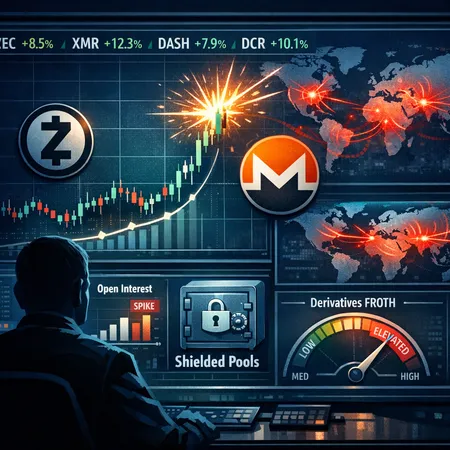
Privacy coins erupted in early April 2026 after a sharp geopolitical escalation in a key region. Within 48–72 hours ZEC led the charge with a parabolic weekly move, followed by strong runs in XMR, DASH and DCR. Traders saw 30–60% weekly spikes in some tickers as buyers chased both immediate protection and speculative leverage. Reporting from Coinpedia documented the April privacy coin surge across DASH, ZEC, DCR and XMR and tied the move directly to the geopolitical catalyst, noting the simultaneity of on-chain flows and price action.
What made this move different from a routine crypto pump was the mix of on-chain behavior and derivatives activity: large withdrawals from exchanges, meaningful increases in shielded pool participation for Zcash, and futures and options desks reporting heavy skew and elevated open interest. That combination compressed liquidity and amplified moves.
Why geopolitics pushed demand for privacy coins
Geopolitical shockwaves produce two distinct behavioral currents in crypto markets: risk-hedge flows and opportunistic speculation. Privacy coins sit at the intersection. For certain market participants — institutions, HNWI, and traders worried about surveillance risk — privacy-preserving primitives become attractive when cross-border capital movement and censorship fears rise. ZEC’s shielded pools and Monero’s default privacy primitives are natural beneficiaries.
The recent episode had a few reinforcing dynamics. First, traditional safe havens (gold, FX) were volatile, which drove a subset of flows into crypto instruments perceived as harder to trace. Second, supply-side mechanics mattered: large exchange outflows and in-protocol shielded inflows removed available market liquidity, causing sharper price moves for a given net buy volume. FXEmpire highlighted rising inflows to Zcash’s shielded pools as an important signal that demand was not only speculative but privacy-directed.
On-chain signals: what to watch (and what they mean)
Shielded pool inflows (ZEC): A sustained rise in coins moving into Zcash’s shielded addresses suggests genuine privacy demand rather than simple marketplace speculation. Analysts at FXEmpire flagged this inflow pattern during the April run, linking it to conflict-driven use cases. Monitor net shielded pool balance, new shielded address creation, and large shielded deposits as early-warning signals of structural demand.
Exchange flows and order book thinning: Persistent withdrawals from centralized venues and large taker buys that chew through order books are classic markers that liquidity is drying up. That raises slippage for execution and increases the chance of gap-style moves on re-open or thinly traded sessions.
Protocol-specific privacy mechanics: Different coins achieve privacy differently. Zcash uses optional shielded transactions powered by zk-SNARKs; Monero’s privacy is opt-out by design via ring signatures, stealth addresses and RingCT; Dash relies on an opt-in mixing feature (PrivateSend). These mechanics affect on-chain observability, custody behavior, and how flows translate into price impact.
Concentration and whale activity: Large single-entity transfers into shielded pools or to cold storage are a stronger signal than distributed retail flows. Look for clustered UTXO movements or single-address transfers exceeding a protocol’s typical large-transfer threshold.
Derivatives froth: how leverage can flip a rally
Derivatives markets often lead or exaggerate spot moves. In this rally several derivatives indicators flashed danger signs: soaring open interest, extreme funding rates on perpetual swaps, and skewed options markets showing a pronounced demand for upside calls and protective puts.
Crypto.news captured the parabolic weekly rally in ZEC and warned that derivatives froth — particularly in illiquid underlying markets — can represent late-stage momentum. Decrypt reported trader optimism calling for much higher ZEC targets after a 62% weekly spike; that optimism often shows up as crowded long positioning.
Key derivatives metrics to track:
Open interest (OI) and OI/spot ratio: Rapid OI growth with price increases often signals leverage chasing. When OI becomes concentrated on a few venues or counterparties, forced deleveraging risk grows.
Funding rates and basis: Persistently positive funding indicates net long leverage paying shorts; if funding spikes, the long side is costly and vulnerable to liquidations. Basis (futures vs spot) widening suggests premium for immediate exposure.
Options skew and 25-delta risk reversals: Heavy demand for calls (call skew) can lift implied vols on the upside and create a convexity that feeds rallies; heavy put buying shows tail-hedge demand. Watch 25-delta skew and top-of-book flow for large block fills.
Liquidation clusters: On-chain and exchange-level liquidation maps help identify where a short-squeeze or long squeeze could cascade. In thin markets, a handful of liquidations can create outsized moves.
When derivatives and spot liquidity are both strained, rallies can overshoot and then violently reverse as margin calls and deleveraging cascade.
Technical and liquidity considerations unique to privacy protocols
Privacy coins often trade with wider spreads and thinner order books than major altcoins, especially outside top-tier venues. That has practical consequences for active traders and risk officers:
Slippage and execution risk: Large orders will move the price; use TWAP/VWAP algorithms or split orders across venues. For very large flows, consider OTC desks to avoid front-running and slippage.
Depth across venues: Some exchanges delist privacy assets in certain jurisdictions. Depth may be concentrated on a handful of platforms — raising counterparty risk if those platforms halt withdrawals.
On-chain settlement timing: Shielded transactions in Zcash can take different processing paths; privacy-preserving operations sometimes slow visibility into actual supply movements, complicating real-time risk exposure assessments.
Cross-protocol arbitrage frictions: If DEX liquidity for privacy-related pairs is limited, cross-venue arbitrage can be slow, widening dislocations between spot and futures or options markets.
Monitoring tools are uneven: Not all analytics providers fully surface shielded flows or ring-signature obfuscation metrics. Combine exchange-level data with dedicated chain analytics and desk intelligence.
Tactical trade setups (and the hedges you should keep in place)
For active traders assessing whether to enter a privacy coin trade during a geopolitically driven rally, consider these pragmatic setups and explicit risk controls:
Momentum breakout (short timeframe):
- Entry: scale in on aggressive 15–60 minute breakouts above prior intraday highs with increasing volume.
- Size: keep position size small relative to average daily volume (ADV); cap exposure to a strict percentage of portfolio risk budget.
- Hedge: use short-dated protective puts or buy inverse perpetuals sized to limit downside during a volatility spike.
- Exit: set both hard stop (percent-loss) and staggered profit-taking levels.
Mean-reversion swing (multi-day):
- Entry: wait for retracements to key intraday moving averages or VWAP after initial parabolic spikes.
- Hedge: pair with short futures or use collars (long spot + buy put + sell OTM call) to finance downside protection.
- Risk control: trim into rallies and re-assess after each close — do not assume the new price level is stable.
Options-defined asymmetric bet (medium-term):
- Structure: buy a call spread (bull call spread) rather than naked calls to reduce Vega exposure; or buy protective puts for a directional spot long.
- Rationale: options let you define max-loss and reduce liquidation risk that comes with futures leverage.
Yield/arb desks and market-makers:
- Technique: provide liquidity but hedge via delta-neutral strategies across futures and options; keep inventory limits tight.
- Watchout: sudden spikes in spot volatility can vaporize inventory PnL if hedges are illiquid.
Concrete risk controls and operational checks
Limit leverage: cap nominal leverage on privacy coins materially below what you use on liquid assets like BTC/ETH. Volatility and liquidity deficits make leverage deadly.
Pre-define stop and size: calculate position size from a VaR or stress-loss model reflecting a wider bid-ask shock than normal.
Monitor counterparty and withdrawal risk: track exchange pause notices and keep an execution plan with multiple counterparties and OTC desks.
Watch regulatory updates: privacy coins have a fraught regulatory history. Rapid policy statements or exchange compliance moves can cause abrupt trading halts and liquidity withdrawal.
Use discrete hedges: prefer options and OTC hedges to avoid slippage in tight order books.
Record asymmetric scenarios: assume a 20–40% intraday gap is possible in a severe liquidity squeeze and stress-test that in your sizing.
Regulatory and compliance caveats
Privacy coins face a patchwork of regulatory responses worldwide. Some exchanges and custodians have restricted or delisted certain privacy assets in past years citing AML/CTF concerns. Traders and risk officers must maintain robust compliance checks: know-your-counterparty, withdrawal monitoring, and be ready to move positions if an exchange signals delisting or operational constraints. Regulatory moves can be sudden and they often produce the most severe liquidity-driven price impacts.
From a legal perspective, trading or custody of privacy assets can attract enhanced due diligence in many jurisdictions. That means onboarding times, withdrawal limits, and counterparty acceptance may be materially affected during periods of heightened demand.
Putting it together: a checklist for trading privacy coins in a tail-risk rally
- Confirm motive: is the move privacy-led (shielded inflows, cold storage activity) or purely speculative? Use on-chain and exchange flow data.
- Watch derivatives metrics: OI, funding, skew, and liquidation maps.
- Size conservatively and prefer options-defined risk where possible.
- Use multi-venue execution and consider OTC for large trades.
- Maintain a regulatory monitoring ticker and reduce exposure if de-list risk rises.
- Keep a clear exit path: pre-defined stop, hedges in place, and liquidity counterparties ready.
For active traders and risk officers on platforms such as Bitlet.app, blending desk intelligence with quant signals (shielded pool inflows, funding curves) will separate thoughtful participation from gambling.
Sources
- Coinpedia — Can privacy coins sustain their breakout rally? Documentation of the April privacy coin surge: https://coinpedia.org/price-analysis/can-privacy-coins-sustain-their-breakout-rally/
- FXEmpire — Zcash price news and commentary on inflows to shielded pools: https://www.fxempire.com/forecasts/article/zcash-price-news-zec-eyes-rally-to-500-as-inflows-to-shielded-pools-rise-1590885
- Crypto.news — Coverage of ZEC’s parabolic weekly rally and derivatives froth warnings: https://crypto.news/zcash-price-cools-after-parabolic-run-as-derivatives-froth-flashes-risk-is-400-in-range/
- Decrypt — Trader optimism and price spike context for ZEC: https://decrypt.co/363946/zcash-could-rise-420-after-62-weekly-price-spike-traders-predict
For further reading on protocol mechanics and market structure, see Zcash and research on privacy in broader DeFi markets.