Bitcoin’s April 2026 Rebound: CPI Shock, $2.2B Options Expiry and What Traders Should Do
Summary
The move in context: why BTC ripped above $72–73k
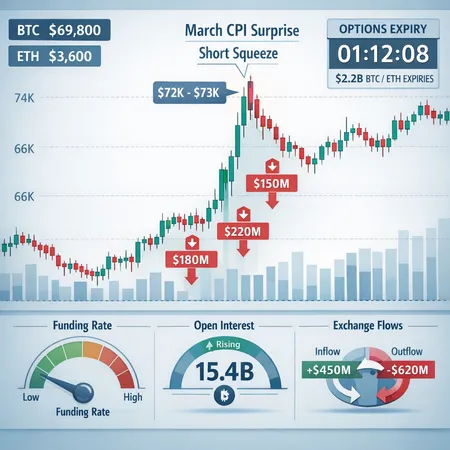
In mid-April 2026 Bitcoin staged a sharp rebound, briefly trading above the $72–73k corridor after market participants digested a surprise CPI beat in March and the accompanying macro repricing. Headlines framed the event as a clean macro catalyst: inflation cooled enough to pull forward risk appetite, and BTC reacted quickly to that narrative — a dynamic covered when markets pushed BTC near $73k in some reports. (Invezz)
That move wasn’t happening in a vacuum. Positioning was heavily skewed: many speculative desks and retail traders had large short exposures after the winter drawdown, funding rates had been positive for extended stretches, and open interest in both spot-derivatives and options was elevated. The market reaction to the CPI print highlights how a single macro datapoint can flip the balance of flows when leverage and options gamma are large. For markets tracking policy and real yields, this was not merely a price update — it was an event that forced active rebalancing across pools of capital and hedging desks.
CPI, the immediate market read and macro backdrop
The March CPI surprise was the proximate trigger — traders priced a modest de-escalation in inflationary pressure, which reduced near-term rate-hike fear and improved risk-on sentiment. Coverage that parsed the CPI print and the immediate BTC reaction helpfully notes that the surprise was enough to push benchmarks like BTC toward $73,115 briefly. (Coinpaper)
But the macro setting is mixed. Sticky elements of inflation and geopolitically driven commodity shocks — notably oil — remain present and can reverse risk appetite quickly if wage or goods inflation re-accelerates. A recent roundup flagged how lingering inflation and oil spikes have produced recurring liquidation waves that complicate the sustainability of rebounds. (Crypto.News)
So: CPI loosened immediate pressure and opened a short-term window for risk assets, but macro cross-currents still set a fragile backdrop. That fragility matters a lot when derivatives positioning is concentrated and expiries are large.
How the $2.2B BTC/ETH options expiry amplifies moves
Large coordinated expiries — in this case roughly $2.2 billion across BTC and ETH — are mechanical accelerants. When a sizeable chunk of options sits short gamma (i.e., sellers who will delta-hedge by trading the underlying), their hedging flows can drive the underlying price into or away from strike clusters. The expiry itself creates a path-dependent feedback loop: as spot moves, dealers adjust delta-hedges, which moves spot further, forcing further hedge adjustments. (U.Today)
There are two related dynamics to watch here: the gamma squeeze and the short squeeze. A gamma squeeze occurs when option sellers (short gamma) must buy the underlying as the market rallies to remain hedged; this buying can accelerate the rally. Conversely, a short squeeze happens when concentrated short futures positions get flushed by rising spot prices and cascading margin calls — forced buys executed at worsening prices. When both effects coincide into a narrow time window, the move can be extremely violent and short-lived.
Importantly, the expiry magnifies where open interest is clustered by strike. If a material amount of call-open interest is clustered just above spot, dealers’ delta hedging creates a natural price magnet as expiry approaches. That magnetism is why you’ll often see pronounced intraday moves and big ROEs around large expiries.
The mechanics: gamma, delta-hedging and cascade risks
Options dealers who are short gamma are short convexity; if spot rises, dealers buy spot (or buy futures) to re-balance their net delta toward neutral. If spot falls, they sell. That simple rule can produce procyclical flows. Add high leverage on futures books and you have a potentially explosive cocktail:
- Dealers’ delta-hedging liquifies the rally (or decline).
- Leveraged shorts (or longs) on perp/futures face margin pressure and liquidations.
- Liquidations beget further deleveraging and order-book thinning, widening spreads and worsening execution.
Historical episodes show the velocity: aggressive leverage has erased accounts in minutes when a squeeze begins. Recent cautionary accounts emphasize how fast liquidation cascades can wipe out even experienced participants when stops are poorly placed or financing costs are ignored. (NewsBTC)
On-chain and derivatives signals to watch (and what they mean)
Below are the highest-signal metrics for sizing and rebalancing ahead of the expiry — track them in near-real time:
Funding rates (perpetual swaps): sustained positive funding means longs are paying shorts; a sudden drop or flip indicates long exhaustion or short rebuilding. Persistent positive funding going into expiry suggests a crowded long side vulnerable to a flip.
Open interest (futures and options): watch not just magnitude but where it’s concentrated by strike. Rising futures OI into a rally points to fresh leverage — fragile, because it can reverse quickly. Large option OI near-the-money forms magnets; reconcile spot against OI heatmaps.
Exchange flows (inflows/outflows): sizeable exchange inflows often presage selling (liquid supply), while large withdrawals can reduce liquidity and steepen moves. Track whale transfers and stablecoin inflows as liquidity proxies.
Liquidation events and order-book depth: real-time liquidation clusters show where stop-losses are getting hit. Thin order books around bid/ask make squeezes more violent.
Implied vs realized volatility and skew: a low realized vol vs high implied vol gap suggests risk premia are elevated; skew compression or expansion around expiries tells you which side of the tail market makers are pricing.
Put-call ratios and buy-write activity: heavy put buying can be protective; heavy call selling can be a short-gamma trap.
On-chain spot metrics: large transfers to exchanges, concentrated wallet activity and staking/withdrawal cadence on L2s can change available liquidity on the spot side. DeFi flow into/away from liquidity pools also affects slippage for large trades — see activity across protocols in DeFi ecosystems.
Many PMs use a live matrix combining funding rate, OI delta, exchange flow, and skew to form a real-time 'squeeze risk' score. That score should inform both sizing and whether to technical-hedge with options or dynamic futures cuts.
Practical trade sizing, hedging and risk-management checklist
For intermediate traders and portfolio managers the aim is not to predict the exact move, but to quantify risk and create deterministic responses. Below is a compact checklist and sizing guidance:
Reassess leverage: reduce net leverage heading into the expiry. If your strategy depends on momentum, trim 20–50% of size on the first breach of defined volatility thresholds.
Define stop bands, not point stops: use a layered stop approach (e.g., reduce 25% at 5% adverse, another 25% at 10%) to avoid being squeezed out by intraday gamma flows.
Use options for convextiy: buy protective puts or call spreads to cap downside at a known cost. If gamma is expensive, consider selling a small amount of skewed options funded by buying further out-of-the-money protection.
Hedge dynamically but conservatively: delta-hedge with a bias towards keeping cash available for margin calls. If funding rates are high, avoid adding long perp exposure to chase momentum.
Watch and react to exchange flows: if exchange inflows spike, be ready to aggressively reduce exposure; if outflows accelerate, liquidity could be drying and slippage risk rises.
Stress-test: simulate a 10–20% rapid move against your book and calculate expected margin calls and P&L. If the realized drawdown exceeds stress tolerances, preemptively de-risk.
Learn from recent liquidations: the cautionary tale of aggressive leverage shows that tight stops and over-reliance on margin financing can wipe accounts—avoid “all-in” behavior near known event windows. (NewsBTC)
Scenarios and tactical posture: is this a liquidity-driven pop or the start of a sustained rally?
Be pragmatic: both outcomes are plausible. Below are condensed scenario frameworks and tactical signals that would shift probabilities.
Bull case (sustained rally):
- Macro confirms disinflation (follow-through CPI data and rates market), real yields compress, and institutional flows (spot/OTC) show sustained buying.
- Funding rates normalize without sudden flips; open interest grows with balanced buy-side participation; exchange outflows continue.
- Option skew flattens as dealers offload large short-gamma books and implied vol drops meaningfully.
Bear case (liquidity-driven pop, fast retrace):
- Macro re-tightens (oil or wage-driven upside), or risk sentiment reverses on geopolitics; funding rates flip sign quickly.
- Expiry-driven gamma and liquidation-induced buys fade after the event, leaving spot unsupported; open interest falls and spot gaps down.
- Exchange inflows spike and realized volatility overshoots implied, prompting outsized average slippage on exits.
Neutral / rangebound case:
- The expiry induces a transient move; market consolidates in a higher range while macro data keeps investors cautious.
Tactical posture for intermediate traders:
- Reduce gross exposure approaching expiry and maintain optionality (light long + protective puts or no-leverage directional).
- Use smaller notional sizes if adding exposure during the squeeze; increase cash buffers and lower leverage.
- Post-expiry, reassess base-case depending on funding, OI, and exchange flows — only add conviction if multiple signals align.
Final takeaways
The April 2026 BTC move above $72–73k illustrates a classic interplay: a macro catalyst (CPI) + crowded derivatives positioning + a large options expiry can create outsized, short-lived rallies. Traders should not confuse a liquidity-driven spike with regime change. Monitor funding rates, open interest and exchange flows closely, and mix defensive option hedges with disciplined position sizing. For portfolio managers the pragmatic approach is to treat this as a rebalancing window—trim or hedge exposure ahead of the expiry, then rebuild only if on-chain and derivatives indicators corroborate a sustained bid.
Bitlet.app users and liquidity providers should factor in these same signals when executing large orders: slippage and market impact around expiries can be material.
Sources
- https://invezz.com/news/2026/04/10/bitcoin-climbs-above-73000-as-inflation-cools-and-risk-appetite-returns/?utm_source=snapi
- https://coinpaper.com/16157/xrp-price-prediction-ichimoku-cloud-flips-bullish-as-ripple-moves-25-m-coins-on-chain?utm_source=snapi
- https://u.today/crypto-options-alert-bitcoin-and-ethereum-set-for-22-billion-expiry-event?utm_source=snapi
- https://crypto.news/bitcoin-clings-to-72k-while-3-3-inflation-and-war-driven-oil-spikes-rattle-us-markets/
- https://www.newsbtc.com/news/a-bitcoin-cautionary-tale/