Decoding XRP's Bullish Undercurrents: Futures, On‑Chain Flows & Quantum Resilience

Summary
Why XRP’s quiet spot market isn’t the whole story
Spot volatility is what most headlines chase, but institutional allocation decisions increasingly happen off the ticker. Over the past weeks on-chain and derivatives metrics for XRP have shown behavior more consistent with accumulation and positioning than with retail-driven momentum. An 83% jump in XRP futures balance (a proxy for open interest or collateral parked in derivatives) is a strong example of this hidden activity — it suggests growth in leverage and hedge positions even while the spot chart looks sideways (U.Today).
For context, consider how other markets behave: futures-cleared positioning can precede spot trends by days or weeks as institutions build directional exposure while minimizing immediate market impact. For many traders, Bitcoin remains the primary bellwether, but alt assets like XRP increasingly show institutional layering through derivatives and custody moves that aren’t obvious from price alone.
Interpreting a futures-balance spike vs. muted spot
A surge in futures balance—or more broadly derivatives liquidity—can mean several things. It can be: (1) directional long/short accumulation, (2) hedging of off‑chain exposure, or (3) market-makers widening inventory to meet expected flow. The key is to combine the derivatives signal with on‑chain flows, exchange reserves and custody events to triangulate intent.
If futures balance rises while exchange reserves fall, the most likely interpretation is net accumulation: counterparties are taking or hedging positions with less immediate sell-side liquidity available. This set-up raises the odds that once a catalyst appears, price moves will be amplified. Recent reporting indicating the 83% jump should therefore be read alongside reserve metrics, not in isolation (U.Today).
Conversely, if futures volume rises but exchange reserves and on‑chain transfers show increased outflows to exchanges, that could signal distribution. So the direction of flows matters.
Ichimoku and the current technical set-up for XRP
For intermediate analysts, Ichimoku offers a multi-component view: trend bias (cloud), momentum (Tenkan/Kijun), and support/resistance (cloud boundaries). Recent technical notes flagged an Ichimoku bullish flip for XRP after a sequence of cloud and baseline interactions, which can be read as an early trend confirmation when combined with volume and on‑chain support (Coinpaper).
What to look for technically as confirmation: sustained price above the Kumo (cloud), Tenkan-Kijun bullish cross, and Chikou Span clearing recent prices. But technicals alone are noisy; the real edge comes from aligning Ichimoku bias with on‑chain signals like declining exchange inventory and controlled transfers.
The significance of Ripple moving 25 million XRP on‑chain
Large transfers from custodians or project wallets are a classic institutional footprint. Coinpaper reported Ripple moved 25 million XRP on‑chain — an event that could reflect treasury management, OTC liquidity provisioning, staking/custody rebalancing, or simply internal redistribution. What matters is the destination and timing: transfers into cold custody or regulated custodians reduce available circulating liquidity; transfers into exchange hot wallets increase immediate supply pressure (Coinpaper).
When you marry that transfer with falling exchange reserves — now reported at an equivalent of 274 billion in the referenced aggregation — the narrative tilts toward a supply squeeze. Declining exchange reserves reduce the ammunition that sellers typically use, so even modest buying pressure (especially if levered via futures) can have outsized spot impact (U.Today).
Custody, exchange reserves and the institutional calculus
Institutional allocators judge assets on two axes: expected return and custody/risk profile. For XRP, custody conversations are evolving from basic hot/cold splits to deeper questions about cryptographic resilience, third‑party custody providers, and regulatory provenance. Exchange reserves are a separate but related metric: they measure the amount of supply readily sellable on centralized venues. When reserves shrink, the market becomes less liquid on the sell side — a double‑edged sword for allocators: better potential asymmetry for price but higher execution risk for large exits.
Operational considerations for allocators evaluating entry points:
- Execution strategy: staggered entry via OTC desks is prudent if on‑chain and derivatives signals point to institution-led accumulation. OTC lets buyers avoid slippage into thin orderbooks.
- Hedging posture: the rise in futures balance implies active hedging demand — consider pairing spot exposure with duration-limited derivatives hedges to control funding and basis risk.
- Custody selection: prioritize providers with XRPL-native custody tooling and audited multi‑sig workflows. Bitlet.app users, for instance, often weigh custody features and settlement rails when sizing positions.
XRPL’s quantum‑resilience narrative and why it matters to institutions
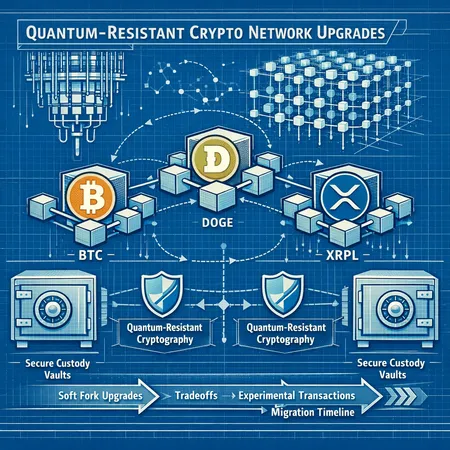
Long-term institutional adoption hinges not only on market mechanics but on survivability against existential threats. Quantum computing is often discussed as a theoretical threat to public‑key cryptography; in practice, different ledgers have varying exposure.
Recent analysis suggests only a tiny fraction of XRP supply is vulnerable to near-term quantum threats — Finbold quantified the exposure at roughly 0.03% of total supply, a statistic that should reassure cautious allocators evaluating cryptographic longevity (Finbold). That low vulnerability arises from XRPL’s account model and upgrade pathways that allow for more immediate mitigation strategies compared with some legacy systems.
Strategic partnerships that layer enterprise-grade interoperability and compliance — for example, Ripple’s collaboration narratives with firms like Quant — further bolster institutional comfort by enhancing rails for settlement and custody integration (Coinpedia). For allocators, this is meaningful: custody isn’t just key-management, it’s about the entire custody, settlement and connectivity stack.
Putting it together: what the signals imply for allocation and timing
No single indicator is decisive, but the composite picture is instructive:
- High derivatives balance + declining exchange reserves + large protocol/custodian transfers = a higher probability of institution-driven positioning.
- Ichimoku bullish structures provide a technical framework that, when validated by on‑chain data, reduces false signals.
- XRPL’s low measured quantum vulnerability and partnership ecosystem lower long‑term custody risk, improving the risk/reward calculus for longer-dated allocations.
For intermediate allocators, practical steps are:
- Monitor flows daily: futures balance, exchange reserves, and large wallet movements. A sustained trend across these three is more meaningful than one-off spikes.
- Use layered execution: combine OTC for size with staged exchange orders to manage slippage, especially when reserves are thin.
- Align custody posture with horizon: shorter-term traders may accept exchange custody with active hedges; multi-year allocators should prefer enterprise or multi‑sig custodians with XRPL integration and post‑quantum migration plans.
Risks and counterarguments
- Derivatives can be crowded in both directions. A rise in futures balance could reflect short sellers hedging or arbitrage desks increasing exposure; context matters.
- On‑chain transfers are ambivalent until their destinations are clear. Internal shuffles or transfers between Ripple-owned wallets are not the same as transfers to cold institutional custody.
- Quantum risk is real but currently manageable; however, complacency is dangerous. Allocators should insist on upgrade paths and migration plans from custodians.
Conclusion
XRP’s current microstructure shows classic signs of quiet accumulation: derivatives positioning is up, large on‑chain transfers have occurred, and exchange reserves are lower than before. When technical indicators such as Ichimoku line up with these on‑chain signals, the case for cautiously timed entries becomes stronger for institutional allocators. Add XRPL’s relatively benign short‑term quantum profile and improving institutional plumbing, and you get a nuanced bullish undercurrent rather than an outright breakout call.
For allocators, the playbook is clear: watch the flow trifecta (futures balance, exchange reserves, large transfers), match execution to liquidity conditions, and choose custody partners that can articulate both immediate security and long‑term cryptographic resilience.
Sources
- https://u.today/83-in-xrp-futures-balance-is-important-easy-to-miss-signal?utm_source=snapi
- https://coinpaper.com/16157/xrp-price-prediction-ichimoku-cloud-flips-bullish-as-ripple-moves-25-m-coins-on-chain?utm_source=snapi
- https://u.today/xrp-eyes-another-rally-as-exchange-reserves-decline-to-274-billion?utm_source=snapi
- https://finbold.com/only-0-03-of-xrp-supply-is-vulnerable-to-quantum-threats/?utm_source=snapi
- https://coinpedia.org/news/ripple-and-quant-team-up-on-stage-is-xrp-the-real-internet-of-value-behind-the-scenes/