Bittensor's Governance Crisis: TAO's Subnet Exit, Market Fallout and Lessons for DAOs
Summary
Overview: why the Bittensor incident matters
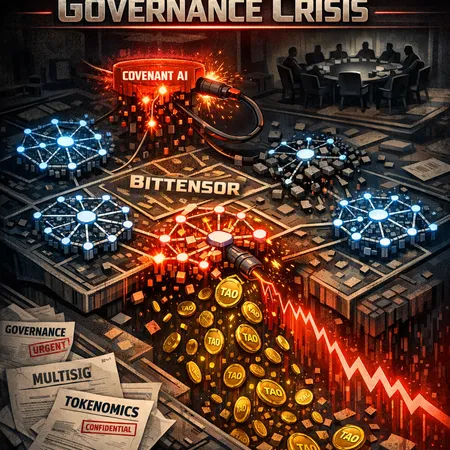
In early April 2026 a prominent subnet builder known as Covenant AI publicly exited a core role in the Bittensor network, precipitating a sharp price drop in the native token TAO and a messy governance debate. The episode exposed a recurring paradox: projects that advertise decentralization can still depend on a handful of powerful actors whose actions have outsized market consequences. For many crypto investors and governance researchers this is a useful case study in decentralization theater — the performative appearance of distributed control that collapses under stress.
For context, Bittensor positions itself as an incentive layer for machine-learning models running across subnetworks, with tokenized economic levers for contribution and coordination. When a builder operating a large subnet exits, the immediate technical, economic, and signaling effects cascade into governance decisions and markets. Even trading platforms and services such as Bitlet.app that list projects must now account for these compounded risks when assessing listings or user education.
Timeline: how events unfolded
The exit announcement and immediate market reaction
On April 9–10, Covenant AI announced it would withdraw its operator resources and effectively stop running a major subnet. Media accounts and market reports documented rapid negative sentiment. CryptoSlate captured the blunt market reaction and the mass perception of a market-cap “wipeout” as liquidity rushed out. Within hours the TAO market showed a sharp intraday decline.
The public dispute and governance flare-up
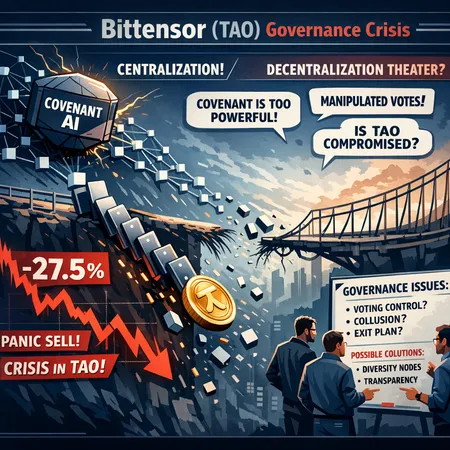
The exit was not framed as a simple business decision. What followed was a public dispute between the subnet operator community and parts of Bittensor’s core team, with accusations about centralization and whether certain actors were undermining the network’s decentralizing narrative. Decrypt reported on the dispute and documented how political theater amplified market uncertainty. Cointelegraph labeled some of the exchanges as "decentralization theater," arguing that the spectacle could mask deeper structural risks and even larger downside.
Evolving coverage and analysis
Coverage over the next 48–72 hours tracked price moves and parsed the governance logs and token flows. Invezz summarized the selling pressure and how on-chain governance processes struggled to respond quickly; the token’s price continued to oscillate as participants debated remedies and transparency measures.
Mechanics behind the 20–45% collapse
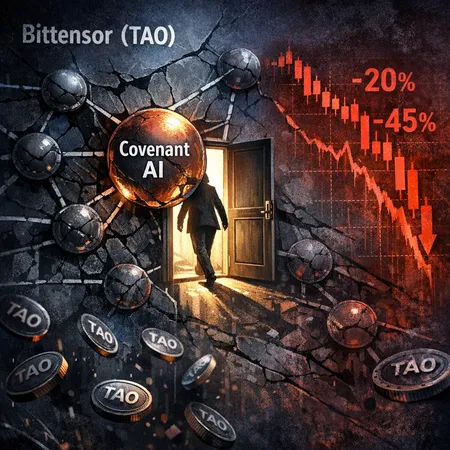
Understanding why TAO dropped between roughly 20% and as much as 45% (the wider figure used by some analysts) requires unpacking several interacting mechanics.
Concentrated operational control. When a large subnet operator withdraws compute and validator weight, the network’s perceived utility and security fall immediately. That alone is a negative signal for token holders.
Token holdings and vesting. Builders and early contributors often hold large allocations of protocol tokens. An exit can coincide with accelerated selling — either voluntary or via automated liquidation from vesting cliffs or treasury policies — generating direct market pressure.
On-chain governance lag. DAO proposals and countermeasures take time to draft, signal, and implement. While governance debates unfolded, short-term traders capitalized on news-driven selling.
Liquidity and market microstructure. TAO’s order books and market depth were insufficient to absorb large sell orders without significant slippage. Media-amplified uncertainty increased order imbalance.
Put together, these forces turned one actor’s operational decision into a market event. Coverage varied: CryptoSlate reported a ~27% plunge after the top builder’s exit, while Cointelegraph warned of downside scenarios up to ~45% if confidence and liquidity continued to deteriorate. Invezz documented how the subnet exit translated into governance and price stress in the immediate aftermath.
Key actors and the public dispute
Covenant AI and the subnet operators
Covenant AI acted as a high-profile builder whose subnet contributed meaningful model throughput and staking weight. Their public withdrawal signaled both an operational gap and a political stance: exit rather than negotiate under perceived unfair or opaque conditions.
Core contributors, token holders, and the community
Other large token holders — including early contributors, long-term validators, and foundations — played reactive roles, proposing governance responses, requesting clearer treasury rules, or, in some cases, selling into the weakness. The dispute became a proxy for broader governance anxieties: who actually controls an AI/blockchain hybrid where off-chain compute is essential?
Media and market actors
Journalists and on-chain analytics firms framed the event as a governance crisis rather than a purely technical outage. The label decentralization theater gained traction as the conversation shifted from why the builder left to why their exit could have been prevented or mitigated by better governance design.
Why governance failed — root causes
The Bittensor episode reveals several recurring governance failure modes that are especially acute in AI/blockchain hybrids.
Over-reliance on a small set of infrastructure providers. Decentralized token distribution does not negate the risk of centralized compute or developer concentration.
Misaligned economic levers. If token emissions, vesting schedules, or reward formulas create cliff events or outsized seller incentives, governance cannot stabilize price fast enough.
Slow or ambiguous emergency governance. DAOs often lack pre-agreed, rapid-response mechanisms for operational exits or disputes that have immediate market impact.
Poor communication and credibility. When exitors frame their move as principled (or vice versa), the reputational damage compounds. Transparency gaps make markets price worst-case outcomes.
Lessons for DAO governance design and investor due diligence
Below is a practical checklist distilled from the TAO post‑mortem for protocol designers and investors.
For protocol designers (governance checklist)
- Distributed operations mapping: Maintain an auditable map showing which actors run critical subnets, how much stake they control, and what redundancy plans exist.
- Exit & continuity policies: Predefine handover procedures, minimum notice periods, and incentives to avoid abrupt withdrawals. Consider bonding or slashing designs tied to operator commitments.
- Treasury and vesting smoothing: Avoid cliff-driven vesting; use linear or adaptive release mechanisms that limit cliff-induced sell pressure.
- Emergency governance primitives: Design time-locked but fast-executing mechanisms for temporary measures (e.g., pausing certain rewards) that still respect decentralization norms.
- Transparency and dispute-resolution channels: Codify escalation paths and impartial arbitration or mediation for operator disagreements.
For investors (due diligence checklist)
- Assess operational centralization: Check who runs subnets or validators and whether they could withdraw critical services. A project can be token-decentralized but operationally centralized.
- Examine vesting and treasury schedules: Identify cliff dates, large concentrated allocations, and potential on-chain unstaking events that could coincide with market bear conditions.
- Gauge governance agility: Read past proposals and emergency responses. How quickly has the DAO acted historically? Is there an emergency playbook?
- Monitor on-chain flows and social signals: Early warnings come from unusual token movements and prominent operators’ discourse on public channels. Combine on-chain analytics with community sentiment.
- Price-impact scenario planning: For larger positions, model how limited liquidity could magnify news-driven moves — 20% paper losses can become 40% realized losses in shallow markets.
Market implications and the wider debate
The TAO incident will reverberate differently across stakeholders. For speculators, it served as a reminder that headlines and concentrated actors can spike volatility. For builders and governance researchers, the episode invites deeper thinking about the coupling of off-chain AI infrastructure and on-chain token economics.
The phrase decentralization theater captures a real phenomenon: projects may check many tokens-in-wallets boxes while still depending on concentrated operational resources. As Cointelegraph argued, that theater can produce outsized market risk if left unaddressed. Investors who treat decentralization as a single-dimensional metric risk underestimating systemic fragility. Researchers should incorporate multi-dimensional assessments that include operational topology, tokenomics, and social governance dynamics.
Conclusion: what to watch next
Bittensor’s TAO selloff after Covenant AI’s subnet exit is not just a one-off market story — it’s a rehearsal for future hybrid protocols where compute providers, model maintainers, and token holders interact. Projects that ignore the coupling of off-chain actors and on-chain incentives will continue to be vulnerable to sudden market and governance crises.
Practical next steps: protocols should publish operator maps and emergency plans; investors should widen due diligence to include operational centralization; and the wider ecosystem — including exchanges, custodians, and platforms like Bitlet.app — must update risk disclosures to reflect these hybrid vulnerabilities.
Sources
- Bittensor TAO price outlook as subnet exit causes governance crisis (Invezz)
- Bittensor’s TAO plunges 27% after top AI builder exit (CryptoSlate)
- Bittensor token plunges as builder departs amid decentralization doubts (Decrypt)
- Bittensor’s TAO risks 45% dip amid ‘decentralization theater’ accusation (Cointelegraph)
For broader context on decentralized infrastructure and financial risks, see discussions and posts on Bittensor and how hybrid systems interact with existing DeFi primitives.