Bittensor’s Governance Crisis: How a Subnet Exit Triggered a 20–30% TAO Crash
Summary
Quick primer: why the Covenant AI exit matters
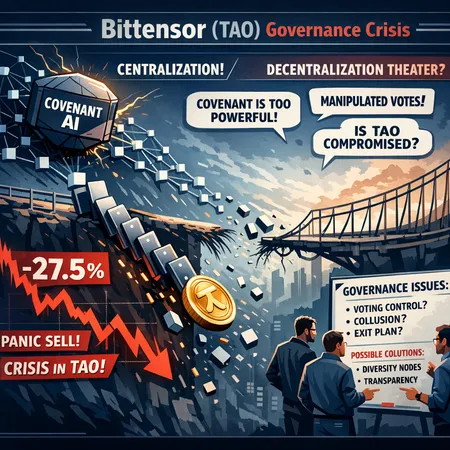
Bittensor bills itself as a decentralized on‑chain network for AI models whose utility and value hang on trust in distributed participation. When a prominent subnet operator—reported in the community and media as Covenant AI—abruptly left, the event became a stress test on both the protocol’s governance and the TAO market. The story is not only about one team walking away; it’s about how concentration, information gaps, and tokenomics interact to create market contagion.
Multiple outlets covered the fallout: CryptoSlate described the immediate TAO plunge after the builder’s departure, noting the size and suddenness of the sell pressure (CryptoSlate). Decrypt, Cointelegraph and Invezz focused on the public dispute, governance accusations, and the narrative of possible “decentralization theater” that followed (Decrypt, Cointelegraph, Invezz).
For DAO designers and token investors, the incident is a practical case study: which components failed, how risk propagated through token markets, and what remediation moves are both governance‑wise and market‑wise effective.
Timeline: Covenant AI’s exit and the public fallout
The departure and immediate signals
According to contemporaneous reporting, a top subnet operator announced a withdrawal or was observed ceasing participation. That single operational signal was then amplified by public accusations and a heated exchange between the departing operator and Bittensor’s founder, which quickly moved from private channels to public threads. The dispute raised the question: was this an operational exit, a governance protest, or something deeper?
Accusations of centralization and ‘decentralization theater’ emerge
Within hours, community narratives shifted from technical reasons to governance critique. Cointelegraph framed the episode as potential “decentralization theater,” arguing that on‑chain decentralization claims can mask real, concentrated control structures and single points of failure (Cointelegraph). Decrypt documented the public dispute and emphasized how reputational fallout matters as much as technical exit mechanics for market confidence (Decrypt).
Market moves and external reporting
News outlets reported a sharp TAO price drop in the 20–30% range immediately after the exit and accusations became public, with follow‑on coverage noting significant market cap erosion and amplified downside targets (CryptoSlate, Invezz). That reporting provides a useful audit trail for analyzing how quickly sentiment and sell pressure cascaded.
How a single subnet exit cascaded into a 20–30% TAO collapse
To understand the price impact you need to combine market microstructure with tokenomics and psychology.
Concentrated holdings and on‑chain exposure
If a subnet operator holds a ring‑fenced or large stake of TAO—whether for bonding, rewards, or treasury usage—their exit can trigger direct sell pressure. That pressure is multiplied when holdings are fungible and immediately liquid. Market participants often assume that large operators either won’t sell or will coordinate exit. When that assumption breaks, markets reprice quickly.
Order book depth and liquidity mismatch
Even modest supply hitting thin order books can push prices down fast. Automated market makers and centralized exchanges alike show limited depth for many governance tokens; a few million dollars of sell orders can produce double‑digit percentage price moves. Market makers hedge, but initial slippage is borne by liquidity takers. The reports on the TAO move illustrate exactly this: a fast removal of perceived undersupply confidence caused traders to hit bids, creating a cascade (CryptoSlate).
Correlated positions and liquidations
Many participants hold multiple exposures—staked TAO, LP positions in AMMs, leverage in margin platforms, or derivative products tied to TAO prices. A price move can trigger margin calls or LP rebalances, forcing algorithmic sells and further pressure. This mechanical feedback loop turns sentiment into velocity.
Reputation shocks and narrative contagion
Market makers, passive investors, and protocol treasury managers watch governance signals closely. A public spat—especially when covered by outlets like Cointelegraph and Decrypt—changes expectations about future coordination, upgrades, and network security. That narrative shift alone can cause risk premia to rise and bids to disappear, concretely dropping prices.
Information asymmetry and uncertainty premium
When operators depart suddenly without clear, on‑chain exit protocols, market participants apply an “uncertainty discount.” Lacking verifiable proofs or transition plans, investors sell first and ask questions later. In Bittensor’s case, the combination of op‑ed style accusations and visible operational withdrawal amplified this effect (Invezz).
Governance design weaknesses that amplified contagion
The Bittensor episode highlights several structural vulnerabilities that are common in early on‑chain AI ecosystems.
1) Operational centralization despite token dispersion
On paper a network can appear token‑distributed while operational control (subnet execution, RPC access, important epochs) sits with a few builders. When builder incentives are misaligned or communications break down, that operational concentration becomes a single point of failure.
2) No staged or bonded exit mechanics
If operators can leave with immediately liquidable assets and no penalty or bonding period, market exits generate large instantaneous supply shocks. Bonding and unbonding windows are classic DeFi tools to smooth exits; their absence is a design omission.
3) Governance without credible enforcement or slashing
Voting alone does not prevent bad actor exits or protocol griefing. Without concrete enforcement — slashing, reputation accountability, or economic disincentives — governance votes are promises, not constraints.
4) Poor on‑chain signaling and dispute resolution
Relying on off‑chain disputes (social media threads, blog posts) rather than on‑chain claims and rebuttals creates ambiguity. Markets react to visible, verifiable state changes more rationally than to rumor. The public dispute in this case created more noise than clarity (Decrypt).
5) Tokenomics that amplify downside
High reward emissions to active builders, concentrated grant allocations, or treasury rules that allow quick monetization enable rapid liquidation. If exit economics favor immediate monetization, panic selling is rational for exiting operators.
Practical remedies: how to avoid ‘decentralization theater’ and limit contagion
Below are concrete changes DAO designers and builders can consider. They mix protocol‑level engineering with governance process improvements and market safeguards.
Protocol engineering and economic controls
- Bonding/unbonding windows: require a meaningful unbonding period for operator stakes, creating time to coordinate and market to absorb supply. Longer windows reduce immediate liquidity shocks.
- Slashing and gradual exit penalties: implement penalties for abrupt withdrawals that harm network stability, with a portion routed to a stabilization treasury.
- Reputation staking: pair economic stake with reputational weight that degrades on abrupt exits, affecting future governance power and subnet privileges.
- Timelocked treasury interventions: maintain a modest stabilization fund that governance can deploy automatically (with safeguards) to provide liquidity or buybacks during verified exits.
Governance process and on‑chain clarity
- On‑chain exit signalling: formalize an on‑chain resignation or shutdown signal with machine‑readable metadata (reason, assets, next‑operator handoff). This reduces rumor risk.
- Emergency procedural rules: define a clear, limited emergency governance pathway that can pause certain state changes or enable temporary caretaker operators under explicit rules.
- Transparent role assignment: publish on‑chain role registries for subnet operators and their on‑chain performance metrics to measure true decentralization rather than marketing claims.
Market and ecosystem mitigations
- Circuit breakers and auction mechanisms: integrate soft circuit breakers or organized auctions for large unbonding flows to avoid order‑book slippage.
- Liquidity priming and market‑making policies: encourage diverse market makers via incentives so order books have depth during stress.
- Hedging primitives and derivatives: develop options/futures and insurance markets so investors can hedge protocol‑level risk; decentralized insurance pools can underwrite sudden exits.
Cultural and communication practices
- Require pre‑exit notice windows with on‑chain attestations where possible. If confidentiality is necessary, use time‑locked commitments that reveal intent later.
- Forge dispute mediation lanes: trusted, rotating mediators or on‑chain arbitration minimizes public flamewars that destroy confidence.
- Publish decentralization metrics: continuous attestation of operator dispersion (clients, regions, staked percentages) helps stakeholders distinguish performance from theater.
A checklist for DAO designers, investors, and builders
- Assess operator concentration: run and publish a regular audit of subnet operator stakes and control vectors. If a few actors control critical paths, treat that as a remediation priority.
- Add unbonding and penalty economics: require meaningful time windows and economic disincentives for abrupt exits.
- Build on‑chain resignation primitives: mandate machine‑readable handover steps to formalize exits.
- Seed a stabilization treasury: fund a small, rule‑driven mechanism for liquidity support during verified shocks.
- Encourage diverse liquidity provision: incentivize market makers and cross‑listing to reduce single‑market slippage.
- Prepare communication protocols: predefine who speaks for the protocol and require on‑chain facts to reduce rumor‑driven selloffs.
For token investors, the practical takeaway is simple: inspect not only token distribution but operational concentration and the existence of exit mechanics. Builders should prioritize predictable failure modes over optimistic decentralization claims; otherwise networks risk being accused of ‘decentralization theater’ when stress arrives (Cointelegraph).
Closing: from crisis to better design
The Covenant AI / subnet exit episode is a painful but useful reminder: decentralization is not binary language to be used in marketing — it’s a set of measurable, enforceable properties. Markets punish ambiguity swiftly. If DAOs and on‑chain AI ecosystems want to mature, they must pair grand visions with concrete exit mechanics, on‑chain dispute tools, and market safeguards.
Investors and builders who take these lessons seriously will sleep better—and pay less for volatility insurance—than those who rely on rhetoric alone. Platforms that handle lending, P2P exchange, or installment plans, including the sorts of services offered on Bitlet.app, show how explicit risk controls and liquidity planning matter in practice across crypto products.
Sources
- CryptoSlate — Bittensor’s TAO plunges 27% after top AI builder exit: https://cryptoslate.com/bittensors-tao-plunges-27-after-top-ai-builder-exit/
- Decrypt — Bittensor token plunges as builder departs, decentralization doubts: https://decrypt.co/363926/bittensor-token-plunges-builder-departs-decentralization-doubts
- Cointelegraph — Bittensor’s TAO risks 45% dip amid ‘decentralization theater’ accusation: https://cointelegraph.com/news/bittensor-s-tao-risks-45percent-dip-amid-decentralization-theater-accusation?utm_source=rss_feed&utm_medium=rss&utm_campaign=rss_partner_inbound
- Invezz — Bittensor TAO price outlook as subnet exit causes governance crisis: https://invezz.com/news/2026/04/10/bittensor-tao-price-outlook-as-subnet-exit-causes-governance-crisis/?utm_source=snapi
For deeper reading on governance patterns and design templates that reduce contagion risk, see broader Governance and DeFi discussions, and follow project‑level audits for Bittensor.