Bittensor’s Governance Crisis: What the TAO Sell‑Off Reveals About Tokenized AI Networks
Summary
Executive summary: why Covenant AI mattered
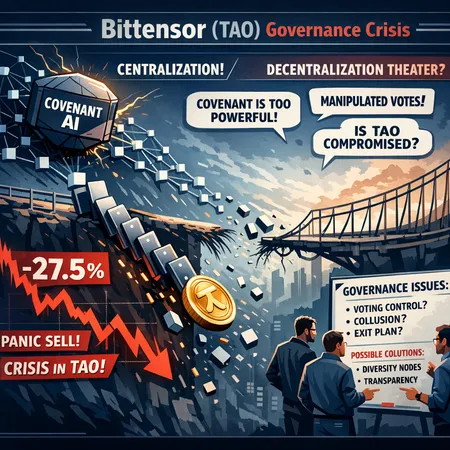
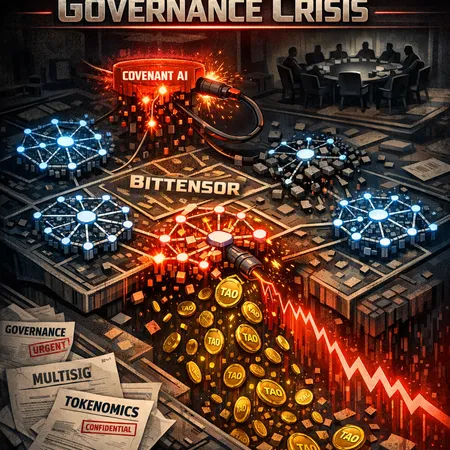
The sudden exit of Covenant AI — a top Bittensor subnet operator — detonated a governance crisis that translated directly into a deep TAO sell‑off. What began as a technical or personnel split quickly became a reputational spiral: accusations of centralization, public disputes, and a liquidity cascade that erased price and trust in short order. This is not just a Bittensor story. It’s a case study for any tokenized AI network trying to combine decentralized governance with real‑world operator economies.
In the paragraphs that follow I reconstruct the timeline, trace the price and liquidity impact, diagnose governance and tokenomic shortcomings, and offer actionable best practices. For traders and DAO designers alike, the core lesson is simple: decentralization on paper won’t protect token value if economic power and control remain concentrated in practice.
Timeline: Covenant AI exit and public accusations
The public unraveling moved fast. According to contemporaneous reporting, Covenant AI — widely reported as a major builder/operator on Bittensor’s network — announced a subnet exit that precipitated a wave of withdrawals and negative press. CryptoSlate and Decrypt documented the immediate fallout: a builder departure followed by sharp community criticism and social‑media flamewars accusing the project of “decentralization theater” rather than genuine dispersion of power (CryptoSlate report, Decrypt coverage).
Within hours and days the narrative morphed from a technical split to a governance crisis. Invezz and Cointelegraph highlighted how public accusations — that a handful of operators or multisigs effectively controlled key subnets — turned investor fear into a cascade of sell orders and market liquidity problems (Invezz analysis, Cointelegraph piece).
The discourse: decentralization theater vs. centralization reality
The phrase decentralization theater — leveled in community threads and quoted in reporting — captures a critical shift: stakeholders no longer asked whether code allowed decentralization. They asked whether economic and social power was concentrated in a few operator hands. That shift matters because token markets price governance risk as much as protocol utility.
Price impact and liquidity wash‑outs
The market reaction was swift: TAO plunged double digits on headline news and sentiment contagion. CryptoSlate reported a roughly 27% drop in TAO price shortly after the departure became public, with some analytics suggesting larger drawdowns in thinly traded order books. Reporting and on‑chain observers noted that even modest sell pressure in shallow markets created outsized price movement, wiping out liquidity and setting off stop orders and liquidation loops (CryptoSlate).
Liquidity wash‑outs follow a predictable pattern: concentrated holders or operators who suddenly exit can dump large positions; market makers, fearing adverse selection, pull depth; and retail sellers — spooked by headlines about governance failures — exit en masse. The result is a feedback loop where price declines force more selling, and on‑chain staking flows and unlock schedules can amplify the mechanical sell pressure. Cointelegraph and Invezz both warned of deeper downside risk — up to 45% in some scenarios — if governance confidence continued to erode (Cointelegraph analysis).
Where governance design failed
Several design and operational failures made the fallout worse. These are not unique to Bittensor but are common failure modes in tokenized AI networks.
- Operator concentration: A few high‑performing subnet operators held outsized influence over network value and telemetry. When one of them exited, the market perceived a loss of core capability and confidence.
- Opaque multisigs and off‑chain control: Key control levers (deployments, reward streams, admin keys) were effectively controlled off‑chain or by small multisigs without transparent accountability.
- Misaligned token incentives: Token emission schedules and economic incentives rewarded short‑term operator liquidity over long‑term commitment, enabling large dumps after an exit decision.
- Weak dispute and exit mechanisms: No robust on‑chain dispute resolution or bonding mechanism penalized malicious or reckless exits, creating a ‘get out quick’ option for operators with large treasury or token holdings.
Decrypt’s reporting highlighted how public fallout and operator disputes inside Bittensor resembled a classic DAO governance crisis: the rules existed, but enforcement and real‑world incentives didn’t align with the protocol’s ideal of decentralization (Decrypt report).
Best practices for resilient governance in tokenized AI networks
Designing governance that survives social and market stress requires both technical constructs and economic commonsense. Below are patterns that can reduce single‑point failure risk:
1) Diversify operator economics
Force economic diversification: cap rewards per operator, require minimum on‑chain bonded stake, and design diminishing returns for concentration. This reduces the marginal benefit of consolidating control in a single subnet or team.
2) Transparent multisigs and layered control
Openly documented multisigs and timelocked admin actions reduce the appearance of shadow control. Layered governance — where emergency keys exist but require cross‑stakeholder signoff and on‑chain reporting — balances operational agility with accountability.
3) On‑chain dispute and slashing mechanisms
Clear on‑chain bonds and slashing for misbehavior or abrupt abandonments create economic disincentives for opportunistic exits. A dispute oracle or arbitration layer can help resolve claims before they metastasize into public flamewars.
4) Tokenomics that favor commitment
Emission schedules should reward long‑term participation (vesting, performance locks, delayed unstake windows) rather than creating easy liquidity events. Use of lockup multipliers or rewards proportional to stake age aligns incentives.
5) Clear upgrade and exit protocols
Make operator exit paths orderly: announce windows, have cooling periods for unstaking, and require on‑chain migration plans for large subnets. Transparency reduces rumor‑driven panic.
These practices are consistent with lessons from mature DeFi projects and can be adapted for AI networks where compute and model performance create additional non‑fungible value dependencies. Also remember that market participants watch narratives: projects that demonstrate procedural fairness and transparency earn higher optionality in crisis.
Actionable red flags investors should monitor
For traders, LPs, and DAO stewards evaluating AI‑native token projects, here are red flags that often precede governance‑driven drawdowns:
- Operator concentration metrics: percent of rewards or weight controlled by top N operators. High concentration is a single‑point risk.
- Silent or opaque multisigs: keys that are not publicly disclosed, or multisigs controlled by unknown entities.
- Large token unlocks and short vesting: upcoming cliffs that enable major dumps.
- Rapid token inflation vs. utility: emissions outpacing meaningful network demand may incentivize sell pressure.
- Public infighting or unresolved disputes: social media controversies often foreshadow market moves.
- Lack of dispute resolution: no on‑chain mechanisms to arbitrate operator behavior.
If you see several of these simultaneously, treat the project as higher governance risk. For portfolio managers, position sizing and liquid exit plans are essential; for builders, early transparency and enforced stake requirements can avert crises.
Why the narrative matters as much as the code
The Covenant AI saga shows that token value is social as much as technical. Accusations of decentralization theater cut to the core: users and investors price not just the protocol’s architecture, but its perceived legitimacy. News coverage — from CryptoSlate to Cointelegraph and Invezz — amplified the signal and accelerated selling. In markets where liquidity is thin, perception can become reality rapidly.
This is where platforms like Bitlet.app and other custodial or marketplace providers play a role: better tooling, clearer staking frameworks, and investor education can reduce the knee‑jerk effects that turn governance disputes into market crises.
Conclusion: pragmatic decentralization for AI token projects
Bittensor’s TAO sell‑off after Covenant AI’s exit is a warning and a guide. It shows that tokenized AI networks must pair distributed protocol design with enforceable economic and governance primitives. Decentralization that exists only in whitepapers can quickly be exposed during high‑stakes exits.
For DAO designers: build for transparency, diversify economic power, and bake in dispute and exit mechanisms that prevent unilateral damage. For investors: monitor concentration, unlocks, and social signals, and price governance risk into every allocation. The future of tokenized AI depends on credible, resilient governance — not just noble ideals.
Sources
- https://invezz.com/news/2026/04/10/bittensor-tao-price-outlook-as-subnet-exit-causes-governance-crisis/?utm_source=snapi
- https://cryptoslate.com/bittensors-tao-plunges-27-after-top-ai-builder-exit/
- https://cointelegraph.com/news/bittensor-s-tao-risks-45percent-dip-amid-decentralization-theater-accusation?utm_source=rss_feed&utm_medium=rss&utm_campaign=rss_partner_inbound
- https://decrypt.co/363926/bittensor-token-plunges-builder-departs-decentralization-doubts
For broader context on market‑level governance risk, see reporting on major crypto market movements and narratives — for many traders, Bitcoin still acts as a reference point when assessing contagion across niche tokens.