Privacy‑Coin Rally: Shielded Pools, Geopolitics, and the Risk of Derivatives Froth
Summary
The April breakout: what actually happened
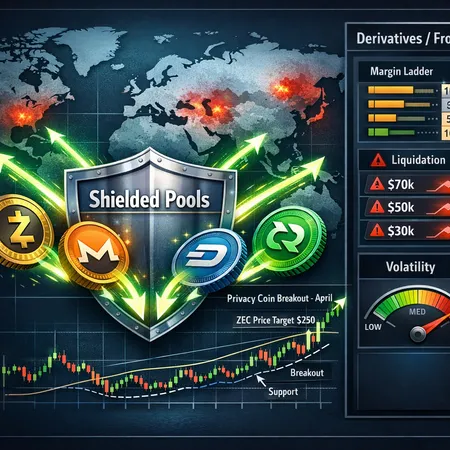
In early April a short, concentrated rally lifted several established privacy coins—DASH, XMR, ZEC, and DCR—well above their recent ranges. Traders noticed the move not just because prices spiked, but because the push came with clear narrative drivers: renewed geopolitical tension and a wave of capital flowing into privacy-preserving mechanisms, especially shielded pools on protocols like Zcash.
Coinpedia identifies an April 4 trigger that catalyzed the wider privacy-coin breakout, with attention rotating across the four pairs listed above. The market reaction was fast: momentum chasers piled in, spot volume rose, and derivatives desks reported surging open interest in ZEC and XMR futures.
For many market participants, Bitcoin still sets the macro rhythm, but this episode shows how focus can shift quickly to niche narratives when risk dynamics change. Bitlet.app users tracking these flows noticed a disproportionate share of activity concentrated in shielded transactions rather than typical exchange deposits, which matters for on‑chain interpretation.
Geopolitical demand: why privacy coins again?
The simplest explanation markets offered was geopolitical: heightened sanctions, regional conflicts, or policy uncertainty can prompt counterparties to seek stronger transaction privacy. That demand is not new, but intensity and timing can vary. In April, several headlines and rumors pushed counterparties toward assets that offer optional anonymity or privacy-focused tooling.
This kind of demand manifests differently than ordinary retail speculation. Instead of just buying spot on exchanges, actors seeking privacy often route capital through non‑custodial shielded pools or use on‑chain privacy features, which reduces the amount of traceable liquidity appearing on exchanges and creates a tighter available float.
The takeaway: geopolitical demand can be both sizeably real and episodic. If the geopolitical pressure endures or broadens, the rotation could be more sustainable. If it’s transitory headline-driven fear, the rally can be reversible once headlines cool.
On‑chain flow: shielded pools and what they mean
On‑chain observers flagged that a notable share of ZEC inflows went into shielded pools rather than clear, transparent addresses. Analysts argued that increasing deposits into shielded pools are a form of latent demand: coins moved into privacy layers are less likely to return quickly to public markets, which effectively reduces circulating supply.
FxEmpire ties rising ZEC price targets directly to flows into shielded pools, suggesting that higher shielded‑pool adoption supports a higher valuation thesis. You can read more about that view in their analysis, which links pooled flows to price forecasts.
However, two important caveats when interpreting shielded‑pool activity:
- Not all shielded activity equals durable demand. Some flows are short‑term operational (mixing, compliance testing, exchange integrations) and may re-enter public markets rapidly.
- On‑chain metrics for shielded pools can lag or be opaque by design. While the inflow is a signal, its persistence and the identity of participants matter for market impact.
So, shielded pools increase uncertainty about available supply. That ambiguity can be bullish while it persists, but it also raises the risk of a sharp liquidity vacuum reversal if large holders rematerialize.
Technical setups and near‑term price targets
Across the board, privacy coins showed strong momentum: higher highs, expanding volume, and oversold indicators flipping to overbought. That combination attracts momentum traders and derivatives desks. Below I summarize each token’s technical posture and near‑term view—starting with ZEC.
ZEC: the poster child for the rally
ZEC led headlines. After the parabolic run, several outlets and trading desks suggested ambitious targets:
- A bullish forecast argued ZEC could eye $500 if inflows to shielded pools remain strong and macro liquidity stays supportive (fxempire).
- Another read put a more modest target around $420, a level referenced by traders citing the momentum that drove ZEC’s 62% weekly spike (Decrypt).
- Conversely, coverage warning about parabolic risk suggested a realistic pullback zone around $400 if leverage unwinds quickly (Crypto.News).
Technically, a sensible framework is: if ZEC clears and holds above the recent breakout cluster, the $420–$500 zone becomes a plausible target range. Key supports to watch: prior resistance now flipped to support (recent breakout low), the 21–50 EMA confluence, and psychological round numbers. Momentum indicators (RSI, MACD) are stretched—shorter timeframes show divergence—so any push toward the upper target should be monitored for weakening momentum and rising funding rates.
XMR, DASH, DCR: the rest of the pack
- XMR (Monero) benefits from being the protocol-level standard for privacy; its on‑chain privacy is native rather than optional. Technically, XMR’s move looked cleaner—less parabolic than ZEC—so it can either lead on a sustainable leg higher or act as the liquidity source if risk‑off hits.
- DASH’s rally was amplified by narrative traders and liquidity squeezes. Support bands are now the primary risk points; a breach could flush leveraged longs.
- DCR (Decred) is smaller market cap but showed outsized percentage gains. That makes it the most volatile of the group and the likeliest to see quick mean reversion.
In all cases, watch volume confirmation, whether breakouts are accompanied by rising active addresses, and the ratio of shielded/anonymous flows to exchange inflows.
Derivatives froth: why leverage can turn a rally into a crash
One of the most important risk vectors in this rally is the derivatives market. Parabolic price action tends to bring large futures open interest, crowded long funding, and options skews that make the top fragile. Crypto.News documents the elevated leverage and the risk that a short squeeze can become a snap reversal when funding flips or large holders take profits.
Mechanics to monitor:
- Funding rates: persistently positive funding indicates longs are paying to stay in; a sudden collapse or a flip negative can trigger rapid deleveraging.
- Open interest (OI) concentrations: if OI is concentrated on a few centralized venues, exchange-level liquidations become more likely and more severe.
- Options positioning: heavy call buying near parabolic highs can lead to gamma risk and violent intraday swings as market makers hedge.
Practically, high funding + stretched momentum + large retail long exposure = higher probability of a 10–30% fast pullback. That’s not inevitable, but it is common in parabolic crypto episodes.
For investors and risk teams: durable rotation or temporary haven?
This rally presents a classic risk/reward trade for institutional and sophisticated retail allocators. Below is a pragmatic checklist and playbook.
Signals that argue for a durable rotation:
- Continued and persistent inflows into shielded pools, with long dwell times (coins staying shielded for weeks/months).
- Broader adoption signals: OTC desks, custody integrations, or corporate treasury interest that go beyond headline-driven retail moves.
- Macro tailwinds (sanctions, capital controls) that amplify privacy demand over a sustained period.
Signals that argue for a temporary haven trade:
- Spike‑and‑fade patterns in on‑chain shielded inflows—sudden bursts followed by a return to exchanges.
- Rapidly rising funding rates and concentrated futures OI (derivatives froth), suggesting speculative leverage is the main driver.
- News-driven headline spikes that dissipate without structural changes to demand.
Risk management checklist:
- Position sizing: keep exposure to privacy coins as a small, explicitly labeled portfolio sleeve unless you have operational insights into counterparty flows.
- Hedging: use inverse futures or options to cap downside if you carry significant exposure. Avoid unhedged levered longs into stretched momentum.
- Liquidity planning: assume higher bid/ask spreads in stressed conditions; set execution limits accordingly.
- Compliance and counterparty risk: privacy coin exposure has non‑price risks—legal, compliance, and custody limitations that should be tested.
If you’re on a discretionary desk: an approach that blends selective exposure (smaller size, staggered entries) with explicit hedges can capture upside while protecting against derivatives-driven blowups.
Conclusion: balanced vigilance
The April privacy‑coin rally combines real on‑chain signals—especially rising shielded‑pool activity—with narrative and momentum factors amplified by derivatives desks. That mix creates both opportunity and outsized risk. ZEC is a focal point: price targets ranging from roughly $400 to $500 reflect both bullish demand scenarios and the obvious vulnerability to leverage unwinds.
For investors and risk teams, the prudent stance is to treat the move as a high‑conviction, high‑volatility allocation: monitor shielded pool persistence, derivatives metrics, and macro headlines closely; size and hedge positions; and be ready to act if liquidity conditions change. Whether this becomes a durable rotation into privacy assets or a temporary haven trade will depend on the persistence of geopolitical pressure and whether on‑chain privacy adoption stays elevated beyond the headline window.
Sources
- Can privacy coins sustain their breakout rally? — Coinpedia
- Zcash eyes rally to $500 as inflows to shielded pools rise — FxEmpire
- Zcash price cools after parabolic run — Crypto.News
- Zcash could rise to $420 after 62% weekly spike — Decrypt
(If you use on‑chain dashboards or tools, cross‑check shielded‑pool metrics and derivatives open interest before committing capital. Platforms like Bitlet.app can help monitor execution and risk.)