Why Circle Minting $10.5B USDC on Solana Rewrote the Playbook for Stablecoin Rails
Summary
What happened — and why it matters
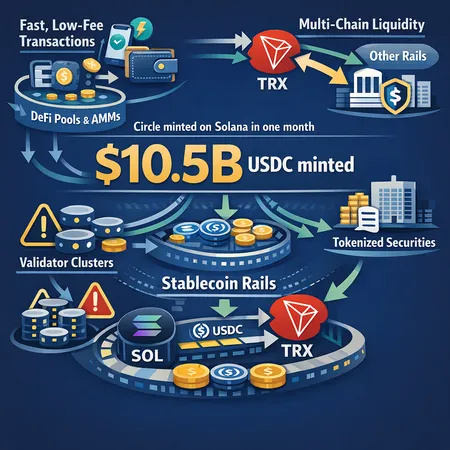
In a single month Circle minted roughly $10.5 billion USDC on Solana. That isn’t a small operational tweak; it’s a clear signal that dollar liquidity is moving onto high‑throughput chains and that issuers and institutions are actively choosing rails for speed and cost. For DeFi strategists and treasury teams weighing where to park or route dollars, the event accelerates a fundamental question: which chains will become primary dollar rails, and what tradeoffs come with each choice?
This shift matters because stablecoins aren’t just trading pairs or settlement mechanisms — they are the plumbing for tokenized dollar flows, lending markets, and tokenized securities. For many treasuries the choice of rail affects counterparty exposure, operational resilience, and the economics of on‑chain settlement. For market participants, including teams using Bitlet.app for installment or P2P flows, those tradeoffs are now front and center.
Technical and UX advantages that make Solana attractive
Solana’s appeal as a dollar rail is rooted in three practical advantages: throughput and finality, ultra‑low fees, and a developer UX designed for high‑concurrency applications. The chain’s parallelized runtime and sub‑second block times reduce latency for high‑frequency settlement and automated market maker (AMM) loops, which matters when you’re moving billions in on‑chain dollars.
Low transaction costs are not just a convenience; they change product design. Cheap microtransactions enable new rails of tokenized business logic — think streaming payments, granular treasury sweeps, or high‑frequency arbitrage between AMMs — without those flows being priced out by gas. From a treasury perspective, this makes Solana attractive for maintaining operational dollar balances on‑chain, running relayers, or automating payouts where on‑chain cost matters.
Developer ergonomics and UX
Beyond raw speed and fees, Solana’s tooling ecosystem is optimized for performance‑oriented apps: Rust SDKs, Serum‑style orderbooks, and composable L2‑like patterns. This makes it faster to build and iterate high‑throughput dollar rails and reduces integration friction for custodians and token issuers. For teams prioritizing frictionless UX — lower failed tx rates, predictable confirmation timing — Solana often outcompetes older EVM chains.
Implications for DeFi liquidity and tokenized dollar flows
When large amounts of USDC land on Solana, liquidity morphs. AMMs on‑chain gain depth in USDC pairs, margin markets and lending pools see more collateral bandwidth, and market‑making strategies that depend on low latency become more viable. For treasury teams, Solana‑based liquidity can lower slippage costs for large rebalances and reduce execution risk during congested periods on other chains.
But there’s another layer: tokenized dollar flows — everything from on‑chain payroll to tokenized securities settlements — benefit when rails offer predictable finality and low fees. Securitized assets or tokenized securities mapped onto chains with deep dollar liquidity reduce settlement friction and counterparty mismatch. The practical upshot: DeFi teams should think of USDC on Solana not just as a trading asset but as working capital that powers native‑chain product primitives.
Competition among rails: Solana vs TRON and others
This is a multi‑rail competition. Circle’s large minting on Solana is a counterweight to other rails that have historically captured dollar flows — notably TRON, which has been a major hub for USDT and other dollar instruments. Strategic moves like Securitize expanding to TRON to enable tokenized securities on that chain show that institutions and issuers will follow where the ecosystem incentives and partnerships align. See reporting on Securitize’s TRON expansion for context.
The market is increasingly multi‑chain in practice: issuers, custodians, and marketplace providers will support several rails to access different liquidity pools and client bases. For example, TRON’s low‑cost environment (ticker: TRX for the native token) and its existing stablecoin liquidity make it a credible alternative for certain tokenized securities flows, even as Solana (ticker: SOL) gains traction for high‑throughput DeFi applications.
Centralization and congestion risks — the tradeoffs
The surge of USDC on Solana exposes two critical risk vectors: centralized issuance/control and network congestion. When a centralized issuer mints large sums on one chain, the chain becomes a focal point for operational risk: any governance decision, custodian issue, or regulatory action affecting that issuer can have outsized on‑chain implications. That’s not a theoretical worry — it’s a real counterparty concentration risk treasuries must manage.
Operationally, massive inflows can also stress node infrastructure and RPC providers. Solana has historically experienced episodes of congestion and outages tied to high transaction volumes or poorly tuned programs. If dollar traffic is responsible for a material share of transaction volume, a spike in usage — whether legitimate or exploitative — can lead to queuing, delayed confirmations, or even harder incidents. Those outcomes are acute for treasuries that need predictable settlement windows.
What this trend means for cross‑chain stablecoin architecture
The immediate lesson is not “pick one chain and stay there.” The smarter architecture for treasuries and DeFi firms will be multi‑rail stablecoin strategies combined with robust cross‑chain tooling. That means: diversified custody (and issuer exposure), active liquidity routing across chains, rapid mint/burn and cross‑chain settlement primitives, and failover playbooks for congestion or on‑chain freezes.
Cross‑chain design choices matter: trust assumptions differ between a custodian mints on Solana versus bridging an asset from Ethereum. Bridged liquidity introduces smart‑contract risk and bridge‑custodian vectors, while native mints on a given chain centralize issuer exposure. For many treasuries, a hybrid model is attractive: keep part of operational balances native on cost‑effective rails like Solana for day‑to‑day flows, while retaining reserve overlays on more conservative chains or centralized accounts as a contingency.
Practical checklist for DeFi strategists and treasury teams
- Assess counterparty concentration: Track which issuers and custodians control significant mints on each chain and set exposure limits.
- Measure execution risk: Simulate large rebalances and sweeps on target rails to observe slippage, confirmation times, and RPC reliability.
- Build cross‑chain routing: Implement liquidity routers or partnerships with multi‑chain market‑makers to move dollars dynamically where execution is cheapest and safest.
- Plan for congestion/failovers: Define alternative settlement windows and pre‑funded fallbacks on secondary rails (and test them).
- Consider regulatory and custodial controls: For tokenized securities, prefer rails with mature compliance tooling and custodial integrations; Securitize’s TRON move is an example of how compliance partnerships can shape where tokenized assets live.
How to think about risk vs. reward
Solana brings executional advantages that can materially lower costs for on‑chain dollar activity, but those savings are accompanied by concentration and availability risks. Treasuries that value low latency and low cost should use Solana where business models require it — market‑making, high‑frequency settlement, or micro‑payments — while maintaining reserve hedges across chains and custodial setups.
From a DeFi strategy angle, the optimal path is often asymmetric: allocate a portion of liquidity where it can earn or economize (Solana), while keeping mission‑critical reserves on rails with stronger guarantees or broader regulatory coverage. Multi‑chain liquidity is not just about fragmentation; it’s about building resiliency and optionality.
Conclusion — an active decision, not a passive outcome
Circle’s $10.5B USDC mint on Solana crystallizes a broader trend: dollar liquidity will flow to rails that offer better economics and UX, but not without new operational risks. For DeFi strategists and treasury teams the choice is active — prioritize which rails serve which functions, implement cross‑chain tooling, and codify failovers.
The era of single‑rail dominance is waning; instead, expect a layered stablecoin architecture where Solana, TRON, EVM chains, and bridges each play roles. Strategic diversification, scenario testing, and partnerships with custodians and issuance platforms (as seen in Securitize’s expansion) will decide who benefits when tokenized dollars keep moving.
For teams evaluating rails, a practical next step is to run integrated drills: simulate a $50M on‑chain payout on Solana, TRON, and an EVM chain and measure real‑world performance. Those empirical results will be far more valuable than theoretical white‑papers.
For further reading on the recent minting activity and sector moves, see the reporting on Circle’s USDC mints and on Securitize’s TRON expansion.
Sources
- Circle minted over $10.5B USDC on Solana — crypto.news
- Securitize expands to TRON, unlocking new era for tokenized securities — crypto‑economy
Note: For context on chain design and multi‑rail tooling, see ecosystem posts on Solana and DeFi.