Practical Guide for HYPE Traders After Renewed Whale Accumulation
Summary
Quick context: what happened and why it matters
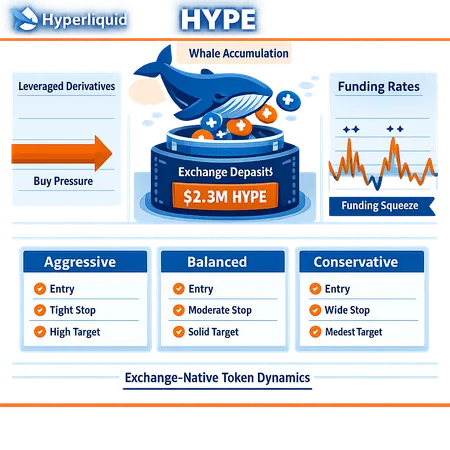
Last week a large wallet deposited funds onto Hyperliquid and bought roughly $2.3M worth of HYPE after moving about $5M onto the exchange, an event captured in reporting on the move. That flow isn't just a headline — on a derivatives-first exchange, concentrated buy pressure can ripple through spot, perpetuals, and funding mechanics in ways that matter to active traders.
For market-structure analysts, this is a classic trade case: a heavy on-exchange deposit + large buy = potential squeeze fuel, liquidity shock, or simply accumulation. News outlets tracking the activity also flagged a renewed spike in whale accumulation, suggesting the move is part of a broader positioning trend rather than an isolated click of the mouse (AmbCrypto report and U.Today coverage).
How concentrated buy pressure on a leveraged exchange changes the mechanics
On a derivatives-native venue like Hyperliquid, heavy buy-side activity can affect multiple layers of the market simultaneously. Think in three buckets: spot, perpetuals (open interest), and funding.
- Spot: a large market buy executed on-exchange lifts the reference price used by the perpetuals market. When liquidity is thin, price moves more for the same size.
- Perpetuals / Open Interest: whales can create or push open interest higher by taking large directional futures positions. Rising OI tends to confirm conviction — but it also amplifies liquidation risk if the move reverses.
- Funding rates: when longs outnumber shorts, funding typically turns positive (longs pay shorts) to equilibrate exposure. Sustained positive funding makes carrying long positions expensive and can attract hedge sellers.
Because Hyperliquid combines exchange-native liquidity with pervasive leverage, a whale can achieve asymmetric effects: lift the spot price with a direct buy and simultaneously stimulate perp-driven squeezes by increasing OI. That combination can liquidate smaller shorts and create a feedback loop that drives price higher — or, if the whale is exiting later, it can leave the market with overstretched long positioning vulnerable to a reversal.
Interpreting whale intent: continuation vs exit
No single metric proves intent. Instead, use a pattern-based read:
- Signs favoring continuation (accumulation): repeated deposits over days, limit/hidden buys layered into the book, accumulation across multiple exchanges, and transfers from exchange to cold storage only after a long accumulation window. If open interest rises in step with spot buys, and funding remains manageable, it suggests conviction.
- Signs favoring exit (selling into liquidity later): single large deposit then market buys, followed by no further deposits and persistent high funding (making it expensive to hold), or a lack of withdrawals after the buy (the asset remains on-exchange, which enables easier exit). Rapid post-buy deposits returning to the original funding source or staging in other exchange accounts can also indicate distribution.
Cross-check behavioral signals. For example, if open interest explodes faster than spot (sharp OI growth with shallow orderbook), it might indicate leveraged positioning that a whale or desk can flip for profit — but it can also be a precursor to forced deleveraging if funding turns unbearable.
Signals to monitor (and how to read them)
Below are practical signals to watch in real time, with what each one usually implies.
1) Exchange deposits and withdrawals
- Why watch: a deposit onto a centralized exchange increases the ease of selling and margin operations; withdrawals to cold wallets are a stronger accumulation signal.
- How to act: set alerts for address clusters and large transfers. A steady inflow with staggered buys suggests accumulation. A single large deposit followed by immediate fills can be either aggressive buy-or-exit — cross-check with subsequent behavior.
2) Open Interest (OI)
- Why watch: rising OI with price confirms leveraged conviction; OI falling while price rises suggests short squeezes or deleveraging.
- How to act: if price rallies with rising OI, treat moves as higher-risk continuation trades (because liquidation cascades can both fuel and reverse rallies). If price rises as OI falls, suspect short-covering; fades are more probable after that initial spike.
3) Funding rates
- Why watch: funding communicates which side is paying — and thus who is crowded. Sustained positive funding = longs paying shorts; sustained negative funding = shorts paying longs.
- How to act: very high positive funding is a contrarian red flag for long holders (costly carry). Traders can offer liquidity by shorting or use time-limited strategies (scalps or hedged positions) to benefit from mean reversion in funding.
4) Orderbook depth and trade size distribution
- Why watch: shallow depth amplifies impact. Hidden/iceberg order patterns can signal a patient accumulator.
- How to act: gauge how much real liquidity sits inside X% of mid-price. If a large buy consumed depth and created a vacuum, watch for follow-through or fast mean reversion.
5) Liquidations and skew (derivative book)
- Why watch: cascading liquidations often accompany leveraged squeezes and can be a short-term accelerator.
- How to act: monitor liquidation feeds on Hyperliquid and global perp books. A flurry of short liquidations in an up move confirms a squeeze; if liquidations are primarily long-side after a reversal, that's a strong risk-off signal.
6) Cross-exchange flow and off-exchange behavior
- Why watch: whales that accumulate only on one exchange are more likely to be manipulating that venue; activity spread across venues is more durable. Also check OTC desks and known market-maker wallets.
- How to act: compare HYPE books and funding across venues; divergence creates arbitrage opportunities but also points to where pressure might shift.
Tactical playbook by risk profile
Below are concrete trade tactics and rules-of-thumb you can use when trading HYPE after a whale accumulation event.
Conservative: capital preservation and participation
- Strategy: Dollar-cost average (DCA) spot buys on pullbacks; avoid or strictly limit leverage (max 1x–2x). Prefer limit orders near depth clusters.
- Risk controls: small position sizes (<1–3% portfolio), fixed stop-loss below a multi-day structural level, scale into winners.
- Why it works: reduces the chance of being liquidated in volatile, exchange-manipulated moves and benefits from longer-term continuation while paying less attention to noisy intraday funding swings.
Balanced: tactical momentum + hedging
- Strategy: Pair a spot accumulation with a small short futures hedge to limit downside (delta-neutral or slightly long). Use OI and funding as triggers to hedge ratio changes.
- Execution: buy spot in 2–4 tranches; if open interest rises 20–30% quickly, add a proportional short perp hedge to protect P&L while keeping upside.
- Risk controls: dynamic hedge rebalancing (recompute hedge every funding period), cap leverage (e.g., 3x with tight liquidation buffer).
- Why it works: captures upside from continuation while protecting against abrupt deleveraging.
Aggressive: directional leverage and squeeze hunting
- Strategy: Use leveraged perp longs during confirmed squeezes (price + rising OI + positive funding), but size tiny and use trailing stops.
- Execution: enter on breakout volumes and watch liquidation clusters; leg into trade only if funding is not yet unsustainably high.
- Risk controls: micro position sizing (<0.5–1% equity per trade), pre-defined exit bands, watch the funding rate cap and time-in-trade.
- Why it works: can capture outsized short-term returns from liquidation cascades, but is vulnerable to quick reversals and maker fees.
Market-making / liquidity-providing
- Strategy: post passive limit bids and asks to collect spread and funding inefficiencies; reduce exposure when funding skews heavily against your side.
- Risk controls: auto-cancellation if spread widens, keep small net delta, run inventory limits.
- Why it works: benefits from the increased volatility and volume after a whale move without requiring directional calls.
Practical checklist and watchlist for your trading desk
- Set on-chain/exchange deposit alerts for large inflows to Hyperliquid.
- Monitor 1-hour and 24-hour open interest changes and the perp price-vs-spot basis.
- Track funding rate history and current funding per hour; flag >0.05% per 8h (example threshold) as “expensive.”
- Watch orderbook depth within ±1% of mid-price and identify liquidity vacuums.
- Use liquidation feeds to detect active short/long cascades in real time.
- Check cross-exchange HYPE prices and funding rate divergences for arbitrage.
Risk notes and behavioral traps to avoid
- Don’t assume a whale is always ‘smart’. Whales can be liquidity hunters, market makers, or even misinformed speculators. Their behavior is only informative when combined with other signals.
- Beware of confirmation bias: one large buy does not equal an unsinkable rally. Look for repeated patterns: deposits, OI growth, funding structure, and withdrawals.
- On exchange-native tokens, concentration risk is high: a few participants can meaningfully move price on thin books. Size positions accordingly.
Final thought
This HYPE episode is a textbook reminder that on-exchange whale flows matter more on leverage-heavy venues. For active traders and market-structure analysts, the value lies in combining deposit flow, open interest dynamics, and funding-rate signals into a single, time-sensitive read. Use the tactical frameworks above to align your execution style with your risk appetite—and remember that platform mechanics matter as much as token fundamentals.
For perspective on larger market dynamics, many traders still look to macro bellwethers like Bitcoin, while the broader DeFi ecosystem shapes cross-asset liquidity and speculative appetite for exchange-native tokens like HYPE (DeFi). Traders using services such as Bitlet.app will also want to factor in platform-specific execution costs and liquidity when sizing positions.
Sources
- AmbCrypto — Hyperliquid: can a $2.3M whale buy drive HYPE to 50? https://ambcrypto.com/hyperliquid-can-a-2-3-mln-whale-buy-drive-hype-to-50/
- U.Today — Hyperliquid: HYPE is not over — spike in whale activity spotted https://u.today/hyperliquid-hype-is-not-over-spike-in-whale-activity-spotted?utm_source=snapi