Western Union’s USDPT on Solana: A Pragmatic Read on Stablecoin Competition and On‑Chain Payments
Summary
Introduction: a legacy rail goes on‑chain
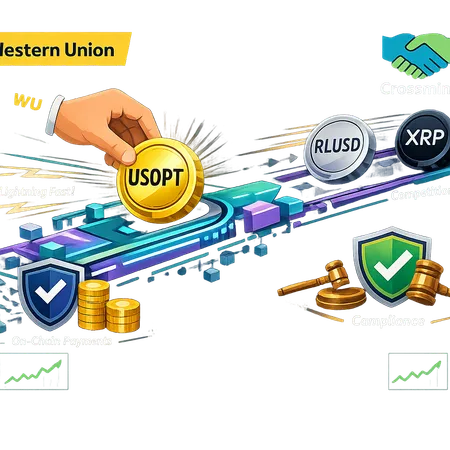
Western Union’s decision to issue a dollar stablecoin, USDPT, on Solana through a partnership with Crossmint is more than a press release — it’s a clear strategic move to convert decades of fiat endpoint access into programmable, on‑chain settlement. The deal folds a recognizable remittance brand into the fabric of blockchain rails, reducing friction for cross‑border payments while amplifying competition in the stablecoin layer.
For payments and product teams evaluating rails, this is a timely case study: a global money‑transfer firm choosing an L1 for reasons beyond hype — cost, throughput, and ecosystem integrations. It also raises immediate questions about how USDPT stacks up against Ripple’s RLUSD and incumbent dollar tokens, and what it means for demand for SOL and liquidity in the Solana ecosystem.
Deal structure: Western Union + Crossmint — who does what
The announced architecture places Western Union as the issuing brand and compliance anchor while Crossmint provides on‑chain minting, wallet and UX plumbing. Reporting on the launch highlights Crossmint’s role in deployment and developer tooling, enabling fiat on‑ramps and token minting on Solana that fit Western Union’s existing corridors and rails (Blockonomi, Bitcoin.com).
Operationally this structure offloads blockchain engineering and front‑end experience to a specialist (Crossmint), while Western Union retains controls around reserves, KYC/AML, and compliance cadence. That split is sensible: legacy payment firms want to leverage crypto rails without becoming de‑facto blockchain product houses. Crossmint’s tooling reduces time‑to‑market and integrates wallets, custody, and Web3 UX, which is crucial for consumer and enterprise use cases.
Why Solana? Speed, cost, and composability
Two practical constraints dominated the chain choice: transaction cost and throughput. Solana offers millisecond finality and sub‑cent fees at scale — properties that matter when you’re moving remittance flows measured in tens of millions of micro‑transactions. For many payments engineers, Solana is attractive precisely because it reduces friction between fiat rails and on‑chain settlement.
Low latency supports use cases that incumbent stablecoins on congested L1s struggle with: instant P2P settlement, real‑time FX swaps against liquidity pools, and UX for retail remitters who expect parity with traditional money transfer speeds. Crossmint’s cross‑chain and wallet abstractions also make Solana’s developer experience palatable for a company accustomed to centralized rails.
Qualitatively, choosing Solana signals a preference for throughput‑first design over absolute decentralization. That tradeoff suits a permissioned issuer backed by a legacy corporate compliance model: they prioritize reliable, cheap settlement and predictable UX over a fully permissionless security model.
How USDPT competes with RLUSD and incumbent stablecoins
Competition will play out on three axes: distribution (corridor reach), trust (reserve transparency and compliance), and price/settlement efficiency.
- Distribution: Western Union instantly brings a massive global distribution footprint. If USDPT can be used natively inside Western Union’s corridors or partner wallets, it gains a practical advantage over newly issued tokens lacking real‑world rails.
- Trust and compliance: Western Union’s brand means institutional counterparties and banks may treat USDPT differently than anonymous issuers. But brand alone won’t substitute for auditability and transparency; rivals will still emphasize reserve attestations, redemption windows, and legal protections.
- Settlement efficiency: RLUSD (Ripple’s stablecoin initiative) aims to integrate with RippleNet’s settlement flows and the XRP ledger’s strengths. USDPT on Solana instead competes by offering lower fees and faster settlement in certain corridors, plus the ability to plug into decentralized liquidity on Solana AMMs.
The market will segment: high‑throughput retail corridors and merchant payments may prefer USDPT on Solana, while financial institutions that already integrate with RippleNet might stick with RLUSD or other institutional stablecoins that offer specific settlement guarantees. Established stablecoins (USDC/USDT) retain market depth and fiat rails; USDPT’s differentiation is the pairing of a global brand with Solana’s UX.
Impact on SOL liquidity and on‑chain payments infrastructure
An issuer the size of Western Union can materially influence on‑chain liquidity dynamics. If USDPT adoption scales, expect several immediate effects:
- Increased SOL demand for transaction fees and rent: even with low fees, high volume pushes nominal SOL consumption. Firms and end users will need SOL for transaction gas, driving utility demand, especially in corridors where coin conversion happens on‑chain. Staking dynamics could also shift if treasury or market makers hold SOL for infrastructure purposes.
- More Solana native liquidity pools: market makers will list USDPT/SOL and USDPT/USDC pairs, creating TVL flows to AMMs and DEXs. That deepens on‑chain settlement rails and improves slippage characteristics for payments.
- Infrastructure scaling and third‑party services: custodians, fiat gateways, KYC providers, and payment processors will expand Solana integrations to capture corridor flows. This will mature the ecosystem — think improved wallets, payment SDKs, and compliance tooling.
Short‑term, the network could see localized congestion during rollout windows or promotional activity, but Solana’s architecture is designed to handle throughput bursts. Long term, widespread payments use raises the baseline demand for SOL as a utility token — even if SOL is not being used as the settlement asset.
Compliance and regulatory questions for a legacy payments giant
A legacy firm issuing a USD token is subject to intensified regulatory scrutiny. Key issues include:
- Reserve management and auditability: Regulators and partners will demand transparency on reserve composition, segregation of funds, and redemption mechanics. Independent attestations or full reserve audits are likely table stakes.
- Custody and banking relationships: To back token redemptions, Western Union must maintain banking lines and custody arrangements that satisfy both fiat regulators and crypto counterparties. Crossborder reserve management is a tricky operational problem.
- Licensing and money transmitter obligations: USDPT may trigger licensing in jurisdictions where Western Union already operates — but regulators might impose additional conditions specific to digital tokens (capital requirements, reporting, transaction monitoring).
- AML/KYC and transaction monitoring: On‑chain transactions complicate KYC when settlement crosses borders. Western Union’s legacy compliance capabilities are an asset, but linking on‑chain pseudonymity to KYC identity without breaking user UX is nontrivial.
In short, being a trusted brand helps with counterpart trust, but regulators will not give carte blanche. This is a test case for how legacy compliance stacks map onto programmable money.
Market outlook: short‑ and medium‑term effects for SOL and XRP
Short term (0–3 months): expect modest SOL upside driven by onboarding liquidity and market attention. Market commentary has already suggested a potential catalyst for SOL in the near term tied to USDPT activity (AmbCrypto). Speculative flows may front‑run real adoption, pushing SOL volatility higher.
Medium term (3–12 months): if USDPT achieves meaningful corridor volume and market makers create deep pools, SOL’s utility narrative strengthens. That translates into sustained demand for SOL for fees and operational needs. However, the effect will be proportional to adoption — if USDPT remains niche or primarily custodial, SOL upside will be limited to temporary liquidity boosts.
XRP dynamics are more nuanced. USDPT directly competes with Ripple’s RLUSD on certain payment use cases, but the two may also coexist in different corridors. If Western Union’s USDPT captures large retail remittance flows by virtue of brand and UX, it could blunt RLUSD’s short‑term commercial runway and put sideways pressure on XRP if market participants view RLUSD as Ripple’s primary growth lever. Conversely, if institutional partners prefer RippleNet’s settlement guarantees, XRP could remain insulated.
Price action will thus depend on adoption speed, corridor exclusivity, and how each stablecoin is wired into on‑chain and off‑chain liquidity.
Operational risks, adoption pathways, and product implications
Operational risk remains high. Issuers must get redemptions right. Any pause in fiat lanes or a banking partner’s withdrawal could freeze USDPT liquidity and damage trust. For product teams, the pragmatic focus should be on predictable redemptions, clear customer support, and seamless UX so end users don’t feel the complexity behind the scenes.
Adoption pathways that look believable:
- Phased corridor launches where Western Union enables USDPT remittances between selected country pairs, measuring UX and settlement costs. This minimizes contagion if anything goes wrong.
- Merchant and payroll pilots where businesses prefer instant settlement over slower wire alternatives; commercial use cases amplify velocity and fee capture.
- Integrations with custodians and wallets (including platforms like Bitlet.app) to make USDPT usable outside Western Union’s walled garden.
If these pathways are followed, USDPT can be more than a corporate experiment — it could be an operationally useful stablecoin that nudges payments volume on‑chain.
Conclusion: incremental but meaningful
Western Union’s USDPT on Solana is a pragmatic play: marry a global payments brand with a high‑throughput L1 and third‑party UX tooling. It won’t instantly dethrone incumbents, but it changes the dynamic by bringing real‑world distribution to a chain that can handle retail payment volumes.
For product‑minded crypto and payments professionals, the takeaway is twofold: expect infrastructure maturation on Solana and prepare for competitive stablecoin dynamics that prioritize corridor reach and compliance as much as on‑chain liquidity. Watch short‑term SOL flows for signs of organic adoption, and treat XRP’s trajectory as contingent on Ripple’s commercial response and RLUSD’s adoption.
Sources
- U.Today — Western Union to launch USDPT on Solana: https://u.today/western-union-to-launch-ripples-stablecoin-rival-usdpt-on-solana?utm_source=snapi
- Blockonomi — Western Union joins forces with Crossmint to deploy USDPT on Solana: https://blockonomi.com/western-union-joins-forces-with-crossmint-to-deploy-usdpt-stablecoin-on-solana/
- Bitcoin.com News — Western Union partners with Crossmint to launch USDPT on Solana: https://news.bitcoin.com/western-union-partners-with-crossmint-to-launch-usdpt-stablecoin-on-solana/
- AMBCrypto — Market take: USDPT launch could spur a March rally for SOL: https://ambcrypto.com/western-union-launches-usdpt-on-solana-march-rally-for-sol/