Why Uniswap's Dismissal Matters — Lessons from Aave's Governance Rift
Summary
Executive snapshot
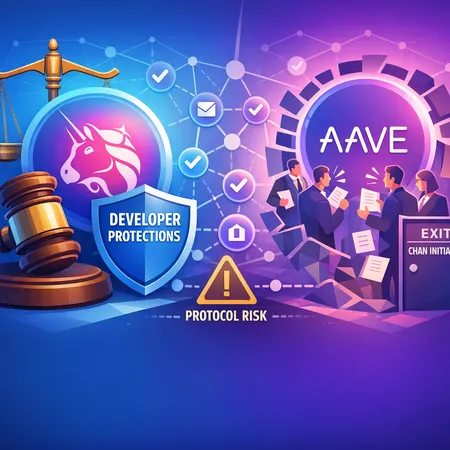
A U.S. judge recently dismissed the amended class‑action lawsuit against Uniswap — with prejudice — a ruling that matters far beyond one courtroom. At the same time, internal governance friction at Aave — most concretely the Aave Chan Initiative’s decision to step back — underscores how quickly DAO delegate systems can shift voting power and political dynamics. Together, these events form a useful case study for protocol teams, legal counsels, and governance participants trying to measure and mitigate protocol risk.
For readers tracking headlines, see the coverage of the dismissal in the press and the reaction from industry leaders: the original dismissal report is summarized by Daily Hodl, and the leadership response and discussion about developer protections are covered by AMBCrypto.
What the Uniswap dismissal actually means
The court dismissed the amended class action against Uniswap — and did so with prejudice, meaning plaintiffs cannot refile the same claim in that jurisdiction. That phrasing matters: it signals a definitive loss for the plaintiffs on the amended complaint and creates a stronger precedent than a mere dismissal without prejudice.
Why this is important for DeFi legal precedent: the ruling narrows an immediate path for claims that seek to hold protocol developers or neutral code infrastructures directly liable for third‑party misconduct. Practically, that reduces one element of legal tail‑risk for open‑source teams building on permissionless rails. But it’s not a full legal exoneration of all risk. Different claims, different facts, different courts — and different jurisdictions — can yield different outcomes. The ruling, therefore, is a meaningful datapoint in a still‑emerging body of case law rather than a neat legal shield.
Industry reaction: developer liability and leadership comments
Market and media reaction emphasized two linked takeaways: (1) this ruling helps clarify — if not fully define — the contours of developer liability, and (2) there’s now more room to argue that building permissionless infrastructure is distinct from facilitating illicit activity.
Uniswap’s leadership publicly framed the decision as vindication for neutral protocol developers; coverage of those comments highlights the broader policy effect on developer protections and governance narratives. See reaction coverage at AMBCrypto for detail on statements from the Uniswap team and the conversation around accountability versus immunity: Uniswap CEO reaction and developer protections.
That said, the practical takeaway for DAOs and engineering teams is caution, not complacency. Legal risk management should still be part of product roadmaps: documentation, modular contract design, optional governance approvals for risky integrations, and clear disclaimers help lower exposure. Many teams — including those building consumer‑facing tooling like payment rails or fiat onramps — will still face higher scrutiny than base‑layer protocol developers.
Aave’s governance inflection: the Chan Initiative exit
While the court battle unfolded, governance tensions at Aave produced a different kind of structural signal. The Aave Chan Initiative — a material delegate and governance participant — announced it would not renew engagement, a change reported by The Block that marks a meaningful delegate shift for the Aave DAO: Aave Chan Initiative will not renew engagement.
Delegate exits like this matter for three reasons:
- Voting concentration: when a significant delegate exits, voting weight can reflow quickly — sometimes concentrating in a few wallets or incentivized delegates. That increases systemic fragility.
- Knowledge & coordination loss: active delegates do more than vote; they shepherd proposals, run risk analyses, and coordinate off‑chain. Their departure reduces institutional memory.
- Reputation and market signaling: a high‑profile exit signals unresolved governance friction, which can depress token holder confidence (relevant to AAVE) and attract adversarial attention.
What Aave’s episode reveals about DAO fragility
Aave’s situation highlights how DAO governance can be brittle when it relies heavily on delegated expertise and a handful of active participants. Delegation is a pragmatic design: it scales decision‑making and allows tokenholders to free‑ride on skilled delegates. But delegation introduces attack surfaces and risks of capture. If delegates act as single points of failure, the DAO becomes vulnerable to external pressure, bribery, or simple burnout.
The mechanics are important: token distribution (how many wallets hold AAVE), voting thresholds, quorum rules, and the ease of delegating/un‑delegating all shape the DAO’s resilience. A supervisor or delegate that leaves in a time of stress can flip governance outcomes by changing vote dynamics overnight.
These fragilities matter for on‑chain governance — and also for off‑chain legal and strategic considerations. When governance is concentrated, courts and regulators may treat a protocol very differently than when governance appears truly decentralized.
Practical governance risk mitigations (for builders and governance teams)
Below are concrete, actionable measures teams can adopt to reduce protocol risk, improve resilience, and adapt delegate models to real‑world pressures.
1) Revisit delegate models and incentives
- Encourage plurality: incentivize more delegates via small grants, recognition programs, or covering gas/operational costs. A broader delegate base reduces single‑point risk.
- Staggered commitments: consider minimum engagement periods or phased delegation so voting weight doesn’t evaporate instantly.
- Transparent delegate metrics: publish on‑chain dashboards that show activity, proposal participation, and voting history so tokenholders can choose delegates based on performance.
2) Governance design primitives
- Adaptive quorum and timelock: higher quorums for protocol‑critical changes; flexible timelocks for emergency patches. Time to act matters — both to defend and to upgrade.
- Supermajority or multi‑axis voting: split critical votes across economic and technical axes (e.g., treasury spending requires both token and developer approval).
- Proposal pre‑screening: technical review or risk scoring before on‑chain voting reduces governance griefing.
3) Technical and operational controls
- Modular contract upgrades: break logic into smaller upgradable modules with narrow responsibilities to limit catastrophic upgrade risk.
- Emergency breakers and circuit breakers: on‑chain pause functions with multi‑party control help stop exploitable flows quickly.
- Formal verification and audits: rigorous testing reduces the attack surface and limits the number of governance emergencies.
4) Legal, treasury, and policy measures
- Legal wrappers and entities: where appropriate, deploy POAs or legal entities to manage off‑chain relationships (without centralizing critical on‑chain control).
- Bounties and insurance: maintain active bug bounties and consider protocol insurance to cover systemic losses; these reduce investor and user pain if things go wrong.
- Clear public messaging and documentation: transparency reduces regulatory and market confusion — and improves the narrative when adverse events occur.
5) Community and coordination practices
- Build decision‑making playbooks: pre‑agreed scripts for common emergencies reduce debate overhead when time is scarce.
- Delegate onboarding and succession planning: train new delegates, run shadow votes, and have public succession plans for major delegates.
- Cross‑DAO coordination: share lessons and threat intel with other protocols; coalitions can resist regulatory overreach and coordinate defensive strategies.
What UNI and AAVE holders should watch next
For UNI holders, the Uniswap dismissal is a positive legal datapoint — but it should prompt active governance vigilance, not celebration. Legal precedent changes slowly; governance teams would be wise to consolidate the technical and operational steps that reduce future exposure.
For AAVE holders, watch delegate churn, on‑chain voting patterns, and treasury proposals closely. Aave’s delegate model delivered strong coordination benefits, but the Chan Initiative’s exit shows the downside of reliance on a small number of engaged actors.
Both communities should track metrics that signal governance health: participation rates, vote concentration (Gini of voting power), proposal throughput, and the frequency of emergency actions.
Conclusion: a dual lesson in law and mechanics
The Uniswap dismissal nudges the legal needle toward greater clarity on developer liability in DeFi, but it’s not a universal shield. Meanwhile, governance maneuvers at Aave demonstrate how fragile DAO coordination can be when delegate models aren't diversified or institutionalized.
The combined lesson for builders, governance participants, and legal teams is simple and urgent: treat governance design as mission‑critical infrastructure. Legal outcomes can buy time and tilt incentives, but robust governance primitives, better delegate incentives, and practical operational controls are what actually reduce protocol risk.
Bitlet.app users and protocol teams alike should fold these lessons into risk assessments, escrow strategies, and governance roadmaps. DeFi's next phase will be shaped by how quickly protocols convert legal signals into stronger governance plumbing.