Solana’s Confidence Test: Step Finance Hack, SOL Price Pressure, and the RWA Paradox
Summary
Introduction
The recent Step Finance exploit and the protocol's decision to suspend operations put a bright spotlight on Solana's security model and the broader health of its DeFi stack. For many observers the story reads like a confidence test: a high-profile hack, a visible operational shutdown, price pressure on SOL, and yet — in parallel — rising institutional flows into real‑world assets (RWA) being tokenized on Solana. This tension matters to DeFi builders, security engineers and institutional allocators trying to decide how much exposure to accept.
What happened: Step Finance hack, shutdown and remediation
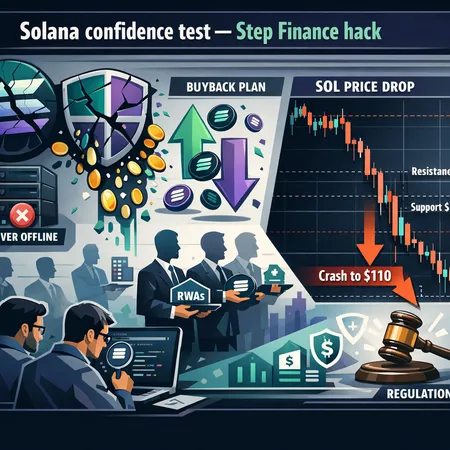
In late January a compromise tied to Step Finance — a widely used Solana analytics and portfolio-management platform — resulted in a significant loss. Reporting summarizes the incident and the decision to pause operations while the team implements remediation steps. The shutdown was framed as necessary to limit further damage and to coordinate a response to affected users (Invezz report).
The protocol later outlined a recovery plan that includes partial remediation and a buyback proposal for STEP token holders as part of the response to losses and reputational damage; Coindesk provides a clear account of that buyback proposal and the governance discussions that followed (Coindesk coverage).
Timeline and key operational choices
- Compromise discovered (January): Funds were drained across addresses related to Step's services.
- Immediate action: Step Finance suspended operations to stop further automated interactions and preserve forensic evidence.
- Remediation: The team announced contingency measures, including a prospective buyback for STEP holders and coordination with wallets and affected counterparties.
The combination of pause-and-fix plus a public remediation proposal demonstrates a willingness to prioritize containment and restitution — but it also amplified a critical short-term side effect: an erosion of user trust.
Trust, operations and the user impact
Security incidents are rarely just technical events; they are reputational crises. For retail users the abrupt shutdown felt like a breach of the implicit contract that DeFi platforms will remain available and transparent. For other protocols and integrators, the incident triggered immediate operational checks — emergency key rotations, withdrawal freezes and limit changes.
From an operational perspective the shutdown exposed weak links in common DeFi flows: third‑party integrations, elevated privileges for aggregator contracts, and insufficiently tested key‑management processes. That said, the hard part for the ecosystem is the inertia of uncertainty: even after a buyback or patch, some users will permanently shift risk away from the vector that failed.
DeFi security implications: what needs to change
The hack is a practical roadmap for where security practices on Solana (and similar chains) must evolve:
- Stronger key management: shift from single-signer risk toward MPC or multisig arrangements with distributed trustees and social recovery patterns.
- Safer integration design: enforce least-privilege on aggregator and analytics contracts; use granular capability tokens instead of full-control approvals.
- Faster incident response playbooks: standardize pause procedures, forensics-friendly logging and an industry-wide alerting cadence to reduce contagion.
- On-chain observability and guardrails: real-time anomaly detection, circuit breakers and budgeted daily transfer limits for high‑risk contracts.
- Insurance + remediation frameworks: pre-funded recovery pools or insured vaults that can reimburse small retail holders quickly to preserve confidence.
Regulatory consequences are likely to follow. As incidents accumulate, regulators will demand better governance, clearer custodian responsibilities, and rapid disclosure. Institutional allocators watching these dynamics will recalibrate their risk premiums or insist on additional on‑chain and off‑chain guarantees.
SOL price technicals: support cracks and immediate outlook
The market reacted quickly. Technical reporting on short‑term SOL action shows a decisive break below the $80 support level, which previously acted as a psychological and structural floor; that move increased bearish momentum and opened the path for further downside (Invezz price coverage).
At the same time, some charts highlight a lower support region near $68 where buyers have intermittently stepped in, producing a tug-of-war that can last days to weeks depending on macro liquidity and sentiment (Coinpaper note on support). Short-term traders should treat the loss of $80 as a signal to tighten risk controls; longer-term holders (and institutional entrants) will weigh fundamental exposures to Solana's throughput and developer activity.
Technical checklist for allocators
- If $68 fails, expect stop‑loss cascades and increased volatility.
- Volume confirmation matters: a break with rising volume confirms conviction; a break on thin volume signals an overreaction.
- Watch derivative skew and funding rates for sentiment insight — they often lead spot price exhaustion.
The paradox: growing institutional RWA interest on Solana despite retail aversion
Perhaps the most interesting aspect of this episode is that institutional flows into RWA on Solana have continued to grow even as retail confidence wobbled. Recent reporting shows RWA value on Solana approaching meaningful figures (around $1.68B reported), demonstrating growing institutional appetite for tokenized assets on the chain (Coinpaper RWA report).
Why would institutions continue to allocate while retail pulls back? Several reasons:
- Different risk profile: institutions price operational and counterparty risk explicitly; they can demand contractual covenants, custody arrangements and insurance that retail cannot.
- Settlement and throughput: Solana's high TPS and low finality latency are attractive for tokenized cashflows and repo-like structures where settlement efficiency matters.
- Specific tooling and off-chain agreements: many RWA deals involve custody, legal wrappers and off‑chain KYC/AML that mitigate exploit vectors present in pure retail flows.
- Diversification and yield: institutions seeking exposure to short-duration, cash-generating assets may find tokenized instruments on Solana more efficient than comparable on-chain offerings on slower chains.
Put simply, institutional allocators are buying different things. They are not simply speculating on STEP or retail UX; they are underwriting a set of contractual and custodial assurances that can insulate them from certain smart-contract execution risks.
Practical guidance: what builders, security engineers and allocators should do next
For DeFi builders and security engineers
- Re-evaluate permissions: run a full inventory of approvals and privileged flows; implement least-privilege and break-glass procedures.
- Adopt multi-layer defenses: combine unit-tested contract logic, on-chain rate limits, multisig/MPC signers and timelocked governance upgrades.
- Improve observability: instrument fallback paths and create automated alerting for anomalous outgoing flows.
- Run red-team exercises and bug-bounty programs with clear escalation ladders.
- Communicate transparently: a public, stepwise incident response plan reduces rumors and can constrain panic withdrawals.
For institutional allocators
- Request on-chain proof points plus off-chain counterparty agreements: custody, insurance and legal recourse are critical differentiators.
- Time exposures: consider laddered entry to hedge the tail risk of further protocol disruptions.
- Stress test wallets and settlement flows with counterparties under different failure modes.
- Price operational risk explicitly: expect higher liquidity premiums on strategies that depend on third‑party tooling like analytics or aggregators.
Note: several custodial and execution services (including interfaces like Bitlet.app) are increasingly offering staged onramps and custody options that institutions can use to manage these operational tradeoffs.
Conclusion: a test, not necessarily a verdict
The Step Finance hack and shutdown are damaging — they shook retail trust, pressured SOL price technicals and exposed recurring operational weaknesses. Yet the same chain is proving attractive to institutional RWA flows that can accept and hedge different risks. The near-term will be messy: watch support levels around $68–$80 for price guidance and track remediation and governance moves from Step and other integrators for signs of improved operational hygiene.
Longer term, Solana's fate will hinge on whether the developer community and ecosystem operators adopt stronger, standardized security patterns and whether institutional participants can continue to structure RWA deals with sufficient safeguards. For builders, security engineers and allocators the takeaway is pragmatic: assume incidents will recur, invest in layered defenses and craft contracts, custody and legal frameworks that align incentives across retail and institutional users.
Sources
- Invezz — Solana DeFi platform Step Finance shuts down after hack: https://invezz.com/news/2026/02/24/solana-defi-platform-step-finance-shuts-down-after-hack/?utm_source=snapi
- Coindesk — Step Finance shuts operations after USD27 million January hack (buyback coverage): https://www.coindesk.com/business/2026/02/24/step-finance-shuts-operations-after-usd27-million-january-hack
- Invezz — SOL loses $80 support, eyes lower lows (technical price coverage): https://invezz.com/news/2026/02/24/sol-loses-80-support-eyes-lower-lows-check-forecast/?utm_source=snapi
- Coinpaper — Solana signals clash as $68 support holds while RWA hits $1.68B: https://coinpaper.com/14862/solana-signals-clash-as-68-support-holds-while-rwa-hits-1-68-b?utm_source=snapi
For builders interested in broader ecosystem narratives, see additional context on DeFi practices and technical trade-offs when assessing cross-protocol exposure on Solana.