BIP 360 — Bitcoin’s First Practical Step Toward Quantum Resistance
Summary
Executive summary
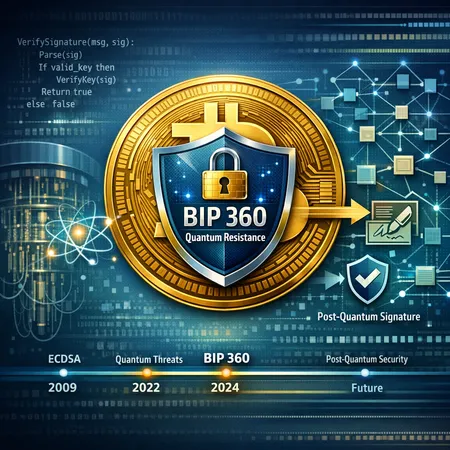
BIP 360, recently added to the Bitcoin repository, represents the network's first practical step toward supporting quantum-resistant cryptography without breaking backwards compatibility. Rather than forcing a single post-quantum replacement, the BIP introduces script- and key-type primitives that let Bitcoin support hybrid verification schemes and future algorithm upgrades. For long-term BTC holders and developers, the takeaway is clear: this is an early, careful engineering move — important for the future, but not a reason to liquidate positions now.
For context on the merge into the repo, see Forbes' coverage of the change and why it's been framed as Bitcoin's initial step against quantum computers: Forbes: Bitcoin took its first step against quantum computers. And remember the market backdrop: short-term volatility and liquidations continue to shape holders' behavior today (CoinDesk, Crypto.News).
What BIP 360 changes — technical overview
At a high level, BIP 360 does three things:
- Adds a new script/key version that can encode support for additional signature algorithms (including post-quantum schemes).
- Defines a hybrid verification model so a spending condition can require both a classical secp256k1 signature and a post-quantum signature, or accept either depending on wallet policy.
- Provides serialization, opcodes (or script semantics), and verification hooks that make it feasible for wallets, hardware devices, and nodes to adopt incrementally.
The important architectural choice is hybridization: instead of yanking out secp256k1, BIP 360 lets wallets create outputs that contain both a classical signature and a PQ signature (or combine proofs in the script). This hedges between current cryptography and future-proof algorithms.
Code-level clarity (pseudocode)
Below is a compact, conceptual example of how a hybrid verification path introduced by BIP 360 might look in a node verification routine. This is illustrative pseudocode — not a verbatim patch — to show the integration points and the checks developers should expect.
# transaction verification pseudocode (simplified)
function VerifyInput(tx, input):
  scriptPubKey = fetch_utxo_script(input.prev_out)
  if scriptPubKey.version == BIP360_HYBRID:
    # script contains pubkeys/types for both classical and PQ
    (classicalPub, pqPub, policy) = parse_hybrid_payload(scriptPubKey)
    classicalOK = verify_secp256k1_signature(tx, input, classicalPub)
    pqOK = verify_pq_signature(tx, input, pqPub)

    if policy == 'AND':
      return classicalOK and pqOK
    if policy == 'OR':
      return classicalOK or pqOK
    if policy == 'HYBRID_FALLBACK':
      # accept if classical OK now, but store a flag for future migration
      return classicalOK
  else:
    return legacy_verify(tx, input)
This pattern permits:
- Backwards compatibility: legacy nodes treat hybrid outputs as unspendable (until they understand the version) or optionally can accept certain patterns.
- Gradual migration: wallets can create hybrid outputs that protect against future PQ-assisted key recovery while remaining spendable today by classical signatures.
A concrete implementation will need serialized forms, test vectors, and tight size limits: PQ signatures (e.g., lattice-based schemes like CRYSTALS-Dilithium) are larger than ECDSA, so the BIP specifies how to encode and compress key material and how scripts must provide proof sizes to avoid block bloat.
Why quantum resistance matters now (but not tomorrow)
Quantum computers pose a specific technical threat: sufficiently large, fault-tolerant quantum machines can run Shor's algorithm and recover private keys from public-key schemes like secp256k1. That would break signatures and allow theft of funds from addresses whose public keys are known on chain (e.g., reused addresses, P2PK outputs).
However, a few important caveats change the urgency:
- Public-key exposure matters. Many Bitcoin outputs only reveal a hash (P2PKH, P2WPKH) until spent; the private key remains safe unless and until the public key is revealed in a spending transaction.
- Current quantum hardware is not large or stable enough to run Shor at the scale required to break secp256k1. Estimates vary and are uncertain; therefore most experts treat the threat as medium-term rather than immediate.
- Migration coordination is hard. A rushed, uncoordinated swap could create new attack vectors and degrade security.
So BIP 360 is appropriately timed: start the engineering work while the threat is still theoretical for practical purposes, but real enough to plan for. Forbes framed the commit as Bitcoin taking its first step; the move is about giving the ecosystem time to design, test, and adopt rather than imposing a rapid fix now.
Compatibility and deployment challenges
Introducing PQ primitives on Bitcoin is not just a cryptography problem — it's an ecosystem and UX one. Key deployment challenges include:
- Wallet upgrades: wallets must generate, store, and sign with hybrid keys, and expose migration flows to users in a secure, understandable way.
- Hardware wallets: firmware must be updated to implement new signing code and handle larger signatures safely.
- Block and transaction size: PQ signatures are larger; widespread hybridization could raise average tx size and fees unless mitigations (compression, merkleized proofs, batching) are used.
- Soft-fork vs hard-fork decisions: BIP 360's design favors a soft-forkable approach (new script versioning) to avoid contentious hard forks; nevertheless, miners and node operators must adopt the new rules to enforce them.
- Key reuse and UTXO hygiene: addresses whose public keys are visible on-chain are vulnerable if a quantum attack ever becomes feasible. That increases the urgency for best practices around address reuse.
Operational risk also matters. Exchanges, custodians, and multisig setups must coordinate migrations. If a subset of custodians migrates to PQ keys while others do not, cross-custody recovery and protocol expectations may diverge.
Realistic adoption timeline
A pragmatic timeline for adoption looks like this:
- 0–12 months: Specification hardening, test vectors, multiple independent audits. BIP 360 in the repo starts community review and testnet experimentation.
- 12–24 months: Wallets, hardware manufacturers, and major clients add optional hybrid signing on testnet/mainnet as an opt-in feature; node software exposes the validation hooks.
- 2–5 years: Early adopters and high-value holders start using hybrid outputs for long-term storage. Custodians and exchanges offer PQ-compatible deposit addresses or promise migration capabilities.
- 5+ years: If quantum machines approach a practical threat level, broad migration accelerates; if not, gradual adoption continues until a point of near-universal support.
This timeline is intentionally conservative. It mirrors how other major upgrades have rolled out in the Bitcoin ecosystem: specification, long review, implementers' opt-in, and then wider migration once tooling and interoperability mature.
What investors should know: security upgrades vs market volatility
Short-term market events — liquidation cascades and volatile price swings — should not be conflated with the long-term security engineering that BIP 360 enables. Recent market behavior (for example, large liquidations that affected many traders) is a reminder that liquidity and risk management matter now; see coverage of recent liquidations and market stabilization efforts (Crypto.News, CoinDesk).
Practical investor guidance:
- Don’t panic-swap. There is no immediate existential cryptographic emergency. BIP 360 is about prudence: start planning, not selling.
- Avoid address reuse for long-term holdings. Where possible, use outputs that don't expose public keys until spent (P2WPKH-like patterns) and rotate addresses for large balances.
- Prefer custodians that publish clear upgrade and migration policies. Institutional-grade custody solutions and exchanges will need to show how they will sign and migrate funds in a post-quantum world; this is a differentiator to watch when choosing where to store BTC. Platforms such as Bitlet.app will need to build these upgrade paths into custody roadmaps.
- Consider cold storage for the largest allocations and maintain robust physical security and multi-party controls.
- Track standards and support: once wallets and hardware offer audited PQ/hybrid support and interop tests are green, consider migrating the highest-value UTXOs.
Practical steps for developers and node operators
If you maintain node software, wallets, or hardware firmware, start with these concrete items:
- Review the BIP 360 test vectors and unit tests; add independent fuzzing and property testing.
- Implement deterministic serialization for PQ keys and signatures; ensure testnet compatibility and backward-compatible serialized forms.
- Add UI flows that clearly explain hybrid outputs and migration costs to users; UX is a major trust factor.
- Coordinate with hardware vendors for secure key storage and signing paths, and with custodial operators for off-chain migration plans.
- Monitor mempool and block-weight implications: simulate the effect of large PQ signatures on fee markets and propose mitigations (batching, signature aggregation where safe, or compression).
Conclusion
BIP 360 is a deliberate, technically conservative move: it prepares Bitcoin for a future where post-quantum cryptography will be necessary, while preserving the stability and compatibility that have been key to the network's success. For developers, the work now is real and detailed — test vectors, firmware changes, and verification hooks. For investors, BIP 360 is a call to plan: harden custody, avoid address reuse, and prefer custodians that publish migration roadmaps — but it is not an immediate emergency that requires wholesale selling of BTC.
For those tracking both market dynamics and protocol security, it's useful to separate short-term noise (liquidations, price churn) from long-term structural work. Keep an eye on client releases, hardware wallet firmware updates, and coordinated migration pilots over the next 1–3 years.
Sources
- Forbes: Bitcoin took its first step against quantum computers — https://www.forbes.com/sites/digital-assets/2026/02/23/bitcoin-took-its-first-step-against-quantum-computers/
- CoinDesk: Pre-market trading stabilizes as Bitcoin reclaims USD66,000 — https://www.coindesk.com/markets/2026/02/23/pre-market-trading-stabilizes-as-bitcoin-reclaims-usd66-000-saylor-eyes-100th-btc-purchase
- Crypto.News: Bitcoin dips under 64.5k as $500M liquidations hit 140k traders — https://crypto.news/bitcoin-dips-under-64-5k-as-500m-liquidations-hit-140k-traders/
For additional context on cryptography and post-quantum signatures, consult NIST and implementation guidance from independent security auditors as wallets and hardware providers publish their BIP 360 test runs.
For many traders and developers, Bitcoin will remain the primary actor while these upgrades roll out, and protocols across DeFi will watch custody and signing changes closely as hybrid addresses become more common.