What the USD1 / WLFI Attack Reveals About Small Stablecoin Failure Modes and Contagion Risk
Summary
Introduction: why the USD1 / WLFI episode matters
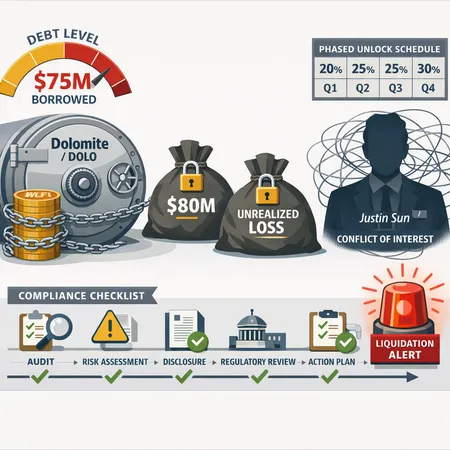
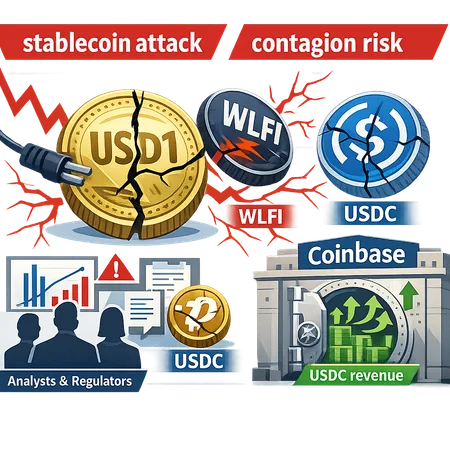
The short story: a coordinated attack knocked WLFI’s USD1 peg offline and briefly depressed WLFI market prices, drawing attention to how small, non-USD pegged stablecoins can fail and how that failure can ripple across trading venues, lending desks and niche DeFi products. For risk managers, stablecoin product teams and regulated crypto strategists, this incident is not an academic exercise — it is a real-world stress test of concentrated issuer risk and market plumbing. For many market participants, Bitcoin is still the macro bellwether; but within pockets of the market, smaller stablecoins like USD1/WLFI can trigger localized shocks that propagate through liquidity corridors, automated market makers and lending pools.
This article reconstructs the timeline, documents the market impact and contagion fears, and draws practical lessons about stablecoin design, issuer sizing and counterparty exposure. Throughout we compare the brittle mechanics that hurt WLFI with the business and regulatory resilience that can favor larger, more transparent issuers such as USDC.
Timeline and anatomy of the peg slip
The public timeline is concise but revealing. Reports describe a coordinated attack that caused a rapid depegging episode for USD1/WLFI, followed by aggressive market selling and a sharp liquidity vacuum. TheNewsCrypto lays out the incident timeline and subsequent partial recovery steps, documenting how price action and on-chain flows unfolded in the immediate hours after the attack reported timeline and recovery details.
Coverage from BeinCrypto emphasizes the market panic and WLFI price weakness that followed the shock, noting how sentiment quickly shifted and thin order books amplified slippage price and sentiment analysis. What these contemporaneous accounts share is a pattern: a concentrated attack exploits limited reserves and fragile market making, creating a feedback loop where selling begets more selling and off-chain counterparties hesitate to provide liquidity.
Immediate market impact: WLFI price moves and liquidity stress
In the hours that followed, WLFI traded substantially below its nominal USD1 peg on multiple venues as liquidity evaporated. Thin order books and concentrated liquidity providers meant that even modest aggressive sell orders moved the price materially. Exchanges and DEX pools that had WLFI exposure saw widened spreads and slippage, while lending protocols with WLFI collateral faced valuation shocks and liquidation cascades.
Price moves were magnified because many market makers had limited capacity to arbitrage the gap: the cost of restoring parity exceeded their risk tolerance given uncertainty about reserve backing and the attack’s nature. That uncertainty in turn fed contagion fears, prompting risk-off behavior from desks and retail participants alike. The BeinCrypto analysis captured this immediate sentiment effect, showing how price weakness drove short-term market panic coverage link.
Failure modes exposed: why small issuers and non-USD-pegged designs are fragile
The episode highlights predictable failure modes for smaller or exotic stablecoins:
- Thin reserve buffers. Smaller issuers often maintain lean reserves and depend on market-making support rather than deep cash equivalents. That creates low shock-absorption capacity against coordinated selling.
- Concentrated counterparties. When reserve custodians, auditors or market makers are concentrated or opaque, a single operational hiccup or reputational attack cascades quickly. Large issuers spread custody and reporting across regulators and trusted custodians; small issuers rarely can.
- Fragile peg mechanisms. Some stablecoins rely on off-chain promises, algorithmic mechanisms or cross-asset swaps to maintain a peg. Those approaches depend on continuous liquidity and credible redemption options — both of which can fail when trust collapses.
- Governance and operational single points of failure. Smaller projects often have limited teams and tighter coupling between treasury control, key management, and market operations, which attackers can exploit.
These failure modes are not hypothetical. They map directly to what the post-attack analysis describes: limited reserves, unclear redemption pathways and a market-making ecosystem that could not absorb aggressive flows. That’s why smaller stablecoins like USD1/WLFI became high-probability targets once an attacker decided market psychology could be exploited.
Contagion pathways: how a local peg break becomes a systemic headache
Contagion is not just a function of size; it’s a function of connectivity. Even a small stablecoin can create outsized problems if it sits inside leverage chains, liquidity pools or custodial rails. Key contagion pathways include:
- Trading pairs: WLFI pairs with popular assets can transmit price moves to liquidity providers and concentrated LPs.
- Lending and collateral: protocols that accept WLFI as collateral see margin calls and forced liquidations when the peg slips, which can cascade into other assets and pools.
- On/off-ramp intermediaries: exchanges, custodians and P2P platforms (including niche venues such as Bitlet.app and smaller local exchanges) that list or custody WLFI can carry credit exposure and reputational damage.
- Market maker withdrawal: large firms or automated strategies pulling liquidity increases slippage elsewhere, which can ripple across AMMs and centralized limit order books.
Market participants worried about contagion voiced these scenarios during the WLFI event. The short-term panic in WLFI markets illustrated how easily trust erosion can become self-fulfilling: counterparties quickly limit exposure and deleverage, making market-making impossible until confidence is restored.
Why incumbent stablecoins and exchange business models may benefit
Large, regulated issuers that emphasize transparent reserves and clear redemption mechanics stand to gain market share and trust after episodes like this. Bloomberg Intelligence’s coverage (reported by Cointelegraph) argues that Coinbase’s USDC revenue could expand substantially if payments and stablecoin usage grows — a dynamic that becomes more plausible as customers shift away from riskier small issuers toward regulated alternatives Cointelegraph summary of Bloomberg Intelligence.
There are several mechanisms by which incumbents benefit:
- Flight to quality. Corporates, custodians and exchanges prefer assets with transparent, regulated reserve practices, expanding demand for USDC-like tokens.
- Regulatory arbitrage shrinkage. If regulators tighten rules (for example, banning high-yield staking or promotional rewards tied to unstable stablecoins), smaller projects that relied on yield incentives lose their competitive advantage.
- Exchange services expansion. Exchanges that process fiat-stablecoin rails and custody reserves can monetize higher volumes and payment flows, increasing fee-based revenue.
The WLFI event underscores that markets may re-price stablecoin counterparty risk, shifting flows toward issuers with clearer governance and regulated custody arrangements. That’s not guaranteed — but it is a plausible near-term market response.
How stricter regulation and rewards bans reshape the landscape
Regulators are actively debating how to treat stablecoins — from reserve disclosure mandates to restrictions on ancillary yield products. A tighter regulatory framework or bans on promotional rewards would tilt the economics:
- Smaller issuers that leaned on incentives to attract volume would see user economics unwind rapidly.
- Exchanges and custodians that can meet regulatory standards would see reduced friction for institutional flows, possibly increasing USDC revenues as payment and settlement volumes migrate.
- A rules-driven market would favor conservative reserve designs (cash, government bills, high-quality commercial paper) and credible third-party attestation, increasing trust but also raising capital costs for issuers.
Coinbase’s potential USDC revenue expansion is one concrete example of how an incumbent exchange’s business model could be reshaped by these forces — beneficiaries of a flight to regulated rails can monetize payments, custody and on-chain settlement more effectively analysis link.
Practical checklist for risk managers and product teams
For teams assessing counterparty exposure to smaller stablecoins, implement the following measures immediately:
- Exposure limits: set hard caps on holdings and counterparty exposure per issuer; model losses under severe depeg scenarios.
- Diversification: avoid concentrated positions in a single small or non-USD pegged stablecoin; prefer allocations to well-audited, regulated issuers for settlement needs.
- Continuous monitoring: instrument on-chain flows, mint/burn events and LP depth; flag unusual withdrawal or swapping patterns in real time.
- Stress testing: run reverse stress tests that assume coordinated selling and market-maker withdrawal; quantify collateral shortfalls and liquidation cascades.
- Legal/operational protections: require redemption guarantees, custody SLAs, proof-of-reserves cadence and clear dispute resolution clauses in counterparty contracts.
- Dynamic collateralization: for internal margining, apply higher haircuts to smaller issuers and algorithmic coins; re-price lending rates based on instantaneous liquidity measures.
If your platform lists or integrates smaller stablecoins, consider delisting criteria tied to minimum reserve transparency and market depth. These are not easy choices, but the WLFI incident shows the cost of inaction.
Design lessons for future stablecoins
Product teams designing new stablecoins should internalize these lessons:
- Prioritize transparent, high-quality reserves over yield chasing. The marginal cost of safer reserves buys credibility and reduces attack surface.
- Build multi-dimensional peg mechanisms that combine on-chain redemptions, robust arbitrage pathways and circuit-breakers to slow runs.
- Decentralize operational risk: split treasury, custody and oracle responsibilities across reputable, regulated counterparties where possible.
- Design for stress: include explicit liquidity buffers, automated redemption ladders and governance processes that can act during market stress without exacerbating runs.
These design choices increase issuance cost but reduce the probability of catastrophic depegging — and that tradeoff matters for enterprise counterparties that will bear direct losses.
Conclusion: recalibrate exposure and favor verification over narrative
The USD1/WLFI coordinated attack is a practical reminder that stablecoin risk is rarely theoretical. Small issuers, opaque reserves and fragile peg mechanisms create predictable failure modes that can produce real losses and systemic friction. For regulated strategists and risk managers, the appropriate response is not blanket avoidance of all non-major tokens — it is disciplined exposure management, rigorous due diligence, and explicit contractual and operational protections.
Meanwhile, incumbent players with transparent reserves and regulated rails — exemplified by the economics around USDC and its place in exchange business models — stand to gain if markets and regulators favor clarity over promotional yield. That shift could deepen settlement rails and change where payment and liquidity flows accrue in crypto’s evolving ecosystem.
Sources
- TheNewsCrypto — WLFI stablecoin USD1 has recovered from coordinated attack: https://thenewscrypto.com/wlfi-stablecoin-usd1-has-recovered-from-coordinated-attack/?utm_source=snapi
- BeinCrypto — WLFI price drop analysis and USD1 shock coverage: https://beincrypto.com/wlfi-price-drop-analysis-usd1-shock/
- Cointelegraph (Bloomberg Intelligence coverage) — Coinbase USDC revenue growth analysis: https://cointelegraph.com/news/coinbase-usdc-revenue-could-7x-as-payments-grow-bloomberg-says?utm_source=rss_feed&utm_medium=rss&utm_campaign=rss_partner_inbound