Institutions, Cash Hoarding, and BTC Liquidity: Interpreting Binance Balances and State Reserve Bets
Summary
Executive snapshot
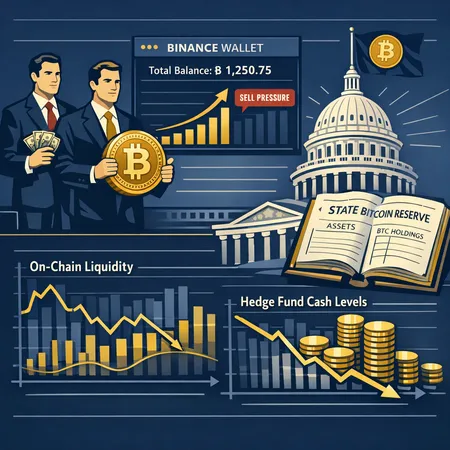
Institutional flows and treasury decisions are now central to how BTC liquidity behaves. Over the past months, multiple signals have converged: crypto hedge funds are holding more cash, Bitcoin balances on wallets associated with major exchanges — notably Binance — have increased, and political actors at the state level are reviving ideas to add BTC to public balance sheets. Each of these is meaningful on its own; combined, they change both where liquidity sits and how it might be accessed or absorbed.
This article synthesizes public evidence, interprets the likely mechanics at play, and highlights practical consequences for allocators and policymakers evaluating BTC exposure.
Why hedge funds are hoarding cash (and why it matters)
Recent coverage shows a trend of crypto hedge funds pulling back into cash and raising cash levels as risk appetite deteriorates and market structure becomes unpredictable (BeInCrypto). There are several practical reasons institutional managers do this:
- Risk buffering: cash is the quickest tool to preserve NAV and meet redemptions without forced liquidation of marked-down crypto positions.
- Optionality: holding cash gives managers the ability to pounce on dislocations, accumulation windows, or large OTC blocks when prices gap.
- Regulatory and accounting constraints: some institutional strategies require minimum cash or liquid equivalents for compliance and stress testing.
For allocators, more cash on the sidelines means reduced immediate buying pressure. For market-makers, it means fewer counterparties willing to take risk on inventory, which raises spreads and raises the cost of executing large BTC blocks.
Exchange balances as a near‑term liquidity signal
On February 23, 2026, data-driven reporting highlighted that BTC balances in wallets linked to Binance hit their highest levels since November 2024 (CoinDesk). Higher exchange balances are a simple but powerful on-chain signal — they reflect where liquidity is aggregated and how quickly coins can be made available to markets.
However, interpreting rising exchange balances requires nuance:
- Sell-side potential: more BTC on exchange hot wallets lowers frictions for creating supply into order books, increasing the immediate sell capacity.
- Custodial reshuffling: deposits can reflect custodial consolidations, client custody migrations, or operational batching rather than intent to sell.
- OTC and flow desks: exchanges also act as clearinghouses for large OTC flow; elevated balances can be transient while block trades settle.
For institutional allocators, the practical takeaway is that rising exchange balances increase the probability and speed at which large BTC positions can enter spot markets — a relevant input into execution planning and liquidity stress tests.
On‑chain liquidity, order books, and market structure implications
When hedge funds hoard cash and exchange balances rise, the interplay changes the market microstructure in predictable ways:
- Thinner natural bids: fewer risk-taking allocators reduces depth on the bid side, making large sells more price‑impactful.
- Concentrated supply on exchanges shortens settlement latency for sellers; algorithmic liquidity providers may widen spreads to protect inventory.
- Derivatives linkages: reduced spot liquidity tends to amplify derivatives dislocations (wider funding rates, basis moves) because traders adjust via targets that assume deeper spot depth.
This combination can increase realized volatility even when macro drivers are neutral. Institutions should model both order-book depth and on-chain custody concentration when sizing trades. Platforms like Bitlet.app and other institutional desks often recommend staged execution, iceberg orders, or direct OTC block trades to reduce slippage.
Practical example: selling 5,000 BTC in a thinner market
If a large manager must liquidate 5,000 BTC and exchange balances are elevated, an execution venue with high visible BTC holdings can absorb the trade faster — but at the cost of larger immediate price moves. Conversely, routing to OTC desks might reduce visible market impact but requires trusted counterparties and settlement capacity.
State Bitcoin reserves: a new institutional buyer with policy complications
Public-sector interest in BTC is reemerging at sub‑federal levels; for example, Missouri lawmakers revived a push to consider Bitcoin for the state's balance sheet (ZyCrypto). A state Bitcoin reserve would be a watershed for demand dynamics for several reasons:
- Predictable, programmatic demand: public treasuries buy to hold, not trade intraday, creating durable bid support.
- Legitimacy and flows: government adoption can lower political and reputational risk in some institutional allocations, encouraging other allocators to consider or expand positions.
- Treasury management implications: states follow different rules than private funds — long investment horizons, public accountability, and specific custody and reporting requirements.
But there are constraints. Public-sector treasuries must design robust treasury management frameworks: custody (cold vs. insured custodian), accounting treatment, counterparty limits, and clear buy/sell discretion. Failure to address these makes such a reserve politically and operationally fragile.
How a state reserve could reshape institutional allocation and market-making
A credible state reserve program changes counterparty calculus in three ways:
- It creates a steady, long-term buyer that can absorb issuance and selling over time, lowering tail risk for allocators.
- It may reduce the incentive for institutions to hoard excessive cash as they can price a portion of future demand with greater confidence.
- It forces market-makers to recalibrate liquidity provisioning: predictable public demand can compress expected slippage but also concentrate tail exposure if reserves decide to liquidate.
In short: public demand can stabilize price formation, but it also embeds political and governance risk into what many allocators had viewed as a purely market-driven asset.
Signals to monitor and actionable steps for allocators and policymakers
Key on‑ramp indicators and recommended actions:
- Monitor exchange wallet balances (especially for major venues): rising balances increase near‑term sell risk; falling balances signal distributed custody and tighter spot depth.
- Track institutional cash levels and hedge fund liquidity: higher cash buffers mean less immediate buying interest and a higher probability of strategic entry rather than reactive buys.
- Watch basis, funding rates, and order-book depth across venues: these reflect where liquidity is priced and how quickly it can move.
- Policymakers considering state reserves should publish acquisition policies: target allocation bands, custody providers, transparent governance, and liquidation guards to avoid forcing market stress.
Execution tactics for large allocators:
- Layered buys/sells: scale into positions across days/weeks using TWAP/VWAP and OTC backstops.
- Use insured custodians and staggered settlement windows to avoid routing all inflows to a single exchange hot wallet.
- Coordinate with market-makers and reputable OTC desks to execute blocks with minimal information leakage.
Conclusion — balancing liquidity, policy, and optionality
The combined story from hedge fund cash hoarding, rising Bitcoin balances on major exchange wallets, and renewed interest in state reserves is straightforward but consequential: liquidity is becoming more concentrated while potential long-term demand sources are emerging. Allocators should treat cash as both an insurance policy and a tactical tool; policymakers should treat state reserves as governance projects that create buyer demand but also new systemic linkages.
For institutional readers, the immediate priority is measurement: quantify exchange concentration, simulate execution scenarios, and bake those results into treasury management decisions. For policy audiences, the priority is clarity: define mandate, custody, and exit protocols before committing public capital.
Understanding these dynamics will help market participants navigate price impact, liquidity risk, and the evolving institutional ecosystem around BTC and broader blockchain markets — including how DeFi plumbing and custodial architecture interact with traditional treasury management.
Sources
- Crypto hedge funds increasing cash levels and risk appetite notes: https://beincrypto.com/crypto-hedge-funds-bitcoin-identity-crisis-etf-outflows/
- BTC balances in wallets linked to Binance hitting highest levels since Nov 2024: https://www.coindesk.com/markets/2026/02/23/bitcoin-balances-on-binance-hit-highest-since-november-2024-here-s-what-it-means
- Missouri state reserve push coverage: https://zycrypto.com/missouri-revives-push-for-bitcoin-reserve-as-new-bill-moves-to-house-committee/
(For execution tooling and institutional custody options, platforms such as Bitlet.app provide context on how custody and staged execution can reduce slippage.)