XRP’s Puzzle: $45M ETF Inflows vs. Persistent Price Pressure — A Pragmatic Roadmap
Summary
Executive snapshot
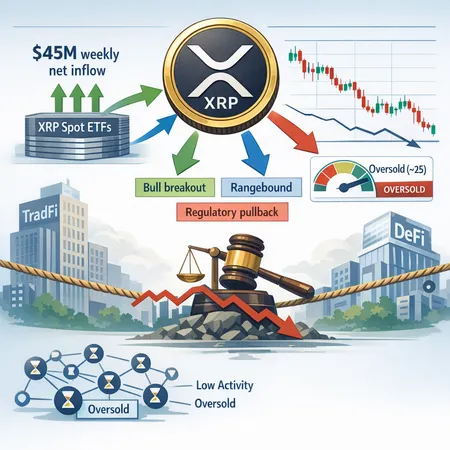
XRP presents a counterintuitive mix: fresh spot ETF demand on one side and persistent price pressure on the other. Data points diverge — weekly net inflows into XRP spot ETFs (~$45M) suggest capital allocation and appetite, while on-chain flow patterns and technical indicators read as deeply oversold. Add a regulatory backdrop where TradFi vs DeFi tensions complicate U.S. policy, and you have a market that could bounce, stall, or roll over depending on which forces dominate. This piece explains the signal mismatch and lays out scenario-based outcomes for traders and investors.
The flows: why $45M of ETF inflows matters (but has limits)
The recent report of roughly $45 million in weekly net inflows into XRP spot ETFs is a clear signal that institutional and retail ETF wrappers are attracting fresh cash. That level of ETF demand matters because ETFs aggregate capital reliably, can reduce friction for large allocators, and create a structural buyer that is not timing the intra-day spot market.
But a couple of caveats are important. ETF flows tell you demand for the wrapper, not always immediate spot accumulation on exchanges that impacts price. ETFs can be created via in-kind mechanisms or use authorized participants in ways that smooth the relationship between fund NAV and visible exchange liquidity. In short: ETF demand is bullish structurally, but not a guarantee of instant price discovery. The U.Today report covers the $45M weekly figure in context: U.Today: $45M weekly net inflows into XRP Spot ETFs.
On-chain and technical picture: why oversold signals deserve respect
Multiple on-chain indicators and classical technical tools now point to oversold conditions. Exchange reserves for XRP have fallen in recent weeks, a bullish sign when sustained — fewer coins on exchanges can limit immediate selling pressure. At the same time, metrics like realized volatility, RSI, and historical drawdown put XRP into territory that analysts classify as historically oversold.
An analysis by NewsBTC highlights that XRP has reached some of its most oversold levels historically, increasing the statistical probability of a bounce or sideways consolidation before any decisive trend resumes. See their deep-dive here: NewsBTC — XRP at most oversold level.
Technically, oversold conditions typically lead to one of three short-term outcomes: a relief rally, a dead-cat bounce that fails near resistance, or a base-building process where volatility contracts and on-chain accumulation slowly reduces supply on exchanges. Given the ETF inflows, the relief rally scenario looks plausible — but only if regulatory and liquidity dynamics don’t intervene.
The regulatory overlay: TradFi vs DeFi tensions and why they cap rallies
A major wildcard is the ongoing clash between traditional finance interests and decentralized finance proponents around U.S. regulation. Coverage from FXEmpire outlines how TradFi vs DeFi tensions are delaying clear policy frameworks, and that legal uncertainty is translating into market caution that disproportionately impacts assets like XRP with contested regulatory histories: FXEmpire — TradFi vs DeFi pressures delay U.S. crypto legislation.
Why does this matter for price? Regulatory ambiguity can: slow onboarding of institutional capital, force allocators to use caution in sizing positions, and create episodic outflows if political headlines suggest unfavorable rulings. For XRP specifically, legacy legal questions have already shaped market perception; until clarity arrives, price sensitivity to adverse regulatory news will likely remain elevated.
Reconciling ETF demand with oversold readings and regulatory risk
Put simply: spot ETF inflows and oversold technicals are not mutually exclusive. ETFs can accumulate while the broader market remains depressed if new buyer demand is offset by weak retail sentiment, programmatic selling, or regulatory-driven exits. Think of ETF flows as a steady hand at the tiller, but not necessarily a wind that always fills the sails.
Practical reconciliation:
- ETF demand reduces the structural supply over time and raises the floor if sustained. However, it can be outpaced by short-term selling or by large holders redistributing liquidity into other products.
- On-chain and technical oversold signals increase the chance of short-to-medium-term mean reversion; but rebounds can be capped by headlines and policy uncertainty.
- TradFi vs DeFi tensions create a regime where volatility spikes around legal/political events; that regime favors nimble, risk-aware positioning rather than blunt directional bets.
Scenario-based outcomes and what to prepare for
Below are three pragmatic scenarios — each includes likely drivers, price behavior, and tactical ideas.
Bearish (risk-off — regulation and macro dominate)
- Drivers: Adverse regulatory headlines, broader risk-off in crypto equities, or a sudden spike in selling from large holders. TradFi–DeFi disputes harden into restrictive guidance.
- Price action: Continued downward pressure; oversold indicators could be pierced as liquidity deteriorates. ETF inflows slow or reverse as reallocations accelerate.
- Tactics: Favor defensive sizing, use stop-losses, consider hedges via options (if available), and avoid levering new positions. Short-term traders can look for breakdown confirmations rather than fading the move.
Base/Neutral (most likely near-term path)
- Drivers: ETF inflows continue steadily but policy clarity remains gradual. On-chain accumulation persists, and exchange reserves stabilize.
- Price action: Sideways to modest upward drift as mean-reversion rallies test resistance levels. Volatility contracts; range-bound trading becomes dominant.
- Tactics: Scale into positions on dips, use tranche buys tied to on-chain accumulation or declining reserves, and consider relative trades (pair trades) against weaker altcoins or versus Bitcoin correlation shifts. Long-term investors can allocate gradually while keeping exposure manageable.
Bullish (ETF demand and clarity align)
- Drivers: Clear regulatory signals that favor market access, continued strong ETF demand, and reduced selling pressure from major holders. Positive macro sentiment toward risk assets.
- Price action: Strong directional rallies with breakouts above key resistance. Oversold conditions reverse into momentum-driven moves as FOMO returns.
- Tactics: Add to core positions, but size with discipline — use trailing stops and option structures where available. Active traders can use momentum entries after confirmed breaks and monitor fund flow reports for accelerating demand.
Practical rules for ETF-savvy traders and altcoin investors
- Treat spot ETF inflows as a structural tailwind, not an instant catalyst. Monitor weekly creation/redemption patterns if available.
- Use on-chain metrics (exchange reserves, active addresses, large holder flows) alongside classical technicals (RSI, moving averages, volume profile) to triangulate risk.
- Stay informed on regulation: follow credible coverage and legal developments because TradFi vs DeFi tensions can change market regime quickly.
- Risk sizing: limit any single-trade exposure, prefer staggered entries, and keep liquid buffers to act on opportunistic moves.
For those building tools or executing strategies, platforms like Bitlet.app can help manage dollar-cost averaging and plan entries that reconcile ETF demand signals with on-chain and technical triggers.
Conclusion
XRP today is a study in contrasts: meaningful weekly spot ETF inflows indicate demand, while on-chain and technical indicators scream oversold. The balance between these forces will be mediated by regulatory clarity — specifically the tempo of TradFi vs DeFi policy outcomes in the U.S. Traders and investors should prepare for multiple paths: a bearish shock, a base-building consolidation, or a bullish breakout if ETF demand and clearer regulation align. Position with discipline, watch flows and on-chain metrics closely, and let scenario planning guide sizing and risk.
Sources
- U.Today — XRP defies market bearishness with $45M in weekly ETF inflows: https://u.today/xrp-defies-market-bearishness-with-45m-in-weekly-etf-inflows?utm_source=snapi
- NewsBTC — XRP at most oversold level: https://www.newsbtc.com/analysis/xrp/xrp-at-most-oversold-level/
- FXEmpire — TradFi vs DeFi clash pressures XRP: https://www.fxempire.com/forecasts/article/xrp-news-today-tradfi-vs-defi-clash-pressures-xrp-near-1-4-1578036