Vitalik’s Warning to L2s, ETH Sales and Falling DeFi TVL: Innovation or Consolidation?
Summary
The signal: Vitalik’s critique and the market noise
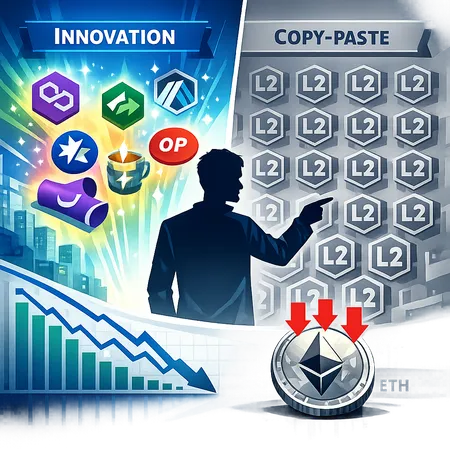
Vitalik Buterin has recently been blunt: many Layer‑2 projects are essentially copy‑paste efforts that add little beyond branding and tokenomics. He’s urged teams to stop copying and start innovating, calling for deeper technical work and meaningful differentiation rather than cloning popular stacks source and amplifying the point in follow‑ups covered across the industry source.
That critique landed amid two other headlines: a report that Vitalik (or at least large ETH sales associated with him) coincided with bearish momentum, and data showing DeFi TVL slipped, pulling the spotlight to health indicators for the Ethereum ecosystem source. Meanwhile, other coverage highlights ongoing institutional onboarding and dozens of adoption initiatives, which complicate a simplistic bearish read source.
Parsing these pieces together requires separating short‑term market noise from structural trends. Buterin’s message is normative — a call for higher technical standards — while the sales and TVL numbers are descriptive, and often volatile.
Why the criticism matters: innovation, not repetition
There are two reasons Buterin’s admonition matters:
- Protocol design is cumulative. A small architectural choice in an L2 affects composability, security, and the kinds of apps it can host. Copying a reference stack without questioning tradeoffs homogenizes the ecosystem and reduces long‑term optionality.
- Liquidity and developer attention are scarce. If many L2s offer near‑identical properties, network effects tilt toward consolidation around a few incumbents — but only after someone builds a clear, usable advantage.
Put simply: when teams equate an L2 launch with incremental engineering and heavy marketing, they risk competing on token incentives rather than product value. That’s precisely what attracts speculative flows but not sustainable user retention.
ETH sales and declining DeFi TVL: signal vs. noise
Reports that influential actors sold ETH and that DeFi TVL dropped below notable thresholds can be alarming in the short term. Yet a few cautions before drawing grand conclusions:
- On‑chain sales can be liquidity management, tax or funding events, or portfolio rebalancing rather than pure loss of faith. The raw fact of a transfer or sale needs context (size relative to total holdings, destination wallets, timing).
- TVL is an imperfect proxy. TVL counts nominal assets locked, which fluctuate with price and bridge dynamics. It also doesn’t differentiate between high‑quality collateral that supports productive lending vs. speculative, quickly moving funds.
- Meanwhile, institutional rails and integration efforts continue to advance, suggesting a more complex picture for Ethereum’s adoption curve and long‑term flow of capital into the stack source.
In short: short‑term selling and TVL compression raise questions about sentiment and liquidity dispersion, but they don’t invalidate the structural case for deeper L2 innovation.
Innovation vs consolidation: two paths for Layer‑2
The ecosystem can evolve along two non‑mutually exclusive paths:
- Consolidation: a few large L2s capture liquidity and developer mindshare because their network effects are stronger (composability, liquidity, shared tooling). This is likely if differentiation is superficial.
- Fragmented innovation: specialized L2s survive and thrive by owning distinct stacks — e.g., zk‑native privacy rollups, modular data availability rollups, L2s optimized for gaming and low latency, or those offering novel MEV‑aware architectures.
Which path wins depends on where builders place their engineering bets. If teams keep reusing the same designs to chase short cycles, consolidation accelerates. If teams invest in architecturally meaningful features — faster prover cycles, cheaper data availability, decentralized sequencers, or native primitives for cross‑rollup composability — we should expect a more diverse, resilient L2 landscape.
Concrete priorities for builders (where real differentiation matters)
Below are tactical areas where work translates into defensible product advantages rather than marketing headlines.
Data availability and modularity
Invest in how and where rollup data is posted. Differentiation here includes integration with modular DA providers, support for cheaper on‑chain proofs, and strategies that trade off L1 settlement for cheaper, scalable DA.
Validity proofs and prover economics
Optimizing proving pipelines, reducing prover costs, and shortening finality times are tangible differentiators for zk rollups. The team that reduces end‑user latency and cost while maintaining proof guarantees creates a clear UX edge.
Composability and cross‑L2 UX
Design primitives for secure cross‑rollup composability (standardized bridges, canonical asset representations) so developers don’t pay a heavy tax when building multi‑L2 apps. UX around wallet flows, gas abstraction, and native middleware matters.
Sequencer and MEV design
Sequencer decentralization and MEV capture/revenue sharing are technical levers that affect both fairness and economic sustainability. Innovate in sequencer selection, time‑band auctions, or protocol‑level MEV distribution.
Developer tooling and standards
A stack with robust SDKs, debuggers, testnets, and safety libraries lowers the onboarding cost for dApp teams — an underappreciated moat.
Security and bridge design
Prioritize audited bridges, upgradable yet safe governance models, and clear emergency procedures. Many projects lose credibility with a single loss of funds.
How investors and protocol strategists should evaluate L2s
Shift due diligence from token economics and TVL to durable, usage‑oriented metrics:
- Active users and retention (weekly/monthly active users per bridge). High churn is a red flag.
- Revenue quality: fees captured on L2 vs. token inflation subsidies. Is the protocol generating sustainable income?
- Developer activity: commits, deployed contracts, and number of active teams building on the L2.
- Composability: how easily can apps interact across rollups? Cross‑L2 TVL and native integrations matter.
- Security posture: audits, bug‑bounty history, bridge safeguards, and multisig/guardian setups.
- Prover/DA economics: who pays for proofs and data? Are costs trending down via engineering improvements?
- Real TVL composition: differentiate between long‑term locked collateral and transient liquidity from incentive programs.
For portfolio allocation, prefer L2s that demonstrate growing organic demand (not just incentive‑driven liquidity) and clear technical roadmaps that address the priorities above.
Practical steps for teams and funders
- Reassess product roadmaps: prioritize making things measurably cheaper, faster, or more composable rather than launching token models.
- Publish transparent metrics: give partners and investors a window into retention, L2 revenues, and bridge flows.
- Build shared primitives: invest in open standards that reduce the cost of cross‑L2 composability and increase network effects without compromising differentiation.
- Consider staged rollouts: prove a niche use case deeply before chasing broad generalist adoption.
A pragmatic path forward
Vitalik’s critique is a welcome nudge: the ecosystem wanted a higher bar for technical and product rigor. Short‑term market moves — ETH sales, TVL dips — will continue to create volatility. But long‑term value accrues to teams that solve real technical problems, not to those who rebrand and redistribute incentives.
For developers, DeFi investors, and protocol strategists deciding where to allocate scarce attention and capital, the choice comes down to durable product advantages. Focus on metrics that reflect sustained usage, on architectures that solve pain points rather than mirror incumbents, and on security and composability as first principles.
Bitlet.app tracks many of these dynamics in payment rails and on‑ramp behavior; watching where real users pay, trade, and hold can be a practical complement to headline TVL numbers.
Sources
- https://www.coinspeaker.com/vitalik-buterin-dumps-eth-defi-tvl-falls-below-100b/
- https://coinpedia.org/news/vitalik-buterin-warns-ethereum-l2-projects-stop-copying-start-innovating/
- https://crypto.news/vitalik-buterin-slams-copy-paste-eth-scaling-projects/
- https://zycrypto.com/ethereum-adoption-achievements-from-35-leading-institutions-and-its-ultra-bullish/
For context on ongoing ecosystem narratives, see coverage of Ethereum and broader DeFi adoption trends.