What David Schwartz’s XRPL Hub Pause Means for XRPL 3.0 and Payments Adoption
Summary
Executive summary
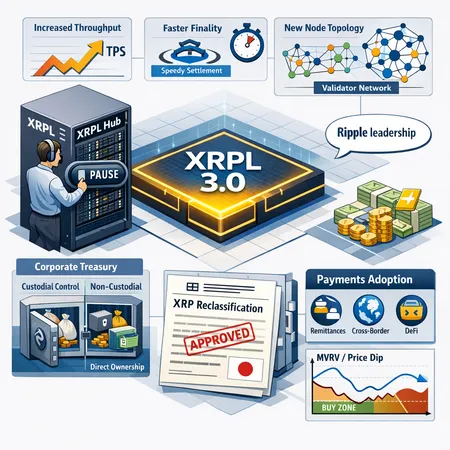
David Schwartz — long-time XRPL architect and Ripple alumnus — publicly paused his personal XRPL hub to perform an upgrade aimed at aligning with XRPL 3.0 milestones. That pause is instructive: it reveals the practical node-level operations and migration constraints that will matter to institutions evaluating XRPL as a payments rail. Taken together with Japan’s active push to reclassify XRP and public comments from Ripple leadership about idle corporate cash, we may be standing at an inflection point where technical improvements and regulatory tailwinds converge to materially accelerate payments adoption.
What Schwartz actually announced and why it matters
Schwartz’s note about shutting down his hub for an XRPL 3.0 upgrade included pre-upgrade performance numbers and an explicit operational pause, which tells us two things: first, the upgrade is non-trivial at the node level; second, early deployers are already stress-testing performance tradeoffs. The public write-up is useful because it’s not just a roadmap bullet — it’s a live experiment that surface-tests latency, CPU/memory profiles, and peer-topology behavior under real usage patterns. See the original announcement for the specifics of his hub shutdown and shared pre-upgrade telemetry.
Throughput: XRPL 3.0 is being marketed to improve transaction throughput and parallelization of some ledger tasks. Schwartz’s pause signals node software changes that likely touch transaction processing paths and the way validators gossip state — the places where throughput wins are realized but also where regressions can appear.
Finality and consensus: Architectural changes in XRPL 3.0 suggest tighter finality windows and potentially configurable confirmation semantics. For payments rails, deterministic finality is a commercial requirement: shorter finality reduces reconciliation complexity and counterparty credit exposure during settlement.
Node topology and operational cost: The hub shutdown highlights how node operators will need to re-evaluate their topology (full validators vs. lightweight peers, hub-spoke patterns) and capacity planning. That in turn impacts hosting decisions, failover design and the economics of running validator infrastructure.
Taken together, Schwartz’s hands-on upgrade provides an early, practical template for institutional node operators to study — not just theoretical claims but actionable performance observations. For the announcement and pre-upgrade performance data, see the report of his hub maintenance in U.Today.
How XRPL 3.0 could reshape custodial vs. noncustodial flows for corporates
A ledger upgrade is significant when it changes settlement cost, latency and operational control. XRPL 3.0 appears focused on making the ledger more performance-scalable and flexible in node roles, which directly maps to corporate treasury considerations.
Custodial flows: Faster throughput and shorter finality can make custodial offerings more efficient and cheaper to run; fewer reorg concerns and quicker settlement reduce capital locked in rails. That enables custodial providers to offer lower fees and tighter SLAs — attractive to treasuries managing large idle balances.
Noncustodial flows: Improved node software and richer topology options can lower the barrier for corporates to run their own validators or dedicated observers. For firms that prioritize control and regulatory auditability, this means they could rely less on third-party custodians while still achieving low-latency settlement.
Hybrid models: Real-world treasury operations often land in hybrid architectures: corporates keep funds with regulated custodians but operate proprietary validators or observers for reconciliation, monitoring and faster finality confirmation. XRPL 3.0’s changes make these hybrid architectures more practical by reducing the resource and complexity premium of running node infrastructure.
This is also where Ripple’s commercial messaging matters. Monica Long has argued that trillions in idle corporate cash will be a driver for crypto and stablecoin adoption, especially when rails are reliable and low-cost. Her point frames the business case: if XRPL 3.0 lowers operational friction, corporates can put a small portion of idle cash to work using tokenized instruments or stablecoin rails with predictable settlement times. See Monica Long’s commentary for broader market context.
Regulatory tailwinds: why Japan’s reclassification matters
Regulation is often the gating factor for treasury adoption. Japan’s active discussions to reclassify XRP and give it clearer regulatory status change the onboarding calculus in a few ways:
Reduced custody ambiguity: If a major jurisdiction clarifies that XRP is a payments-or-asset class with clear rules, custodians and banks are more comfortable holding and transacting in XRP. That reduces counterparty legal risk for corporates.
Faster KYC/AML operationalization: Clearer rules simplify compliance playbooks; compliance teams can map XRP flows to existing money-transmission or securities frameworks rather than invent bespoke policies.
Signaling effect: Japan’s moves provide a regulatory blueprint for other countries. When a large, reputable market adopts a workable classification, global banks and treasury teams treat it as a de-risking signal.
For practitioners, this matters not just as headline risk reduction but in concrete terms: onboarding timelines shorten, legal opinions are less contentious, and custody contracts become simpler. For coverage of Japan’s regulatory push and why the market is paying attention, see the reporting from Bitcoinist.
Short-term market signals (MVRV, price dips) and why the upgrade is not only about price
Price action often dominates headlines, but ledger upgrades and regulatory clarity have operational value beyond short-term market moves. Recently, on-chain metrics like the 30-day MVRV indicated that XRP dipped into undervalued territory; that’s an important market signal but not the whole story.
MVRV context: A 30-day MVRV dip suggests recent holders are at a paper loss versus realized value; it can signal capitulation or accumulation windows. Traders watch this, but treasury teams should care more about settlement risk, liquidity depth and operational cost than day-to-day MVRV oscillations. See the Cryptopolitan piece for the on-chain metric discussion.
Liquidity and venue access: Even with a dip, if custodians, exchanges and payment integrators broaden access post-regulatory clarity and after XRPL 3.0 stabilizes, liquidity depth improves — which is a more durable enabler for payments adoption than short-term price moves.
Sentiment vs. utility: An upgrade can change the utility calculus (cheaper, faster settlement, easier custody patterns), which can attract corporate flows irrespective of transient market sentiment. In short: price is a signal, not the driver of long-term payments adoption.
Operational and compliance implications for treasury, compliance and node operators
For treasury managers:
Consider a phased pilot: Start with a small allocation for rail-testing (payments, settlements, or stablecoin gateways) and measure settlement times, reconciliation overhead and custody SLAs. XRPL 3.0’s faster finality should reduce reconciliation lag — quantify that.
Liquidity buffers: Even with faster settlement, maintain short-term liquidity buffers to handle off‑ramp or fiat conversion frictions.
For compliance teams:
Update risk assessments: Re-run money-transmission, sanctions screening and peacocked AML models against new XRPL 3.0 observability features and Japanese regulatory templates.
Engage custody partners: Ask custodians how XRPL 3.0 changes their Proof-of-Reserves, auditing cadence and cryptographic key controls.
For node operators and infra teams:
Re-evaluate topology: Test both full-validate and observer modes under XRPL 3.0 in staging, and plan for rolling upgrades with clear fallbacks.
Capacity planning: Benchmark CPU, memory and disk I/O for XRPL 3.0 under expected TPS. Schwartz’s hub telemetry is a helpful starting datapoint for realistic expectations.
Bitlet.app users and integration engineers should treat this like any rails migration: run canary nodes, keep robust monitoring, and pair technical pilots with legal/compliance sign-offs.
Why institutions should pay attention now
Three converging factors make XRPL 3.0 more than an engineering milestone: (1) the upgrade targets the exact pain points that slow corporate adoption (throughput, finality, node economics); (2) Japan’s regulatory momentum reduces legal onboarding friction; and (3) Ripple’s commercial narrative about idle corporate cash frames a tangible demand pool for payments and stablecoins. If these vectors continue to align, expect more pilots from banks, PSPs and large corporates — but executed carefully, not blindly.
Recommended next steps for product and institutional strategists
Run a short technical pilot: Deploy observer nodes running XRPL 3.0 in a lab environment and replicate Schwartz’s telemetry scenarios. Measure latency, finality and reconciliation times.
Coordinate legal, compliance and treasury: Prepare a joint checklist that maps regulatory status (using Japan’s framework as a template) to custody requirements and onboarding timelines.
Design hybrid custody pilots: Test split custody or on-prem validator setups to retain control while leveraging custodial liquidity.
Monitor on-chain health and market signals: Track MVRV and liquidity depth, but prioritize operational KPIs (settlement windows, CPU/memory profile, audit trails).
Conclusion
David Schwartz’s public hub pause is a valuable, practical data point — it makes the invisible costs and tradeoffs of a ledger upgrade visible to institutions. XRPL 3.0 can materially improve the operational calculus for corporate payments by reducing settlement times and lowering node economics, while Japan’s regulatory momentum and Ripple’s commercial positioning create an environment where treasuries and payment providers can start to move from analysis to pilots. Traders will watch price and MVRV, but for product and institutional strategists the immediate question is operational readiness: can you run, monitor and reconcile XRPL 3.0 nodes alongside your compliance and custody stack? If the answer is yes, this is a strategic moment to experiment and define production paths.
Sources
- David Schwartz’s hub shutdown and XRPL 3.0 pre-upgrade data: Ex-Ripple CTO provides major update on his XRP experiment (U.Today)
- Japan’s regulatory push to reclassify XRP: Why is Japan All In On XRP? (Bitcoinist)
- On-chain metric and recent MVRV dip analysis: XRP dips 5.7% into the undervalued zone (Cryptopolitan)
- Monica Long on idle corporate cash driving adoption: 700,000,000,000 sitting idle on S&P 1500 balance sheets will drive next wave of crypto adoption (DailyHodl)
For comparative context on rails and market bellwethers, many strategists still watch Bitcoin and DeFi flows as a proxy for institutional risk appetite.