K33’s USDC Loans Against BTC: What Institutional-Style Crypto-Backed Lending Means for Liquidity and Risk
Summary
Executive overview
K33’s announcement that it will offer USDC loans collateralized by Bitcoin is more than a new product launch — it signals a maturing credit layer in crypto where institutional-style collateralized lending becomes a mainstream tool for market participants. For many traders, Bitcoin remains the primary market bellwether, and the way BTC is used as collateral will shape spot liquidity, funding markets, and borrowing costs.
This article walks through the product mechanics (collateralization, LTVs, liquidation rules), compares K33’s offering with incumbent centralized lenders and margin platforms (contextualized by NEXO’s recent stablecoin inflows), and assesses likely effects on BTC supply on exchanges and spot liquidity. Finally, we unpack regulatory, custody, and counterparty risks for borrowers and lenders — the concrete issues that determine whether crypto-backed loans are a stabilizer or a new source of systemic fragility.
How K33’s USDC-for-BTC loans work (product mechanics)
At a high level, crypto-backed loans exchange price-stable liquidity (USDC) for a pledge of BTC. Key mechanics to evaluate:
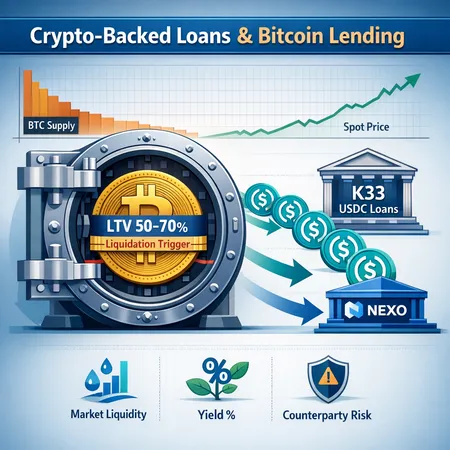
Collateralization and LTV: K33 will require borrowers to post BTC at a defined loan-to-value (LTV), which sets the initial leverage and safety margin. Lower LTVs (e.g., 40–60%) are conservative; higher LTVs (70%+) enable more capital efficiency but raise liquidation risk during drawdowns.
Liquidation triggers and process: Loans typically include a maintenance margin or liquidation threshold. If BTC value falls and the loan’s LTV breaches that threshold, the protocol or custodian initiates a liquidation — either an on-platform auction, an automated market sale, or third-party execution. The specifics (speed, auction mechanism, penalties) materially affect realized losses for borrowers and slippage for markets.
Pricing and oracles: Real-time, robust price feeds determine when liquidations occur. Oracle resilience (redundant feeds, TWAPs, circuit-breakers) matters: a single broken feed can trigger cascading liquidations. Institutional-style lenders often combine exchange and aggregated OTC prices to reduce flash-event risks.
Custody and segregation: Institutional users expect segregated custody and clear rehypothecation rules. Does K33 leave collateral in client-controlled custody (non-rehypothecated) or does it allow rehypothecation for balance-sheet use? The former reduces counterparty exposure but constrains liquidity; the latter increases market efficiency but raises creditor-priority concerns in insolvency.
Contract terms and recourse: Are loans non-recourse (collateral only) or recourse (lender can seek additional recovery)? Non-recourse is simpler for borrowers but concentrates risk on lenders and counterparties.
K33’s announcement frames the new product as USDC loans backed by BTC (the primary product detail source), and institutional buyers will look for transparent LTV schedules, explicit liquidation fallbacks, and strong custody guarantees to treat these loans like a financing tool rather than a high-risk margin product. See the K33 product announcement for the initial specification and rollout details (K33 launch announcement).
Why LTV and liquidation design matter for market liquidity
If a lender sets high LTVs and tight liquidation thresholds, a moderate BTC drawdown can produce large, forced sales. Those sales reduce BTC supply on exchange order books, spike slippage, and can turn localized liquidations into broader price declines. Conversely, conservative LTVs and flexible liquidation mechanisms — staggered auctions, negotiated OTC settlements, or time-weighted exits — can diffuse selling pressure and preserve orderly markets.
How K33 compares with incumbent centralized lenders
The centralized lending landscape is diverse: from large custodial lenders and trading firms to modern non-custodial DeFi protocols. Two useful comparators:
NEXO and large centralized platforms: Centralized lenders like NEXO have shown strong demand for stablecoin credit lines; NEXO surpassed $30 billion in stablecoin inflows as crypto-lending demand surged (Blockonomi coverage). That inflow snapshot underscores institutional and retail appetite for stablecoin-backed balance-sheet operations. Such incumbents often offer faster execution, deep balance sheets, and wrapped collateral programs, but they also bring concentrated counterparty risk and opaque rehypothecation practices.
DeFi lending and margin protocols: On-chain lending often enforces strict overcollateralization and transparent liquidation mechanics enforced by smart contracts. DeFi's strengths are transparency and composability; its weaknesses are oracle vulnerability and sometimes procyclical liquidations in periods of extreme volatility.
K33 seeks a middle path: institutional-style underwriting and custody with a product aimed at liquidity-demanding borrowers who want USDC rather than selling BTC. The market backdrop — including the stablecoin inflows into major lenders — shows there’s significant capital chasing collateralized lending returns and utility.
Likely effects on BTC exchange supply and spot liquidity
Crypto-backed lending that converts BTC to USDC without requiring spot sales can reduce immediate selling pressure in theory. Borrowers who would otherwise sell BTC to raise dollars can instead borrow, keeping BTC off market order books. This mechanism can be liquidity-accretive: it reduces forced selling and may support spot prices.
However, there are important caveats:
Rehypothecation and margin reuse: If lenders rehypothecate collateral or deploy it in markets, they can increase leverage and create synthetic supply pressure later. That reuse can concentrate liquidity risk across platforms.
Liquidations still cause sales: In stressed markets, margin calls and automated liquidations may still push BTC to exchanges — sometimes at worse prices than an orderly OTC sale. The difference lies in liquidation mechanics: auction vs. negotiated OTC sale.
Institutional flows and ETF demand: Recent large inflows into BTC and ETH ETFs (nearly $2 billion in a strong week) signal renewed institutional appetite that can absorb some loan-financed USDC buying power or provide exits for liquidations without collapsing order books (CoinDesk ETF inflows). If ETF channels remain deep, platform liquidations may be less disruptive.
Net effect: well-structured USDC loans against BTC can reduce routine spot supply and smooth selling during normal volatility, but in extended drawdowns poor liquidation design or rehypothecation can amplify stress.
Regulatory, custody, and counterparty risk considerations
Institutional adoption hinges on clear legal frameworks and mitigations for credit risk. Areas to scrutinize:
Custody segregation and creditor priority: Does the loan contract clearly state ownership rights in insolvency? Custody segregation and bankruptcy-remote structures matter; lenders that commingle assets or rehypothecate without clear customer protections create elevated legal risk.
Counterparty solvency and disclosure: Borrowers should evaluate lenders’ own balance sheets, asset-liability matching, and stress tests. Centralized lenders with opaque balance sheets introduce credit risk that’s not present with fully overcollateralized, on-chain models.
Stablecoin issuer risk: Borrowing in USDC introduces exposure to the issuer (Circle) and regulatory scrutiny of stablecoin reserves and convertibility. Loan users are effectively long lender credit and short stablecoin issuer risk.
Regulatory compliance and licensing: Lenders operating across jurisdictions face varying requirements for custody, lending, and securities laws. Institutional borrowers will favor platforms with clear licensing and strong KYC/AML compliance.
Market and oracle manipulation risk: Price feeds and execution venues must be resilient. Protocols can mitigate this with multi-source oracles, TWAPs, and manual circuit breakers.
Transparency and governance: Regular reporting, proof-of-reserves, and independent audits reduce information asymmetry and build trust among institutional counterparties.
Practical takeaways for borrowers and lenders
Borrowers seeking USDC loans against BTC should prioritize platforms that publish LTV bands, liquidation mechanics, custody arrangements, and proof-of-reserves. Conservative LTVs and flexible liquidation rules reduce tail-risk.
Lenders should avoid unmanaged rehypothecation and should stress test portfolios against both price shocks and mass redemptions. Diversifying collateral and having fallback auction partners or OTC desks reduces execution risk.
Both sides should monitor macro liquidity channels such as ETF flows: sustained inflows into BTC products (CoinDesk coverage) increase the ecosystem’s ability to absorb liquidation-related selling.
Keep an eye on market concentration indicators. Large stablecoin inflows (e.g., NEXO’s milestone) show demand but also create concentration if routed through a few platforms.
Conclusion
K33’s USDC loans secured by BTC add another institutional-style credit option to the crypto ecosystem. Done right — with conservative LTVs, robust custody and oracle design, transparent liquidation mechanics, and clear legal protections — these loans can reduce routine spot selling and enhance capital efficiency for institutional borrowers. Done poorly, they can become a contagion vector through rehypothecation, opaque balance sheets, or brittle liquidation systems.
For investors evaluating platforms, the decision comes down to trade-offs: capital efficiency versus counterparty and operational risk. Platforms like Bitlet.app and other market tools will be watching how these lending flows change on-exchange BTC supply and whether liquidity channels such as ETFs can absorb or dampen stress events. Ultimately, product design and transparency — not marketing — will determine whether crypto-backed loans become a net stabilizer for the market.
Sources
- K33 announcement: K33 launches crypto-backed loans allowing users to borrow against Bitcoin
- Context on lending demand: NEXO surpasses $30 billion in stablecoin inflows
- ETF inflows context: Bitcoin and Ether ETFs post best week since October with nearly $2 billion in inflows