How Much Should Ray Dalio’s Bitcoin Critique Move the Needle for Investors?
Summary
Why Dalio’s critique matters to allocators
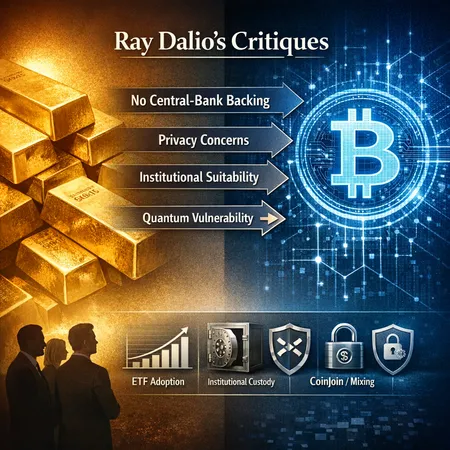
Ray Dalio’s comments — summarized in press coverage and commentary here and unpacked further by outlets like Blockonomi and CoinGape — quickly became a talking point for wealth managers weighing crypto exposure. He frames Bitcoin as fundamentally different from gold because it lacks central‑bank backing, has privacy and institutional suitability constraints, and may be vulnerable to quantum computing. These are high‑stakes claims when pension funds, family offices, and sovereign wealth funds debate meaningful allocations.
This piece evaluates each of Dalio’s three core points against current on‑chain and market evidence, and then translates that analysis into practical guidance for sophisticated investors and allocators.
Dalio’s three core arguments, briefly summarized
Lack of central‑bank backing and monetary anchoring: Dalio argues that gold’s centuries‑long role as a monetary anchor and its central‑bank reserves make it uniquely suited as a safe haven in crisis. Bitcoin lacks analogous official backing or liability‑free reserve status. Sources: NewsBTC and Blockonomi cover his framing in detail.
Privacy and institutional suitability: He suggests Bitcoin’s transparency, regulatory friction, and privacy shortcomings limit its usefulness for institutions that need confidentiality, capital controls navigation, and simple settlement mechanics.
Quantum vulnerability: Dalio raises the specter that future quantum computers might break the cryptographic primitives that underpin Bitcoin, making it an insecure store of wealth.
Each of these deserves a reality check.
1) Central‑bank backing: what it buys and what it doesn’t
Dalio is right that gold benefits from being a long‑standing central‑bank reserve asset. That status gives gold deep support during certain macro regimes because central banks hold it as an official asset on balance sheets.
Counterpoints worth noting:
Market adoption and institutional acceptance can functionally mimic some reserve properties. Since the approval of spot BTC exchange‑traded products and increased institutional custody offerings, Bitcoin has attracted significant institutional capital and treasury allocations from corporations and funds. While this is not the same as central‑bank reserves, it does create a large, persistent demand pool that can support long‑term price resilience.
Bitcoin’s policy‑resistant monetary rule (fixed issuance) is an economic property that some investors treat as a non‑state hedge — different from gold but meaningful. That property has attracted allocators seeking an asset uncorrelated with fiat expansion.
So: Dalio’s institutional argument is doctrinally correct — gold’s reserve status is unique. But in practice, a network of institutional holders, regulated custodians, and retail demand can create a tranche of “market reserve” behavior for BTC that partially — not fully — overlaps with gold’s role.
2) Privacy and institutional suitability: trade‑offs and progress
Dalio’s point that privacy constraints and regulatory scrutiny limit Bitcoin’s institutional utility is grounded in reality. Bitcoin’s transparent ledger makes some privacy‑sensitive uses difficult, and compliance teams worry about AML/KYC, de‑risking and reputational exposure.
However, the ecosystem has evolved along several fronts:
Custody solutions: Qualified custodians and institutional custody products (MPC multisig, insured custody, and regulated trust models) have proliferated, letting institutions meet their governance and compliance needs while holding BTC under secure frameworks. These custody innovations close much of the practical gap Dalio highlights on institutional suitability.
Privacy tech progress: While Bitcoin is not a privacy coin by design, improvements such as Taproot/Schnorr (which improves plausibly deniable spending patterns for some use cases), CoinJoin implementations (Wasabi, Samourai) and off‑chain networks like Lightning provide increasingly privacy‑friendly rails. They don’t make Bitcoin fully private, but they expand the spectrum of transaction patterns available.
Product evolution: Institutional products (spot ETFs, futures with regulated settlement, OTC desks with compliance tooling) make BTC operationally accessible to asset managers who need KYC/AML transparency and custody assurances.
The implication: privacy remains a legitimate constraint for some use cases, but institutional suitability has improved materially. Institutions can now obtain custody wraps and compliance controls that make holding BTC operationally viable.
3) Quantum risk: real but distant (and manageable)
Dalio’s quantum warning taps into a genuine technical vulnerability: widely used asymmetric cryptographic primitives (ECDSA/ECDH using secp256k1) could, in theory, be broken by sufficiently powerful quantum computers running algorithms like Shor’s.
Important context for investors:
Timeline uncertainty: Current public estimates of when a quantum computer could break secp256k1 vary widely. Most mainstream cryptographers and institutions treat the risk as medium‑term rather than immediate. The window could be years to decades — not months.
Practical exploitability constraints: Attacks would plausibly target private keys that have been exposed via on‑chain public spending patterns (for example, addresses that reveal public keys after a spend). Keys that remain off‑chain (cold storage, multisig) reduce attack surface.
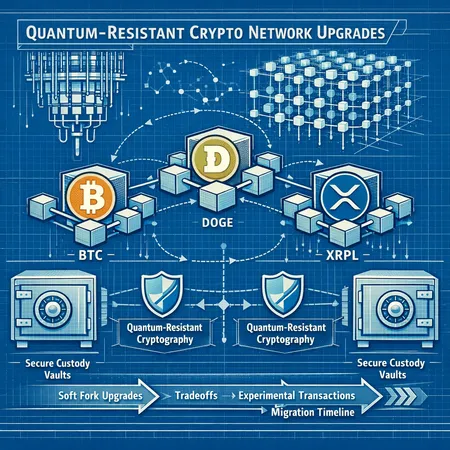
Migration and mitigation paths: The crypto community, standards bodies, and national labs are investing in post‑quantum cryptography (PQC). Transitioning Bitcoin to PQC‑secure signature schemes is technically plausible — though socially and technically complex — and many networks and custody providers are already planning contingency strategies.
In short: quantum computing is a credible long‑term technical risk, but it is not a near‑term existential collapse. Investors should monitor academic and industry milestones and prefer custody practices that reduce key exposure.
On‑chain and market evidence that counters (or complicates) Dalio’s framing
ETF adoption and institutional flows: The approval of regulated spot and futures vehicles, along with enterprise treasury allocations, signals that institutional frameworks have matured. These products bring regulated access, audit trails, and familiar custody paradigms to institutional allocators.
Custody landscape: The growth of regulated custodians, insured custody products, multi‑party computation (MPC) schemes, and bank custodial involvement reduces the operational barriers that Dalio highlights.
Privacy tooling and off‑chain rails: Taproot, CoinJoin services, and Lightning Network advancements make certain privacy properties better than a few years ago, though Bitcoin is not and likely won’t become an anonymity network by design.
Active research on quantum resilience: Academic and industry work on PQC provides credible pathways to remediation before a practical quantum attack emerges.
Collectively, these developments show Bitcoin is moving toward more institutional maturity. That doesn’t erase the differences with gold — it narrows actionable gaps for many investor use cases.
Investor use cases: store‑of‑value vs medium‑of‑exchange — and what that means for allocation
Investors should separate two primary use cases when deciding how Dalio’s critique should affect allocations:
Store‑of‑value (SoV): Investors who treat BTC as a potential inflation hedge or uncorrelated asset are most sensitive to macro, liquidity, custody and narrative risk. Dalio’s points about reserve status and quantum risk matter here, but they are among several factors (volatility, tax treatment, correlation regimes). For these investors, a modest allocation (single‑digit percentage of liquid portfolio, depending on risk profile) with strong custody and a migration plan for PQC is sensible.
Medium‑of‑exchange (MoE) and payments: For users focused on payments, privacy and transaction finality are critical. Here Dalio’s privacy critique is more consequential. Lightning and off‑chain solutions may be more appropriate than on‑chain BTC for payment rails.
For wealth managers: treat BTC as a distinct risk‑bucket. Size allocations according to client risk tolerance, investment horizon, and the degree to which BTC’s idiosyncratic risks (regulatory, narrative, quantum) are tolerable.
Custody and privacy trade‑offs: practical rules for allocators
Prioritize custody governance over DIY narratives. Use regulated custodians or a multi‑custodian approach for large allocations.
Use cold, air‑gapped key storage for long‑term holdings and prefer multisig or MPC where possible to reduce single‑key attack vectors.
Build a migration playbook: identify monitoring triggers (quantum benchmarks, major cryptographic breakthroughs) that would prompt a coordinated migration to PQC signatures or key rotations.
Balance privacy with compliance: if a client needs privacy, use privacy‑aware practices (off‑chain settlement, CoinJoin, Lightning) while documenting the compliance rationale.
Mentioning market infrastructure: platforms like Bitlet.app and regulated custodians are part of the evolving service layer that wealth managers can leverage when constructing compliant exposure to BTC.
How much should Dalio’s critique change allocations? A pragmatic view
For long‑term, diversified allocators: Dalio’s critique should be one input among many. Gold’s uniqueness as a central‑bank reserve is real, but Bitcoin’s different properties (fixed supply, digital portability, network effects) justify a role as a diversifier. Most fiduciaries will find Dalio’s points important but not dispositive.
For conservative institutional treasuries: Dalio’s emphasis on formal reserve status and privacy may counsel caution. Institutions with low appetite for narrative or technical risk may prefer to increase allocations to gold or cash equivalents over BTC.
For allocators seeking asymmetric upside: Bitcoin’s idiosyncratic risks are part of the return story. Those willing to manage custody and monitor technical risks may maintain or increase allocations despite Dalio’s critique.
Quantification note: there is no one‑size allocation. Many family offices and funds that view BTC as a diversifier choose low single‑digit allocations, while more aggressive allocators may hold higher percentages. Dalio’s critique should temper enthusiasm but not automatically reduce BTC to zero.
Short‑to‑medium term technical risk checklist (actionable)
Monitor cryptography milestones: follow academic publications and NIST PQC progress.
Prefer custody solutions that minimize on‑chain public key exposure for large holdings.
Maintain insurance and multi‑custodian strategies to mitigate counterparty risk.
Keep an operational migration plan for key rotation or protocol upgrades should PQC become urgent.
Conclusion: balance skepticism with evidence
Ray Dalio’s Bitcoin critique correctly highlights meaningful differences between BTC and gold: reserve status, privacy, and the theoretical quantum vulnerability matter. Yet the empirical landscape has shifted — institutional products, regulated custody, improved privacy tooling, and active research on quantum resistance all blunt those arguments.
For sophisticated investors and wealth managers the right stance is prudently balanced: recognize Dalio’s concerns, build governance and contingency plans that address them, but also acknowledge Bitcoin’s evolving institutional infrastructure and potential portfolio diversification benefits. Treat BTC as a distinct asset class with specific operational demands, not as a direct one‑to‑one replacement for gold.
Sources
- Ray Dalio’s remarks and summary coverage: NewsBTC coverage of Dalio’s comments.
- Analysis of Dalio’s full argument set: Blockonomi piece on Dalio’s views.
- Additional reporting and context: Coingape summary of Dalio’s critique.