XRP’s March Momentum: Can Institutional Moves and New Infrastructure Turn Momentum into Tradability?
Summary
What happened in March: momentum, whales and the ETF narrative
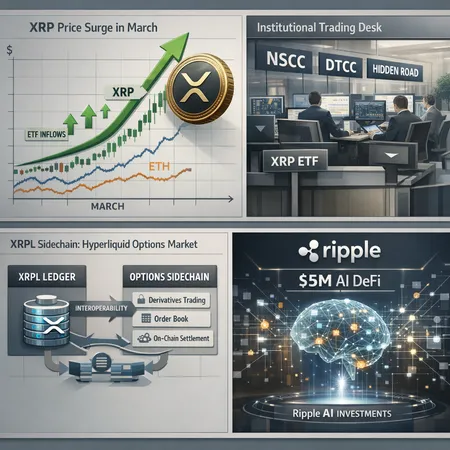
XRP showed a clear rebound in early March, drawing renewed attention from traders and market watchers. Short‑term price action reflected both spot technicals and renewed speculation that wider institutional plumbing could make XRP easier to hold and trade at scale. Media and analysts flagged whale accumulation and a reduction in selling pressure as part of the move, and commentators tied part of the momentum to the broader conversation around spot exchange‑traded funds (XRP ETF) and whether institutional demand could materialize if custody and settlement frictions fall.
Price momentum alone rarely changes the structural story, but momentum matters because it focuses capital and attention. For many traders, Bitcoin remains the primary market bellwether; XRP’s recent pickup is notable because it occurred alongside infrastructural headlines that could affect long‑term tradability rather than being merely speculative noise.
Institutional plumbing: Hidden Road, NSCC/DTCC and why it matters
A practical bottleneck for institutional flows into tokens is not just compliance — it’s custody, clearing and settlement. The announcement that Hidden Road is now live on the NSCC (the clearing arm of the DTCC) represents a connectivity milestone: it signals progress toward integrating digital‑asset custody and post‑trade processes with the traditional securities plumbing institutional desks use every day. Finbold covered this step and its potential to make tokenized flows operationally easier for large financial players.
Why is that relevant to XRP and tradability? Institutions rarely adopt assets that require bespoke plumbing. When custody, clearing and settlement operate within familiar rails, the incremental operational risk of holding a token declines. That can reduce the premium institutions demand for onboarding and custody, lower bid/ask spreads in institutional books, and increase the willingness of market makers to provide continuous liquidity.
That said, Hidden Road’s DTCC connectivity is a necessary but not sufficient condition for inflows into XRP. For custody to translate into actual buys, asset managers need cleared products (for example, ETFs or tokenized securities) that use these rails. The flow path looks like: custody/clearing availability → product issuance (ETFs, tokenized funds) → investor demand → on‑chain or exchange trading. Hidden Road addresses the early steps, which are important, but product issuance and demand must follow.
The XRPL sidechain pitch: options market opportunity and the design choice that matters
The XRPL community has discussed building a Hyperliquid‑like sidechain aimed at exchange‑grade options execution to tap a roughly $40B options market opportunity. Cryptoslate’s coverage lays out both the ambition and the tradeoffs: to make options trading on XRPL attractive to exchanges and professional market makers you need millisecond execution, deep liquidity, and clearing workflows that align with institutional expectations.
Here’s the critical design fulcrum: does the sidechain require XRP for settlement, margin, or gas, or does it use neutral primitives such as stablecoins and external collateral? If the architecture embeds XRP as the native settlement or collateral asset, the impact on on‑chain demand is straightforward — options issuance and settlement would create systematic, recurring demand for XRP, not just episodic trading flows. Conversely, if the marketplace uses stablecoins or off‑chain collateral, the benefits to XRP’s native demand are muted; the sidechain might still benefit the XRPL ecosystem but not materially increase XRP‑denominated liquidity.
Beyond currency choice there are operational issues that will decide adoption: how custody providers (like Hidden Road) integrate the sidechain, whether existing derivatives venues can route order flow there, and how clearing is handled at the DTCC/NSCC level. Each link in that chain introduces friction and timeline risk. If the XRPL sidechain nails latency, liquidity incentives and integrates with incumbent custody/clearing systems, it could become a venue where institutional desks post and hedge large options books — and that would be a structural change.
Ripple’s $5M bet on AI‑driven DeFi: diversification or distant promise?
Ripple’s strategic $5M backing of AI‑driven DeFi infrastructure signals a product diversification beyond payments and settlement. As reported by Coinpaper, the investment targets protocol designs where AI agents assist in liquidity routing, risk management, and perhaps automated market‑making. That’s a different axis of utility: instead of simply making XRP easier to settle, these projects aim to increase the functional uses of XRPL and related rails.
From the standpoint of tradability, AI‑augmented DeFi could improve on‑chain liquidity efficiency — smarter routing could tighten spreads and lower slippage for large orders. For institutions and advanced retail traders executing sizeable trades, reduced execution costs matter. But this is a longer horizon value driver. AI infrastructure is promising, and it may compound other developments (like the sidechain), but it won’t by itself create immediate institutional demand unless regulatory and custody gaps are closed.
How these pieces fit together: scenarios for on‑chain demand and tradability
Think in terms of conditional scenarios rather than binary outcomes. Below are three plausible paths and their implications for XRP demand and tradability.
1) Base case — incremental improvement
Hidden Road/DTCC integration reduces operational friction, the XRPL options sidechain progresses but uses stablecoins for margin, and Ripple’s AI investments incubate experimental DeFi primitives. In this scenario, tradability improves: institutional desks find it easier to custody and trade tokenized exposures, market‑making tightens a bit, and OTC desks feel more comfortable quoting larger sizes. However, because the derivatives and DeFi stacks don’t require XRP as collateral, on‑chain demand for XRP grows only modestly and remains dominated by speculative flows.
2) Optimistic case — architecture aligns with XRP
Hidden Road and similar custodians fully support XRPL rails for cleared settlement, the sidechain mandates or incentivizes XRP usage for margin or settlement, and AI‑driven liquidity tools improve execution quality. Here, demand dynamics change materially: options issuance and settlement create recurring demand for XRP, institutional desks and market makers hold strategic XRP balances, and liquidity deepens to the point where spreads compress meaningfully. This is the thesis under which an XRP ETF narrative becomes operationally credible and flows could resemble those that followed BTC/ETH ETF approvals.
3) Pessimistic case — fragmentation and regulatory drag
Custody remains siloed, the sidechain stalls or deliberately avoids XRP to sidestep volatility risk, and AI projects struggle for product market fit or regulatory clearance. Tradability stagnates; any momentum is short‑lived and driven by retail sentiment. Institutional desks stick with BTC/ETH and tokenized securities that map cleanly to fiat risk profiles.
Practical risks and execution hurdles
- Design risk: If the XRPL sidechain intentionally avoids XRP exposure, it limits the token’s derivative‑driven demand. The architecture choice is the linchpin.
- Custody/clearing adoption: Hidden Road’s DTCC milestone is meaningful, but widespread institutional use requires multiple custodians, market makers, and product issuers to operationalize flows.
- Liquidity provisioning: Even with infrastructure, market makers must be willing to post tight markets for large sizes. That depends on perceived counterparty, regulatory, and balance‑sheet costs.
- Timing and regulatory clarity: Institutions move slowly. Even technically solved problems can take quarters or years to produce large tick‑up in traded volumes.
What to watch next (practical indicators)
- Product issuance: announcements of tokenized funds or ETFs explicitly tied to XRPL rails or custody arrangements that reference Hidden Road/DTCC. That’s the clearest short‑term signal that custody improvements are converting into investable products.
- Sidechain design choices: public proposals or governance votes that state whether XRP will be required for margin/gas/settlement. That decision is the single biggest determinant of derivative‑driven XRP demand.
- Market‑maker participation: public commitments or pilot programs from established liquidity providers to quote on XRPL venues or the proposed sidechain.
- Execution improvements from AI tools: pilot results demonstrating lower slippage or better routing for large institutional trades.
Platforms like Bitlet.app and institutional desks will monitor these indicators closely — improvements in custody and execution often precede sustained volume shifts.
Bottom line: momentum plus infrastructure creates potential, not a guarantee
XRP’s March momentum matters because it coincides with infrastructure and strategic moves that reduce several real frictions for institutional adoption. Hidden Road going live on NSCC/DTCC is a practical milestone that lowers operational resistance; the XRPL options sidechain could unlock a large derivatives pool if its architecture links demand to XRP; and Ripple’s AI investments may improve execution and DeFi services over time.
However, the translation from infrastructure to material tradability depends on design and adoption choices. The single most consequential question is whether new derivatives and execution venues require XRP as a native economic primitive. If they do, the effect on on‑chain demand and tradability could be sizable. If they don’t, the ecosystem still benefits, but XRP’s direct demand may only edge higher.
For advanced retail and institutional readers assessing the landscape, the prudent view is conditional optimism: these developments materially raise the possibility of deeper, more persistent capital flows into XRP — but they are not a guaranteed switch that will instantly replicate BTC/ETH ETF inflows. Watch custody integrations, sidechain governance decisions, and early product issuance as the clearest signals that momentum is converting into structural tradability.