SHIB Derivatives Spike: What the 666% Futures Flow Surge Reveals About Meme‑Coin Risk
Summary
Executive snapshot
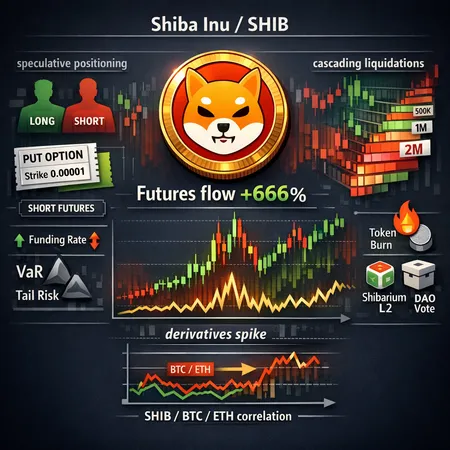
The Shiba Inu ecosystem is back under the microscope after on‑chain data and flow trackers registered a 666% short‑term futures flow spike in SHIB derivatives. That kind of number is not a routine uptick; it signals concentrated rate‑of‑change in speculative positioning that can turn a token‑specific move into a market‑wide stress event. For derivatives traders and risk officers, the incident is a useful case study in how meme‑coin liquidity and crowd psychology interact with leveraged products.
What happened: the 666% futures‑flow spike explained
The headline figure — a 666% surge — came from trackers watching short‑term futures interest and new order flow into SHIB contracts. In plain terms: traders piled into futures (and likely leveraged long positions) over a short window, far exceeding typical baseline activity. Reporting on the event highlighted both the metric and its timing: a rapid inflow of speculative capital that briefly dwarfed normal steady‑state volumes (U.Today report).
Why it matters: futures flow is both a measure of directional conviction and a proxy for potential liquidation pressure. When many participants take leveraged longs simultaneously, a modest adverse move can trigger margin calls, forced deleveraging, and a cascade of market sales that deepen the down move.
Top‑trader positioning and fading conviction: a dangerous blend
Analysis of exchange orderbooks and derivatives positioning shows a pattern often seen in meme‑coin cycles: top traders—entities with high notional exposure—initially push a narrative (buy the rumor, buy the token), then scale back as the move matures. A recent write‑up of professional positioning suggests bullish conviction among late buyers that may be fading rather than firming Bitcoinist analysis.
Two implications for volatility and tail risk:
- Concentrated longs create asymmetric downside risk. If a few large accounts reduce exposure or get stopped out, the liquidity vacuum amplifies price swings.
- Fading conviction signals that follow‑through buying is weaker than the initial spike; without sustained demand, short‑term flows can reverse violently and force a wave of liquidations.
That combination—heavy speculative flow plus weakening follow‑through—is why derivatives desks should view the 666% spike as a red flag, not just a curiosity.
How extreme meme flows cascade into liquidations and wider market moves
Meme tokens typically trade on thinner order books at many venues vs. majors like BTC or ETH. The mechanics of a cascade are familiar: leveraged long positions are marked to market; a price slide triggers initial liquidations; liquidation sellers hit market orders; order books dry up; slippage increases; more liquidations occur.
A key systemic vector is cross‑margin and correlated derivatives desks. When SHIB liquidates en masse, desks using cross‑collateralized margin may see realized losses that force deleveraging of unrelated positions, nudging volatility in Bitcoin and other large caps. Conversely, a broader risk‑off episode can unwind long SHIB positions as traders rotate out of high‑beta assets.
Correlation: when SHIB decouples and when it follows the market
SHIB’s correlation with the broader crypto market is not constant. In idiosyncratic meme rallies, SHIB can decouple and even spike while majors are muted. But during forced deleveraging, correlation rises—liquidations are indiscriminate in the short run. Important practical points:
- During calm markets, SHIB volatility is mostly idiosyncratic and driven by social sentiment, token burns, or utility news.
- Under stress, cross‑asset links (exchange margining, funding‑rate arbitrage) cause contagion. That’s when even DeFi liquidity pools and AMM peg mechanics can transmit instability.
Risk officers must therefore model both regimes: idiosyncratic shocks and stress‑period correlation spikes.
Trade ideas: hedging speculative SHIB exposure
These ideas assume a derivatives desk seeking practical, implementable hedges rather than speculative bets.
Short futures in tranches: stagger short futures at multiple price levels rather than one block notional. This reduces timing risk and allows the desk to average into a hedge as liquidity shifts.
Buy protective put structures: for large long exposures, buying puts (vanilla or Bermudan where available) caps downside. For cheaper protection, consider long‑dated out‑of‑the‑money puts plus short calls to finance part of the cost.
Long volatility via straddles/strangles: if you expect a squeeze or a massive move but are unsure of direction, a near‑term straddle captures that. Be mindful of theta burn; stagger expiries to avoid synchronized decay.
Options collars and calendar spreads: collars can reduce hedge cost; calendar spreads capture front‑month skew while allowing longer‑dated upside exposure.
Cross‑asset overlays: hedge narrative risk with a modest short in BTC/ETH if you anticipate contagion. This is a blunt instrument but useful if the desk has cross‑margined exposure.
Operational tips accompanying trades:
- Size hedges relative to realized liquidity (use slippage budgets).
- Set conservative initial margin buffers and automated kill switches.
- Use TWAP/VWAP algorithms to execute large hedges to limit market impact.
Governance, utility, and events that could reframe SHIB’s risk profile
Not all meme‑coin risk is purely speculative. Fundamental changes can materially alter SHIB’s profile:
- Shibarium and L2 developments: if Shibarium adoption improves on‑chain utility and fee capture, SHIB’s volume base could become stickier, reducing idiosyncratic tail risk.
- Tokenomics changes (burn mechanics, liquidity‑locked commitments): aggressive, credible token burns or mechanisms that reduce circulating supply can shift supply/demand dynamics—but market participants often price credibility and execution risk into these claims.
- Governance and centralized decision points: proposals from project teams or multisigs can create single‑point‑risk events; multisig compromises or contentious governance can trigger rapid sentiment flips.
Traders should model the probability and timing of these events and avoid treating them as guaranteed risk mitigants.
Practical checklist for derivatives desks and risk officers
- Monitor real‑time futures flow and funding rates for SHIB; set alerts for anomalous spikes.
- Stress test portfolios for liquidation cascades that start in low‑liquidity memecoins and propagate via cross‑margin.
- Maintain playbooks: preapproved hedges, execution algorithms, and margin buffers.
- Review bilateral and exchange counterparty limits; ensure rapid collateralization pathways.
- Keep a watch on on‑chain governance proposals and major utility announcements; treat them as event risk windows.
Platforms and algos will matter. Traders using retail or institutional rails (including Bitlet.app) should ensure their margin and execution settings reflect memecoin tail‑risk.
Conclusion
The 666% spike in SHIB futures flow is a vivid reminder that meme coins, while often dismissed as purely speculative, can generate systemic‑style stress for leveraged derivatives markets. The interplay of concentrated positioning, fading top‑trader conviction, and thin liquidity creates a fertile ground for squeezes and liquidation cascades. For derivatives traders and risk officers, the right posture combines proactive hedging, robust stress testing, and operational readiness to execute under severe market dislocations.
Sources
- U.Today — Report on the 666% SHIB futures flow spike: https://u.today/shiba-inu-prints-mark-of-the-beast-in-666-futures-flow-spike?utm_source=snapi
- Bitcoinist — Analysis of top‑trader positioning and SHIB’s crossroads: https://bitcoinist.com/shiba-inu-at-a-crossroads/