Solana's March Breakout: Technical Triggers, USDPT On‑Chain Catalyst, and Trade Scenarios
Summary
Executive overview
Solana’s March move stitched together a clean technical breakout with a timely on‑chain catalyst: the announcement and early rollout of USDPT via Western Union and Crossmint. The price action—characterised by a hammer candle, reclaiming of key EMAs and a breakout from a descending channel—created a momentum entry that coincided with renewed on‑chain liquidity flows. This article maps the technical setup, explains how USDPT can materially change liquidity dynamics on Solana, reviews the immediate drivers of a sharp 24‑hour rally, and lays out objective continuation and failure scenarios with trade management rules.
Technical setup: what the charts showed and why it mattered
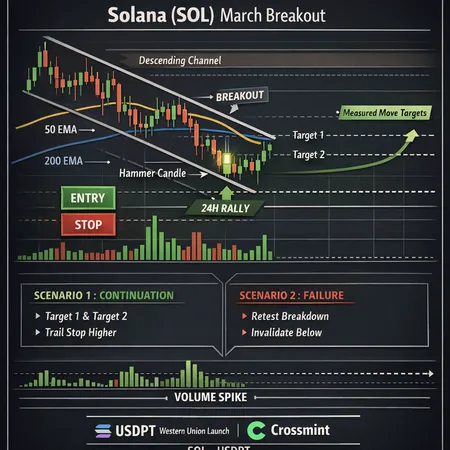
Price structure mattered first. After a month of lower highs inside a clear descending channel, SOL printed a hammer candle on a higher‑timeframe close that signalled rejection of lower prices and potential exhaustion of selling pressure. Technical coverage of the pattern noted the hammer and the subsequent test of channel resistance as a breakout trigger Coinpaper.
Following that candle, SOL began reclaiming short‑ to mid‑term exponential moving averages (EMAs). Reclaiming the EMA20 and EMA50 (and turning them into support on intraday pullbacks) is a classic confirmation for momentum traders — it shows buyers are stepping in not just for a one‑bar bounce but to sustain higher levels.
The channel breakout also offers a mechanical target: measure the channel height and project that distance from the breakout point for an initial objective. On top of the measured move, watch for horizontal resistance zones from prior swing highs and liquidity clusters — these are where stops and profit taking often accumulate.
Technical checklist for a credible breakout
- Confirmed daily or 4‑hour close above the descending channel.
- Hammer or reversal candle at the channel lower bound, followed by a higher‑volume impulse upward.
- Reclaim and hold of EMA20/EMA50 on pullbacks (EMAs acting as support).
- Increasing on‑chain activity and order‑book depth on Solana DEXs and CEXs.
If these items align, the breakout has both price structure and momentum backing it; if one or more fail (e.g., price falls back under EMA50 on high volume), the breakout becomes suspect.
On‑chain catalysts: USDPT, Western Union, and Crossmint — why it matters
The fundamental story that paired with the technical setup was the deployment of a Western Union‑branded stablecoin, USDPT, on Solana via Crossmint. Initial reports flagged Western Union’s plans to launch USDPT on Solana, creating a rails‑level narrative that matters for liquidity and real‑world payments U.Today. More detailed coverage highlighted the Crossmint partnership and the expectation of USDPT activity on Solana’s L1 as an actual on‑chain liquidity source Blockonomi.
Why is USDPT a catalyst for SOL price? There are a few linked channels:
- Native stablecoin minting and custody on Solana increases on‑chain liquidity for DEXs and market makers, often increasing trading volumes and fees that accrue to validators and stakers in the ecosystem.
- Institutional or enterprise rails (e.g., Western Union flows) can bring sustained inbound stablecoin demand across remittances and payments, which often creates predictable flows into spot and liquidity‑provision markets.
- New stablecoin liquidity tends to be converted into local base pairs (USDC/USDT/fiat) for hedging or to underwrite markets — this conversion creates organic demand for SOL through gas usage, liquidity provisioning, and sometimes direct treasury purchases by integrated services.
In short, USDPT is not just PR; it represents a potential structural increase in on‑chain capital routing through Solana. That structural shift can act as a multi‑week to multi‑month tailwind for SOL if flows are persistent.
For context, the Crossmint integration signals easier fiat‑to‑onchain rails for retail and enterprise users, which dovetails with broader activity in DeFi on Solana and could shorten the path from fiat to on‑chain liquidity pools.
The 24‑hour rally: what moved prices and how liquidity amplified it
During the reported 24‑hour window, SOL registered a roughly 14% jump that broke month‑long consolidation—coverage of that move highlights a mix of technical breakout follow‑through and news‑driven flow BeInCrypto. A few mechanics to note:
- Breakout momentum: The hammer + EMA reclaim and daily close above the channel attracted momentum traders and algorithmic buyers (CTA-style entries), stacking bids on shorter timeframes.
- News flow: Fresh USDPT headlines acted as a catalyst that increased buy‑side intent from macro and on‑chain desks anticipating stablecoin liquidity arrival.
- Liquidity thinness: Solana markets can be shallower than major crypto pairs. On thinner order books, institutional-sized or concentrated retail flow pushes price further than in deep markets, intensifying percentage moves.
This combination—technical traders entering on pattern confirmation and fundamental traders positioning for USDPT liquidity—creates a self‑reinforcing rally until profit taking or larger sell liquidity appears.
Scenarios: continuation vs. failure (with objective levels and management)
Below are tradeable scenarios framed around the technical structure and catalysts. Exact price levels depend on your chart and timeframe; use the mechanics rather than fixed numbers if your timeframe differs.
Scenario A — Continuation (bull case)
- Trigger: Daily/4‑hr close above channel and EMAs hold on a pullback to EMA20/EMA50.
- Expectation: Measured move target from channel height on the breakout, followed by secondary targets at the next historical resistance clusters.
- Confirmation: Rising on‑chain stablecoin inflows (e.g., USDPT minting and DEX deposits), higher DEX volumes and increasing open interest on perpetuals rather than a spike in liquidation‑driven volume.
- Trade management: Enter partial size on breakout; add on successful retest of EMA20 with a tight stop under EMA50. Target first measured move, take partial profits, trail stop to breakeven then to a moving average or a fixed ATR‑based trail.
Scenario B — Failure / fakeout (bear case)
- Trigger: Rejection back into the channel with decisive close below EMA50 and increased selling volume.
- Expectation: Rapid retracement to the lower channel boundary and possible test of previous lows. A retest with another failed reclaim signals a trend continuation to the downside.
- Trade management: Keep initial position small or use options to define risk. If price closes back under EMA50, exit remaining longs or flip bias. Use stop placements below the low of the breakout candle for defined risk.
Scenario C — News‑driven squeeze then fade
- Trigger: Large inflows tied to USDPT announcements cause a short squeeze and a transient spike.
- Expectation: Volatility spike with quick retracement as liquidity providers rebalance. If DEX and CEX order books remain thin, price can gap and then mean‑revert.
- Trade management: Avoid chasing large spikes; wait for a pullback into EMAs or a clear retest. Use OPM (options) to express a structured directional view if you want limited downside.
Specific risk and money management rules
- Position sizing: Risk no more than 1–2% of account per trade. Define risk by stop distance (e.g., USD risk = account * risk%) rather than by percent of the current price.
- Stop placement: Conservative stop under the low of the breakout candle or under EMA50; aggressive traders can use intraday ATR multipliers for tighter stops.
- Profit-taking: Take at least 30–50% of position at the first measured target; let the remainder run with a trailing stop (e.g., EMA20/ATR‑based trail).
- Event risk: If material USDPT on‑chain events (large mint, major exchange listings, or Western Union announcements) hit the tape, widen stops or reduce size until the volatility resolves.
Liquidity and market microstructure considerations
Solana’s L1 design supports high throughput, but the trading ecosystem still exhibits bouts of shallow order books. That means:
- Breakouts can be exaggerated; watch for unusually large spreads and slippage on large fills.
- On‑chain indicators (DEX volumes, stablecoin deposits, large wallet movements) often give earlier and clearer signals about whether flows are structural or ephemeral.
- Cross‑venue liquidity: Monitor both major CEX order books and DEX pools. USDPT activity may show up first in DEX pools or liquidity vaults before spilling over to spot order books on exchanges.
A pragmatic approach: combine chart triggers with an on‑chain check (is USDPT liquidity actually being minted and moved into DEX pools?) before scaling into a full position.
Practical checklist before entering a trade on SOL
- Chart: Daily and 4‑hr close above channel, EMAs aligned and successful retest (or tight breakout candle with volume).
- On‑chain: Noticeable USDPT minting or liquidity provisioning, increased DEX volume, or major wallet flows tied to Crossmint/Western Union.
- Order book: Acceptable depth on CEXs for your intended size or adequate DEX liquidity to avoid crippling slippage.
- Macro: No immediate cross‑asset risk events (major BTC selloff, macro data shocks that could reverse risk appetite).
If all four align, risk defined entries into a breakout trade become reasonable; if one or more fail, either reduce size or stay on the sidelines.
Conclusion: a catalyst‑driven technical breakout with clear guardrails
Solana’s March breakout combined sound price structure—a hammer candle, reclaiming EMAs and a descending channel breakout—with a tangible on‑chain catalyst in USDPT and Crossmint/Western Union actions. The technicals gave traders a concise entry and target framework, while USDPT represents a potentially durable liquidity tailwind that could support higher SOL price action if flows persist.
That said, markets can and do fake out. Traders should prioritize risk management, use on‑chain checks to validate the fundamental story, and adapt position sizing to liquidity conditions. For those monitoring order‑flow and on‑chain liquidity more closely, services such as Bitlet.app can help operationalize fiat‑to‑crypto flows into trading workflows—though always pair platform tools with your own risk rules.
Sources
- Coinpaper: technical note on hammer candle and channel breakout https://coinpaper.com/15181/solana-price-prediction-hammer-bounce-tests-channel-resistance?utm_source=snapi
- BeInCrypto: report on SOL's rally and breakout https://beincrypto.com/solana-price-registers-rally-what-helped/
- Blockonomi: coverage of Western Union + Crossmint USDPT deployment on Solana https://blockonomi.com/western-union-joins-forces-with-crossmint-to-deploy-usdpt-stablecoin-on-solana/
- U.Today: announcement coverage of USDPT on Solana https://u.today/western-union-to-launch-ripples-stablecoin-rival-usdpt-on-solana?utm_source=snapi
For broader context on cross‑asset impacts, watch Bitcoin momentum as a risk‑on barometer; for how stablecoin rails interact with DeFi flows see discussions on DeFi and the wider market commentary on Solana.