Can XRP Kick‑Start the Next Wave of Altcoin ETFs? A Roadmap for Asset Managers
Summary
Executive snapshot
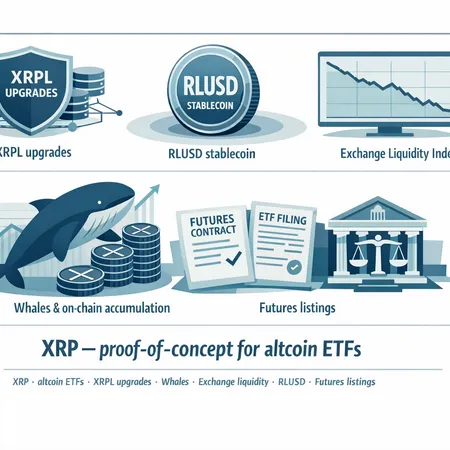
XRP has quietly become a test case for one of the crypto industry's most consequential questions: can an altcoin anchor a regulated ETF product the way Bitcoin did with futures and then spot funds? Between Ripple's push to harden XRPL infrastructure and build RLUSD-style stablecoin rails, visible large-wallet accumulation, and a measurable change in exchange liquidity profiles, XRP ticks several boxes that asset managers watch closely.
This piece lays out the technical and market developments, the emerging regulatory pathway built on futures listings, and the remaining structural gaps that could delay or derail a broad altcoin ETF wave. It is written for ETF product leads and asset managers evaluating the roadmap and prerequisites for launching regulated altcoin ETFs.
What’s changed on XRPL and RLUSD — infrastructure moving toward institutional readiness
Ripple has signaled a multi-pronged infrastructure strategy: upgrading XRPL's settlement and validation capabilities while also building out RLUSD as an institutional stablecoin corridor. Analysts see these efforts as a bid to reduce operational friction and present a cleaner, institution-friendly asset stack.
Blockonomi lays out Ripple’s ambition to transform RLUSD and XRPL infrastructure into something that behaves more like an institutional stablecoin layer, with attention to compliance and rails integration (Blockonomi). That matters for ETF issuers because a regulated product needs dependable rails for cash flows, creation/redemption, and risk-management operations.
On the XRPL security side, improvement efforts have emphasized faster finality, enhanced node software, and tighter validator governance — incremental but important changes that reduce operational risk. For ETF teams, these are the kinds of upgrades that shift conversations from “experimental protocol” to “serviceable market infrastructure.”
On‑chain concentration: whales are placing big bets
Large holders — whales — have materially increased XRP accumulation. Reporting from Santiment and coverage by zyCrypto documents historic levels of whale accumulation and on‑chain concentration, suggesting that the supply distribution has skewed toward a relatively small number of large addresses (zyCrypto / Santiment).
From an ETF-issuance perspective this is a double‑edged sword. On one hand, whale accumulation can be read as conviction and potential source liquidity when coordinated selling isn’t happening. On the other, concentrated holdings are a market‑structure risk: a single large liquidation or token movement can instantly undermine the price stability ETFs depend on. Index constructors and risk teams will need explicit thresholds and mitigation playbooks for concentrated supply risk.
Exchange liquidity is shifting — a red flag for some index designs
Exchange-level liquidity matters for both pricing accuracy and the practicalities of ETF creation/redemption. Recent reporting highlights a fall in XRP liquidity on major venues like Binance — a decline that can amplify price moves and widen execution spreads (U.Today).
Lower on‑exchange liquidity increases slippage risk for large baskets or creation/redemption trades and complicates surveillance computations that rely on continuous, deep pricing data. ETF providers will want to see stable, diverse liquidity pools across regulated venues or else limit authorized participants and impose stricter creation size limits.
The regulatory pathway: why futures listings matter
The Bitcoin ETF playbook shows a pragmatic route: start with regulated futures products based on exchange‑traded derivatives, then use the visibility and surveillance frameworks those venues supply as steps toward spot approvals. CryptoSlate argues that XRP could rewrite the playbook for altcoin ETFs by following a futures-first pathway: build a robust futures market, list contracts on regulated derivatives exchanges, and use that market to address surveillance and manipulation concerns (CryptoSlate).
Futures contracts offer several pragmatic advantages: they trade on regulated exchanges with established market‑surveillance regimes, they produce transparent price formation, and they give regulators and custody providers a clearer ledger of institutional participation. For asset managers, a healthy, regulated futures strip is a compelling precursor to attempting a spot ETF filing.
Why XRP is being framed as a proof‑of‑concept
Three practical reasons have elevated XRP into proof‑of‑concept status:
- Infrastructure momentum: RLUSD ambitions and XRPL upgrades are reducing operational friction points that previously made altcoins impractical for regulated products.
- Observable, institutional‑style activity: whale accumulation and OTC flows suggest deeper, non‑retail engagement with the asset.
- A plausible futures pathway: market participants and some analysts believe that regulated futures listings can create the surveillance and price continuity that regulators require, mirroring Bitcoin’s journey.
These factors together make XRP an attractive candidate to demonstrate whether the market and regulators can mature altcoin ETF mechanics beyond theory.
Remaining hurdles — what product teams must solve before filing
Despite the progress, several concrete challenges remain:
- Liquidity breadth and depth: Exchanges must show sustained, geographically diverse liquidity to support transparent NAV calculations and to limit slippage on creations/redemptions.
- Concentration and market‑manipulation risk: High on‑chain concentration demands clear mitigation strategies (circuit breakers, concentration limits, issuer disclosures).
- Custody and settlement model: Custodians need robust custody assurances for XRPL assets and any associated stablecoin rails like RLUSD, including insurance and recovery procedures.
- Surveillance sharing and data access: Regulators and exchanges will expect surveillance sharing agreements and access to on‑chain and off‑chain activity data.
- Stablecoin/regulatory risk: If an altcoin ETF relies on an institutional stablecoin corridor (e.g., RLUSD), product teams must model counterparty, reserve, and regulatory risks.
- Index methodology and tracking: ETF providers must craft transparent indices that prevent price‑stamping and are resilient to venue outages or thin markets.
Practical checklist for ETF product leads
If you’re evaluating an XRP‑based ETF or using XRP as a model for other altcoins, consider this operational checklist:
- Confirm regulated futures liquidity: Are there active, regulated futures contracts with open interest and low realized spreads?
- Map liquidity venues: Do multiple regulated venues show consistent order‑book depth for both spot and derivatives?
- Concentration thresholds: Define maximum allowable holder concentration and governance steps if a threshold is breached.
- Custody readiness: Validate custodians who support XRPL/RLUSD with SOC reports, insurance wrap, and recovery playbooks.
- Surveillance and legal: Secure surveillance‑sharing agreements and preclear the index methodology with legal counsel.
- Stress testing: Run simulated creation/redemption events, including edge cases like liquidity evaporation on a major exchange.
These are not theoretical items — they are the hard prerequisites that transformed the Bitcoin product landscape and will be scrutinized in any altcoin ETF review.
What a realistic timeline might look like
If stakeholders — exchanges, custodians, issuers, and protocol teams — coordinate, a plausible sequence is:
- 12–24 months: futures markets deepen; custodial and surveillance frameworks mature.
- 24–36 months: pilot filings or conditional approvals tied to robust futures liquidity and surveillance sharing.
- 36+ months: broader spot approvals if sustained market structure improvements and regulatory comfort accumulate.
This timeline depends heavily on regulator signals and whether exchanges can demonstrate resilient, multi‑venue liquidity.
Final assessment: promising, but contingent
XRP legitimately looks like a test bed for altcoin ETFs. Infrastructure upgrades and RLUSD ambitions reduce operational frictions, and the futures‑first pathway is a sensible regulatory route that has precedent. Yet concentrated holdings, weakening exchange liquidity in key venues, and outstanding custody/surveillance requirements mean XRP is a candidate — not a done deal.
For asset managers and ETF product leads, the prudent approach is to treat XRP as a conditional proof‑of‑concept: continue building operational readiness (custody, surveillance, index design) while monitoring futures market depth and exchange liquidity metrics. Tools like deep on‑chain analytics and venue liquidity trackers will be essential to the due diligence process.
Bitlet.app and other service providers monitoring these developments should emphasize cross‑functional readiness: legal, trading, custody, and index teams must be aligned before any filing.
Sources
- XRP rewrites the playbook so altcoin ETF approvals could surge in late 2026 after a wave of futures listings — CryptoSlate
- Ripple’s XRP whales continue to roar despite on‑chain losses soaring to 2022 levels — zyCrypto / Santiment coverage
- XRP faces liquidity crunch on Binance — impact on price — U.Today
- Ripple’s bold push: transforming RLUSD and XRP infrastructure into an institutional stablecoin powerhouse — Blockonomi
For context on broader crypto market trends and how ETFs fit into the ecosystem, many teams also track on‑chain analytics and derivatives flows alongside venue surveillance. For many traders and institutional teams, comparison points like Bitcoin ETFs remain the benchmark when assessing altcoin product readiness.