Why Bitcoin's Reclaim of $71K Matters: ETFs, On‑Chain Liquidity, Geopolitics, and Trader Moves
Summary
Executive snapshot
Bitcoin's recent reclaim of roughly $71,000 isn't just a round-number headline. It represents the intersection of renewed institutional demand, shifting fund flows, and an on-chain liquidity picture that is less forgiving than it was earlier in the year. For many traders and allocators the relevant questions are: which flows are real and persistent, how quickly can liquidity reappear if markets sell off, and how will geopolitical shocks amplify moves?
For many readers, Bitcoin still functions as a macro-sensitive, liquid risk asset — but one whose microstructure has changed since the ETF era began. Below I unpack the price move, the ETF mechanics and fund-level nuance, what on-chain signals are telling us about selling pressure, the role of geopolitical risk, and practical trade and allocation takeaways.
What happened: the $71k move in context
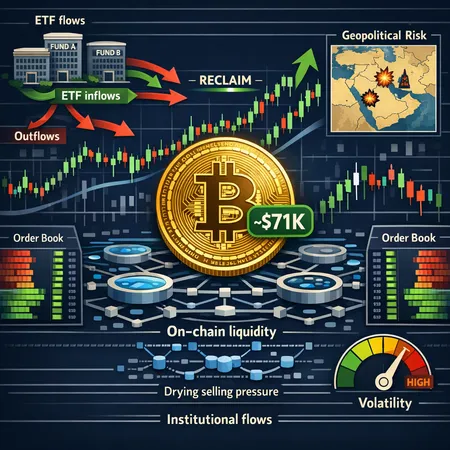
Over the last session BTC pushed back above the ~$71k mark, a level it briefly lost earlier in a pullback. Coverage from outlets tracking the move highlights both the price action and the context: CoinDesk detailed the surge above $71,000 and emphasized Bitcoin's resilience amid growing Middle East unrest, while reporting that the rally built on institutional demand and reduced immediate selling pressure. Crypto.News likewise reported the climb above $71k and noted on-chain signs that selling pressure may be abating.
This wasn't a quiet, low-volume grind higher. The reclaim came on visible ETF-related flows and headline-driven volatility — a classic combination that produces fast, headline-grabbing moves but with little guarantee of smooth follow-through.
ETF flows and fund activity: who's buying and who's selling
Two key patterns are worth separating: (1) net spot-ETF flows across the ecosystem, and (2) how individual funds (and their APs) interact with secondary markets.
- Several trackers and analysts noted a flip in ETF flows after a heavy drawdown period. CoinPedia highlighted that spot ETF flows turned green after a record drawdown, signaling that some institutional demand returned and that the selling tide had paused.
- At the same time, provider-level dynamics vary. The BlackRock iBit vehicle posted sizable inflows (reported as roughly $225 million in one report), which helped counteract outflows elsewhere and effectively soaked up supply that might otherwise have pushed price lower.
Mechanics in brief: when ETFs receive net purchases, authorized participants (APs) must obtain the underlying BTC to balance inventories. That process forces buys in the spot market — either by transferring coins from custodians or through new custody creation — and therefore directly increases physical demand. Conversely, redemptions can create selling pressure as APs return or source BTC to meet redemptions. Because these flows are often large and persistent, they can both absorb supply and, when they reverse, amplify moves lower.
The nuance: not all “inflows” are equal. Some flows are rotation between ETFs or between secondary and primary markets. Others reflect fresh institutional allocations. Tracking flows at the provider level (daily net flow, cumulative AUM change, and creation/redemption activity) helps distinguish cyclical rotation from durable buying.
Relevant coverage and data points: CoinPedia's analysis on flows flipping green explains the context behind money returning, and Cointelegraph documented the specific inflows to BlackRock's iBit that offset other selling pressure.
On-chain liquidity and the drying up of selling pressure
Price moves driven by ETF demand are more impactful when on-chain liquidity is tight. Several on-chain indicators pointed to a reduction in immediate selling pressure prior to — and during — the $71k reclaim:
- Exchange reserves: net outflows or a flattening of exchange balances reduce the available supply that can be quickly sold into the market.
- Exchange inflow activity: fewer large inbound transfers to exchange addresses suggest sellers are less eager to liquidate at market, or that custodians and long-term holders are holding steady.
- Realized distribution: if previously active large holders have paused selling, there is less “slosh” to create liquidity at the margin.
Crypto.News flagged on-chain signs consistent with an easing of selling pressure; that dovetails with the ETF flow story — when spot demand returns and exchange inventories fall, price can re-test higher more easily. But there’s a trade-off: thinner liquidity means the same nominal order size can move price more, which increases intraday volatility.
Geopolitical risk: a volatility amplifier, not a directional dictator
Geopolitical events — in this case Middle East tensions referenced in recent coverage — often produce quick risk repricing across asset classes. CoinDesk explicitly linked Bitcoin's surge above $71k to resilience amid the Middle East conflict, noting that BTC can display both safe-haven and risk-on characteristics depending on the market's cross-asset reaction.
How geopolitical risk intersects with the ETF/on-chain picture:
- Shock + tight liquidity = larger short-term moves. A headline can trigger a cascade of stop orders when liquidity dries up, magnifying price swings.
- If institutions see BTC as a hedge in a particular shock, ETF flows could pick up, driving price higher. If the broader market moves to a risk-off posture and institutions liquidate, ETF redemptions could increase selling pressure.
- The same geopolitical headline can be parsed differently by different pools of capital: allocators balancing FX, rates, equities and BTC will react based on their mandate and leverage.
In short, geopolitical risk increases the odds of two-way volatility; it doesn't guarantee up or down direction, but it raises the premium on active risk management.
What this combination means for near-term price discovery and volatility
Synthesize the inputs and a few practical implications emerge:
- Directional bias: with spot-ETF flows turning net positive in pockets and on-chain selling pressure reduced, the directional tilt is constructive for BTC in the near term. That said, durable upward momentum depends on whether inflows persist beyond headline-driven bursts.
- Volatility regime: expect larger two-way intraday moves. Tighter liquidity makes the market more sensitive to headlines and to chunky orders from APs or custodians.
- Price discovery: we may see faster re-pricing events as ETFs and AP mechanics interact with relatively shallow order books at key levels; support and resistance will be tested more aggressively and resolved quickly.
Scenario framing for traders and allocators:
- Bullish continuation: sustained net ETF inflows + falling exchange reserves = higher probability of re-testing or exceeding recent highs.
- False breakout / retracement: transient ETF-driven spikes that attract profit-taking from traders and create redemptions, leading to sharp pullbacks.
- Range with higher volatility: flows roughly balance (inflows offset outflows) and price oscillates in a defined band but with larger amplitude.
Practical trade and positioning takeaways (for intermediate traders and allocators)
Monitor ETF flow data daily and provider-level activity. Flows that persist for multiple sessions are more meaningful than single-day bursts — watch net creation/redemption trends.
Watch on-chain exchange metrics. Falling exchange balances and reduced large inflows are bullish microstructure signs; rising exchange inflows or accelerated miner/large-holder selling are red flags.
Size into strength, not all at once. Given the elevated volatility environment, consider scaling entries: commit portions of your intended position over multiple signals (flow confirmation, consolidation above support, realized vol contraction).
Use options to manage tail risk. For allocators seeking exposure without full spot risk, consider buying puts for downside protection or using synthetic positions that limit drawdowns while keeping upside exposure.
Keep time-horizon discipline. Short-term traders should stay alert to headline risk and thinner liquidity; longer-term allocators can use ETF flow reversals as an opportunity to rebalance rather than panic-sell.
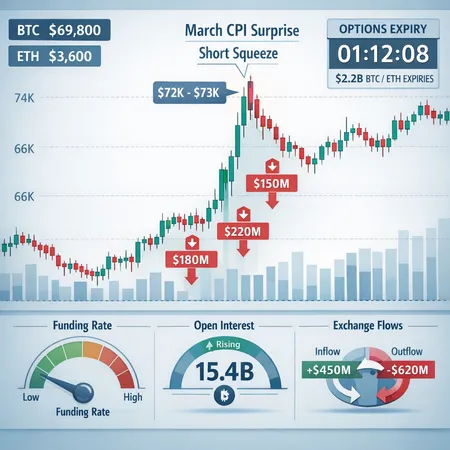
Monitor funding rates and derivatives activity. Elevated funding or skew can indicate crowded directional positioning that might exacerbate corrections.
Prepare for quick stop management. Thin liquidity can turn stops into cascades — use limit entries when possible and give larger stop buffers in high-volatility windows.
Track provider rotation. Not all institutional flow is net new capital; some is rotation between ETFs. Distinguish new AUM growth from simply moving coins between products.
Signals to keep on your dashboard (quick checklist)
- Daily net spot-ETF flows (and cumulative 7–30 day sums) by provider.
- Exchange BTC reserves and large transfer counts.
- Options skew and put/call ratio for BTC.
- Funding rates across major perpetual venues.
- Open interest changes in futures vs. change in spot price.
- Geopolitical/ macro headlines and cross-asset risk moves (equities and FX correlation).
Platforms like Bitlet.app make it easier for allocators and traders to track some of these flows and to manage multi-exposure portfolios, but the core work is watching the interaction between flows and liquidity in real time.
Bottom line
The reclaim of ~$71k reflects more than a momentary bid: spot-ETF demand and provider-level inflows (notably to large products) combined with easing on-chain selling pressure created a price-friendly microstructure. However, thinner liquidity and geopolitical headlines mean the road higher — if it continues — will be jumpier. Intermediate traders and allocators should therefore prioritize flow monitoring, conservative sizing, and options hedging where appropriate: the market can move quickly, and in both directions.