Case Study: Cardano's ADA Moves into 137 SPAR Supermarkets — Tech, Settlement, and Lessons
Summary
Executive overview
In early March 2026, a practical milestone for Cardano landed in everyday retail: ADA was accepted as a payment option across 137 SPAR supermarkets in Switzerland through a partnership built on DFX.swiss and Open Crypto Pay. The deployment is notable not just for scale, but for its emphasis on a native ADA checkout experience rather than a tokenized IOU or purely off‑chain voucher system. That distinction shapes merchant risk, on‑chain volume, and product requirements for anyone in the payments and BD trenches.
For business teams and product managers evaluating merchant integrations, this case delivers three immediate takeaways: 1) integration architecture matters (UX and risk are decided by the gateway), 2) fiat rails and compliance are the merchant's real concerns, and 3) throughput/fees determine whether a blockchain is suitable for high‑frequency retail payments. For context on the announcement and rollout, see the reporting from Cryptonomist on the SPAR deployment and DFX.swiss/Open Crypto Pay integration.
How DFX.swiss / Open Crypto Pay enables native ADA checkouts
Payment architecture — high level
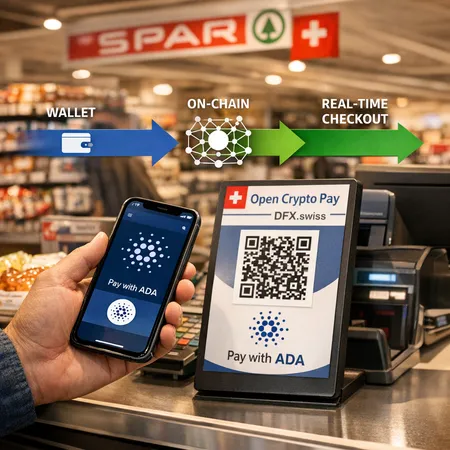
The DFX.swiss/Open Crypto Pay stack acts as the bridge between point‑of‑sale (POS) systems and the Cardano blockchain. At a conceptual level the flow is:
- POS requests a payment option and amount for a customer.
- Open Crypto Pay (fronting the gateway) generates a payment request tied to an on‑chain address or invoice and displays a QR code or deep link.
- The shopper approves payment from their ADA wallet; the wallet constructs and signs a native ADA transaction and broadcasts it to the Cardano network.
- The gateway watches for the transaction, confirms inclusion in a block (or an agreed optimistic acceptance), and signals the POS to finalize the sale.
- Optionally, DFX.swiss converts ADA to fiat (CHF) in real time and settles funds to the merchant to remove exposure to price volatility.
This pattern mirrors typical crypto‑POS integrations, but with a key difference: the checkout is native ADA — the transaction itself uses ADA on Cardano rather than a wrapped or off‑chain representation.
Why Cardano’s technical profile helps
Cardano’s ~20‑second block cadence and generally low fees (relative to some L1s during peak congestion) make it feasible to use on‑chain confirmation as part of a retail UX. That said, the UX still hinges on how the gateway handles confirmations. DFX.swiss can accept an optimistic broadcast or wait for a small number of confirmations; the faster the merchant wants finality, the more gateway capital and risk management tools are needed.
From a product perspective, the integration requires:
- A lightweight SDK or standards for generating payment requests and invoice metadata that POS systems can embed.
- Wallet support for deep links / QR payloads that include amounts, currency (ADA), and merchant memo fields.
- Reliable node and mempool monitoring to detect broadcasts and inclusion quickly.
- Liquidity paths or custodial rails for instant fiat settlement if merchants want zero market risk.
Merchant experience and UX design
For a supermarket cashier and customer, the experience needs to be as frictionless as a card swipe. That means: clear signage, a POS‑visible “ADA” option, a single QR code or tap, and a confirmation state that matches human expectations (accepted vs pending). DFX.swiss/Open Crypto Pay emphasizes that merchants do not need to manage keys or on‑chain complexity — the heavy lifting is on the gateway and the shopper’s wallet.
A positive UX also requires fallback flows: network hiccups, insufficient wallet balance, and refunds. For refunds, the merchant either issues fiat refunds after reconciling on‑chain receipts, or the gateway performs a reversal on Cardano if both parties accept. These policies must be explicit in merchant onboarding.
Settlement flow: wallet → on‑chain → real‑time checkout
The exact sequence
- POS sends amount and generates payment request via Open Crypto Pay.
- Customer scans QR / opens wallet deep link; wallet constructs native ADA transaction (address + amount + metadata) and signs.
- Wallet broadcasts transaction to Cardano nodes; the gateway’s monitoring service sees the broadcast.
- Gateway decides acceptance policy: optimistic (broadcast seen) or conservative (wait 1+ confirmations). Cardano’s block time allows low‑latency confirmation windows.
- After acceptance, gateway informs POS; cashier completes sale.
- If chosen, DFX.swiss converts ADA to CHF immediately and credits the merchant bank account or merchant wallet.
Removing volatility and merchant risk
Merchants rarely want exposure to crypto price swings. The commercial viability of ADA checkout hinges on the gateway offering an immediate fiat settlement option or a hedging mechanism. DFX.swiss operates as the counterparty that ingests ADA and either holds it or converts it into fiat or a stable asset before settling with the merchant. That conversion is a business‑model lever — it drives fees, counterparty risk, and compliance scope.
Effects on Cardano’s on‑chain volume and ADA utility
A real retail deployment at SPAR’s scale introduces recurring, small‑ticket transactions to Cardano. If widely adopted, we can expect:
- Increased on‑chain transaction volume and UTxO churn from many low‑value payments.
- Elevated demand for ADA as a medium of exchange in contested retail corridors, which strengthens its transactional utility beyond speculative demand.
- New patterns of wallet behavior (fast‑pay wallets optimized for retail UX) and potential growth in payment‑specific tooling — invoice standards, receipts metadata, merchant discovery protocols.
However, the marginal economic impact on ADA’s price is uncertain. While real usage increases token utility, speculative and macro drivers still dominate short‑term price movement. Macro forecasts, like the outlook discussed by Claude and covered in CryptoNews, see ADA among assets that could strengthen later in 2026 — retail adoption is a supportive narrative but not the sole determinant.
Regulatory and merchant adoption hurdles in Europe
Compliance and KYC/AML
Retail deployments must square with national and regional rules. Switzerland has been proactive in crypto infrastructure, which helps pilots like SPAR, but EU markets introduce additional complexity via frameworks such as MiCA and evolving AML directives. Gateways like DFX.swiss shoulder much of the KYC/AML burden by operating as regulated entities that can onboard merchants and perform customer checks where required.
Taxation and reporting
Merchants need clarity on VAT, receipt rules, and accounting for crypto receipts. Point‑of‑sale systems must generate merchant records that reconcile fiat accounting with on‑chain events. This is non‑trivial and often slows merchant onboarding.
Bank and acquirer relations
Some banks and acquirers are still cautious about working with shops that accept crypto, especially if custody arrangements are unclear. Having a regulated gateway that settles in fiat alleviates much of this discomfort.
Consumer protection and refunds
Retailers must be able to process returns and refunds in a familiar manner. Gateways must provide clear flow charts for reversing or compensating customers, which sometimes means off‑chain fiat refunds even when payment was on‑chain.
Lessons for other blockchains pursuing retail traction
UX beats technical elegance: merchants care about speed, simplicity, and predictable settlement. Make the buyer journey identical to card payments.
Offer instant fiat settlement as an optional product. Removing volatility risk dramatically reduces merchant resistance.
Build or partner for robust merchant onboarding (KYC/AML, tax, reconciliation). Compliance is often the gating issue, not the chain itself.
Optimize for low fees and quick finality. Retail checkouts cannot tolerate long confirmation times; design acceptance policies and monitoring to balance speed and fraud risk.
Provide SDKs and standards for invoices and metadata so POS vendors can integrate without reengineering core systems.
Pilot with reputable retail chains. A brand like SPAR accelerates trust, exposes UX gaps quickly, and creates a reusable rollout template.
Measure the right KPIs: checkout conversion, time‑to‑confirm, percentage of merchants taking fiat settlement, and refund dispute rates.
Actionable checklist for BD and product teams
- Technical: implement payment request standards, monitoring, and wallet deep‑link support.
- Financial: assemble fiat rails and hedging/custody partners to offer instant settlement.
- Legal/Compliance: ensure gateway and merchant onboarding processes meet local KYC/AML and tax reporting needs.
- UX: design optimistic acceptance flows, clear pending/accepted states, and fast refunds.
- Partners: target pilot merchants with large footfall and conservative operations; use pilots to refine SLA and risk models.
- Metrics: track conversion lift vs card, average ticket size, and operational incidents.
Final thoughts
SPAR’s rollout in Switzerland demonstrates the practical pathway from blockchain capability to everyday retail use. The technical plumbing — a reliable gateway, wallet interoperability, and Cardano’s performance envelope — is necessary but not sufficient. The commercial success of on‑chain retail payments rests on how payments platforms handle settlement risk, compliance, and seamless UX. For teams at Bitlet.app and other platforms considering similar integrations, the SPAR/DFX.swiss example is a useful blueprint: marry strong technical execution with pragmatic financial rails and legal frameworks.
Sources
- Announcement: Cardano accepted in 137 SPAR supermarkets via DFX.swiss/Open Crypto Pay — Cryptonomist.
- Macro outlook on ADA strengthening later in 2026 — CryptoNews (Claude forecast).
For teams researching payment rails and merchant integrations, examples like this also tie into broader conversations about crypto payments, Cardano ecosystem tooling, and how DeFi rails can evolve to support mainstream retail spenders and merchants in the near term.