Decoding the $5.48M Chainlink Whale Accumulation: Tradeable Signals from Wallet Clustering to Liquidity
Summary
What happened — the raw on‑chain events
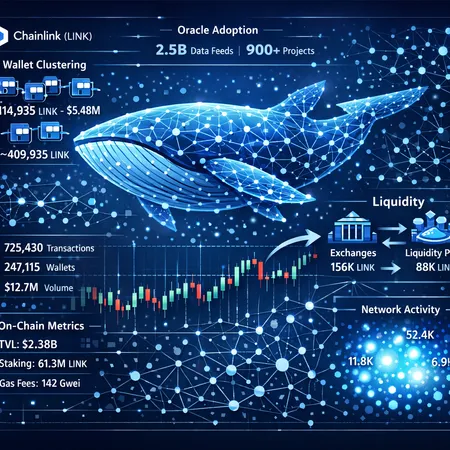
Two crypto outlets reported large LINK movements in quick succession. AmbCrypto flagged a whale buy of 414,935 LINK for about $5.48M ambcrypto report. A separate write‑up identified two newly created wallets accumulating 409,935 LINK ($5.48M) around the same timeframe thenewscrypto report. The dollar figures imply an average execution price near $13.2 per LINK, give or take slippage and timestamp differences.
At face value, these are non‑trivial on‑chain flows: half‑million‑dollar buys are large relative to regular retail activity and can move mid‑tier order books on many spot venues. But the market impact and informational content depend on where the coins moved (custodial vs non‑custodial), whether flows aggregated on exchanges, and the persistence of the behavior.
How to read whale accumulation: conviction vs. noise
Whale accumulation is not binary—context separates smart‑money conviction from one‑off opportunistic trades.
- Steady accumulation into non‑custodial addresses (cold wallets, known hedge fund addresses, or multi‑sig) is the strongest sign of conviction. It suggests intent to hold and potentially remove supply from liquid markets.
- Splitting buys across new wallets can be a simple execution tactic (reduce slippage, avoid MEV), or an attempt to obscure intent. Two newly created wallets gathering ~409,935 LINK may be a deliberate split of a larger accumulation strategy.
- Transfers to custodial exchange addresses often precede selling. If a whale move ends at an exchange deposit, treat it as potential supply entering the market.
- Short time horizon flips (large buy → quick sell or transfer to exchange) point to liquidity play / arbitrage rather than long‑term conviction.
For the current events, comparing the ambcrypto and thenewscrypto observations raises a practical question: are these reports tracking the same underlying flow fragmented across wallets, or separate coordinated actions? That matters for sizing potential market impact.
Wallet clustering and heuristics for quants
Quantitative traders should go beyond the headline and run clustering heuristics to classify the wallets involved. Practical steps:
- Address provenance: label destination addresses as custodial (exchange) vs non‑custodial (self‑hosted) using known exchange tag databases. Exchanges are likely to amplify selling pressure.
- Temporal patterns: test whether the wallets continue to accumulate over days/weeks or were single‑move actors. Use rolling windows (7/30/90 days) to spot accumulation persistence.
- Inter‑wallet graph analysis: look for repeated value flows between a cluster of addresses—splits and re‑aggregations indicate single entity control.
- Counterparty exposure: check if wallets later interact with DeFi routers, oracles, or staking/contract addresses—this gives clues about intended use (e.g., collateral provisioning vs. HODL). For many traders, Chainlink activity tied to oracles can be materially different than purely speculative accumulation.
These heuristics should be backtested: for example, measure 7‑day and 30‑day forward returns after (a) a single large non‑custodial accumulation vs (b) a large custodial deposit. That will quantify historical payoff to the signal.
Liquidity, order books and short‑term price mechanics
A ~$5.5M buy in LINK is meaningful but its price mechanics depend on real liquidity.
- Order book depth: on mid‑tier spot exchanges, available depth at the best bids may be a fraction of a whale purchase. If the buyer executed aggressively on a single exchange, slippage could explain the average $13.2 execution price. Smart execution often uses TWAP/VWAP across venues.
- Exchange balance changes: a falling aggregate LINK balance on exchanges while whales accumulate off‑exchange is a classic bullish combination—less available sell pressure. Conversely, rising exchange balances after a whale buy signals distribution.
- Derivatives flows: watch changes in open interest and funding rates. Heavy accumulation combined with rising long open interest and positive funding can amplify moves; however, liquidations can cut rallies short if leverage is crowded.
Quant rule of thumb: treat a reported whale accumulation as a liquidity shock unless exchange outflows confirm supply removal. Monitor minute‑level exchange snapshots for immediate order book responses.
Oracle adoption vs. speculative accumulation — causation or correlation?
Chainlink’s core narrative is oracle adoption: more projects integrating Chainlink feeds or increased on‑chain oracle calls can sustainably raise token utility and demand. But whales sometimes accumulate ahead of expected adoption news (positioning), and sometimes they buy into momentum with no immediate fundamental change.
Key discriminators:
- On‑chain oracle usage metrics: rising number of Chainlink oracle calls, new contracts requesting price feeds, or growth in subscription revenues are direct evidence of adoption. If accumulation coincides with these metrics, the buy is more likely to be fundamental.
- Timing relative to announcements: accumulation before a confirmed partnership or an SDK rollout suggests speculative positioning. If buys follow verifiable adoption updates, they more credibly reflect reaction to real demand.
Historically, Chainlink price moves have been amplified when adoption narratives were validated by partnerships or protocol upgrades. But without visible increases in oracle usage, whale accumulation by itself is not definitive proof of future demand.
Historical precedents: what past whale moves teach us
Looking back at on‑chain episodes across cryptomarkets, several patterns repeat:
- Whales can seed an initial price run by removing supply and creating a squeeze where retail buying meets thin order books.
- Sustained rallies typically require follow‑through demand (real user adoption, derivatives flow that supports the trend, or a cascade of smaller buyers). Without that, whale‑led pumps often retrace once the whale takes profits.
- Splitting large purchases across new addresses is a common execution technique to reduce slippage and detection. It does not necessarily indicate deception.
For LINK specifically, past price appreciations tied to oracle adoption and ecosystem integrations tended to sustain longer than purely speculative moves. Thus, for quant traders, the lesson is to combine whale signals with adoption and exchange‑balance metrics before extrapolating a multi‑week trend.
Turning whale tracking into tradeable hypotheses
Below are practical, testable hypotheses you can feed into systematic strategies.
Accumulation + Exchange Outflow Hypothesis
- Signal: Large non‑custodial accumulation (>0.05% of circulating supply into addresses not tagged as exchanges) + 7‑day decline in aggregate exchange LINK balance > 2%.
- Tradeable action: Long spot or delta‑neutral long (buy spot, sell futures) sized to liquidity; target 7–21 day holding window.
- Backtest metric: 7‑day forward return, Sharpe ratio vs baseline.
Custodial Deposit Hypothesis (Distribution Risk)
- Signal: Large inbound to custodial exchange addresses from unknown wallets.
- Tradeable action: Reduce exposure, tighten stops, or take a small short depending on derivatives liquidity.
Oracle Adoption Confirmation Hypothesis
- Signal: Whale accumulation + measurable uptick in oracle calls/new feed subscriptions over 14 days.
- Tradeable action: Scale into a medium‑term long; consider options structures (call spreads) to limit downside.
Liquidity‑Driven Short Squeeze Hypothesis
- Signal: Whale accumulation occurs while order book depth at mid‑tier exchanges is thin and long open interest rises rapidly.
- Tradeable action: Tactical long, but hedge with short futures size to control exposure; exit quickly if funding flips.
Each hypothesis should be validated by backtests that include slippage, exchange fees, and gas costs for on‑chain interactions.
Execution and risk management (for retail and quants)
Translating whale signals into positions requires robust execution and risk controls.
- Position sizing: allocate conservatively — whale indications are noisy. Use Kelly‑fraction approximations only after you have a robust edge.
- Execution: use TWAP/VWAP and venue‑splitting to reduce market impact. If you’re building a model, include simulated slippage calibrated to historical order book depth.
- Stops and hedges: prefer structured hedges (options or futures) over simple stop losses when liquidity is thin. Stops can cascade into slippage in low‑depth markets.
- Counterparty and manipulation risk: be aware of spoofing, wash trading, and coordinated campaigns. Cross‑validate any whale signal with multiple on‑chain indicators (exchange flows, oracle usage, sustained accumulation).
- Monitoring: set automated alerts for key events—exchange inflows/outflows, address re‑aggregation, and unusual increases in oracle calls. Platforms like Bitlet.app and other on‑chain dashboards can help track exchange flows and wallet clustering in real time.
Concluding framework: what to watch next for LINK
When a large whale buy like the reported ~414,935 LINK appears, fold the observation into a checklist:
- Where did the tokens land? (custodial vs non‑custodial)
- Do exchange balances fall or rise post‑move?
- Is accumulation persistent across days or a single burst?
- Are on‑chain oracle metrics and adoption indicators moving in tandem?
- How are derivatives metrics (open interest, funding) reacting?
If multiple items check out—persistent non‑custodial accumulation, falling exchange balances, and rising oracle usage—the odds tip toward meaningful smart‑money conviction. If the move ends on exchanges or is quickly redistributed, treat it as a liquidity play.
For quants and on‑chain analysts, the practical path is clear: formalize signals, backtest them against realized returns including realistic slippage, and combine whale tracking with liquidity and adoption metrics before deploying capital.
Sources
- AmbCrypto — report on 414,935 LINK whale buy: https://ambcrypto.com/chainlink-can-5-mln-in-whale-buys-help-link-target-14/
- TheNewsCrypto — report on two wallets accumulating ~409,935 LINK: https://thenewscrypto.com/wallets-accumulating-link-underline-potential-of-chainlink-will-it-stand-the-test/?utm_source=snapi