On-Chain Exchange Data: Coinbase, Chainlink DataLink, and Institutional Market Infrastructure
Summary
Executive summary
Coinbase’s recent integration of Chainlink DataLink to publish premium exchange data on-chain is a practical experiment with big institutional implications. For product leaders building execution, settlement and compliance stacks, the shift from opaque, siloed feeds to verifiable on-chain exchange data promises more auditable workflows, tighter settlement finality and programmatic compliance. This article breaks down the tech, explains who benefits (custodians, settlement layers, brokerages), and outlines near-term use cases — with an eye toward implementation choices.
Why on-chain exchange data matters now
Institutional adoption of crypto trading has accelerated. Mainstream brokerages announcing BTC and ETH trading channels increase the volume and complexity of institutional flow — and that flow wants consistent, provable market context. For many traders, Bitcoin remains the primary bellwether, and when brokerages like Charles Schwab add BTC/ETH to their product sets, as covered here, institutional order flow begins to bridge traditional custody and on-chain settlement in earnest.
Publishing exchange-grade data on-chain changes the risk and audit surface: it enables counterparty systems to reference a single, tamper-evident source for prices, order-book snapshots and execution reports, instead of reconciling multiple proprietary feeds after the fact.
Technical overview: what is Chainlink DataLink?
Chainlink DataLink is an oracle construct designed to publish off-chain datasets — including exchange-grade market data — directly onto blockchains in a standardized, verifiable way. Unlike simple price oracles that return a single aggregated value, DataLink focuses on robust delivery of richer datasets: time-series ticks, order-book snapshots, and premium exchange-level metadata.
Key technical elements:
- Source attestation: DataLink allows provenance metadata (origin exchange, timestamp, signature) to travel with the dataset so consumers can verify where the data came from. This is critical for institutional audit trails.
- Chunked, versioned publishing: Large datasets (e.g., full order-book levels) are chunked and versioned so clients can reconstruct precise snapshots and confirm sequence integrity.
- On-chain anchors and hashes: Rather than storing terabytes on-chain, DataLink publishes cryptographic anchors and content-addressed hashes on-chain that point to the authoritative dataset, enabling on-chain verification without prohibitive storage costs.
- Hybrid aggregation patterns: Chainside aggregation and node-side validation let DataLink support both raw exchange outputs and aggregated, exchange-of-record products intended for downstream consumers.
For product teams this means the difference between trusting a third-party reporting API and referencing a cryptographic anchor that proves an order book or trade tape existed at a specific time. The practical implication: better auditability and lower reconciliation friction.
Coinbase integration: what it signals
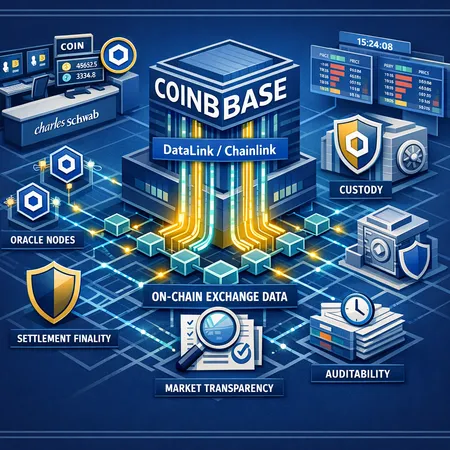
Coinbase’s integration to publish premium exchange data via Chainlink DataLink is an important industry milestone. The announcement describes Coinbase making exchange-grade datasets available on-chain through Chainlink’s stack, enabling external contracts and services to consume provenance-backed market data directly from a primary exchange source.
Why this matters for institutions:
- Primary-market anchors: When an exchange of Coinbase’s scale (ticker: COIN) publishes data that can be cryptographically verified on-chain, downstream systems can reference that anchor rather than relying only on third-party aggregators.
- Interoperable market context: Execution algorithms, custody systems and settlement layers can all read the same exchange-of-record snapshot, reducing cross-system drift.
- New compliance tooling: On-chain proofs simplify auditor workflows because proofs of data existence and integrity are programmatically retrievable.
(See the Coinbase–Chainlink integration announcement for the primary details.) Coinbase integrated Chainlink DataLink to publish premium exchange data on-chain.
How mainstream brokerages fit into the picture
When mainstream broker-dealers like Charles Schwab open BTC and ETH trading (coverage summarized here), they widen the institutional funnel and create more demand for consistent market-state information across fiat-brokerage ledgers and blockchain settlement layers. Brokerages will not publish exchange-level datasets directly on-chain initially, but they will rely on verifiable oracles to reconcile internal order records with on-chain evidence of price/time.
Two practical interactions to expect:
- Fiat-on/off ramps and hedging: Brokerages executing large block trades will want on-chain price anchors to confirm execution fairness for internal compliance and client reporting.
- Cross-ledger reconciliation: Brokerage trade reports and custodial movements require reconciling ledger-native records (SWIFT/ACH/bank feeds) with on-chain settlement receipts. Oracles that attest to exchange state (via DataLink-style anchors) become the common denominator for reconciliation.
Coinciding coverage of brokerage adoption shows how traditional finance is building appetite for on-chain proofs that support institutional workflows. See reporting on mainstream brokerages adding crypto access (BTC/ETH) for context: Charles Schwab adding BTC and ETH trading.
Benefits for custodians and settlement layers
Custodians and settlement layers are the natural early adopters of on-chain exchange data because their core responsibilities are integrity, finality and auditability.
Concrete benefits:
- Deterministic settlement triggers: Smart contracts or settlement coordinators can use verified exchange snapshots as triggers for net settlement calculations, margin calls, or cross-margining adjustments. This reduces reliance on lagging offline reconciliations.
- Improved dispute resolution: When custody disputes arise (did an execution occur within an authorized price band?), on-chain anchors with provenance shorten dispute windows by providing immutable evidence.
- Efficient proof generation for auditors: Custodians can produce cryptographic evidence (hashes, signed manifests) pointing to order-book or trade-tape snapshots without shipping raw datasets.
For example, a settlement layer could accept a DataLink-published order-book snapshot hash as proof that a trade executed against specific liquidity at time T, then use that anchor when finalizing ledger state for downstream ledgers.
Auditability of order books: realistic or hype?
The idea of a fully auditable, on-chain order-book history is attractive, but there are trade-offs:
- Partial vs. full publication: Exchanges may publish high-value snapshots (top N levels, trade tapes, VWAP windows) rather than entire real-time book dumps, balancing privacy and bandwidth.
- Signature and sequencing guarantees: True auditability requires cryptographic signatures tied to exchange infrastructure and sequential integrity to prevent selective disclosure. DataLink’s versioning and attestation models address this by coupling hashes with origin metadata.
- Anti-manipulation limits: Publishing order books on-chain could expose actionable intel to on-chain bots. Exchanges and institutional consumers will likely adopt delayed or aggregated release strategies to avoid front-running risks while preserving auditability.
In practice, the most useful model for institutions is hybrid: publish authenticated snapshots and trade tapes with time offsets and metadata so auditors can reconstruct execution context without exposing live order-level depth in real time.
Near-term use cases for institutional stacks
Here are near-term, high-impact use cases where on-chain exchange data adds measurable value for product teams and traders:
1) Real-time risk and margining
Risk engines can pull attested price and depth snapshots to compute intraday margin and liquidity stress tests. Instead of trusting a single vendor feed, margin engines can reference multiple on-chain anchors (from different exchanges) to form a verifiable consensus about market state.
2) Settlement finality and automated netting
Especially for cross-platform netting, settlement coordinators can require submissions to include DataLink anchors proving the price or order book state used to compute net amounts. This shortens settlement cycles and reduces post-settlement reconciliations.
3) Compliant reporting and audit trails
Regulated firms can embed cryptographic proofs in trade reports and compliance packages, allowing auditors to programmatically verify that submitted execution claims match exchange-published evidence. That’s a material improvement over manual CSV reconciliation processes.
4) Orchestrated custody flows
Custodians running authorized spend workflows can condition releases on verified market events (e.g., liquidity thresholds, price floors), creating more automated and auditable custody policies.
Implementation patterns and architecture considerations
Adopting DataLink-style on-chain data requires architectural choices. Below are common patterns and trade-offs:
- Anchor-first vs. payload-first: Anchor-first systems publish cryptographic hashes on-chain with full payloads stored off-chain (content-addressed storage). This minimizes chain cost but requires reliable off-chain retrieval. Payload-first systems write more data on-chain at higher cost but reduce third-party dependencies.
- Push vs. pull models: Exchanges can push snapshots to oracle operators for publishing, or oracle operators can pull signed snapshots on cadence. Push models give exchanges tighter control, while pull models can increase resilience.
- Governance and SLAs: Institutional consumers will require SLAs, uptime guarantees and dispute resolution paths for oracle data. Integrated governance (multi-party attestation, notarization services) can help meet institutional procurement requirements.
- Privacy controls: Design patterns for delayed disclosure, aggregated snapshots, or differential release timing mitigate front-running while preserving audit trails.
Product leaders should prototype with synthetic flows first: simulate margin calls and settlement using attested anchors before relying on them for production-critical responsibilities.
Limitations and open questions
- Data cost and scale: High-frequency tick data at institutional scale can be expensive to anchor on-chain; careful sampling, compression and selective anchoring strategies are necessary.
- Regulatory acceptance: Regulators and auditors will need to adopt standards for reading and accepting on-chain proofs as official records. Early engagement will accelerate acceptance.
- Standardization across exchanges: For the full benefit, multiple exchanges need compatible attestation formats so consumers can aggregate feeds reliably. Chainlink’s approach aims to standardize these formats, but industry coordination matters.
Practical next steps for fintech product teams
- Define the data contract: Decide which assets (BTC/ETH) and which fields (top N levels, trade tape, VWAP) matter for your use cases.
- Pilot with anchors: Run a pilot that consumes DataLink-style anchors and verifies payloads off-chain to validate integrity and latency characteristics.
- Integrate into risk and settlement flows: Replace at least one manual reconciliation step with automated verification against an on-chain anchor.
- Coordinate with custodians/brokers: Ensure your custodial or brokerage partners can produce or consume the necessary attestation metadata.
Teams at Bitlet.app and other fintechs building custody and P2P flows should treat DataLink integrations as enablers for cleaner audits and shorter settlement windows rather than speculative infrastructure experiments.
Closing thoughts
Publishing exchange-grade data on-chain — exemplified by Coinbase’s DataLink integration — is not an overnight game-changer, but it is a foundational improvement in how institutional crypto markets can establish common, verifiable market context. For fintech product leaders and institutional traders designing execution, settlement and compliance stacks, the idea is simple: move from multi-system reconciliation to single-source verifiable anchors. That shift lowers friction, improves auditability and creates new automation possibilities across risk, settlement and reporting.
To stay competitive, teams should pilot standardized anchors, engage with custodians and brokers on attestation expectations, and prepare governance models for SLAs and dispute resolution.
Sources
- Coinbase integrates Chainlink DataLink to publish premium exchange data on-chain: https://www.crowdfundinsider.com/2026/04/271026-coinbase-integrates-chainlink-data/
- Charles Schwab adds BTC and ETH trading coverage: https://www.coinspeaker.com/charles-schwab-bitcoin-ethereum-crypto-brokerage-trading/