Stablecoin Rails 2026: Regulatory Frontiers, Custody Shifts, and Geographic Expansion
Summary
The 2026 inflection: why stablecoin rails matter now
Stablecoins have ceased to be an experimental plumbing layer — they are now core rails for payments, treasury settlement and cross-border flow. That matters for compliance officers and treasury managers because the ledger a unit of value lives on determines counterparty risk, jurisdictional exposure and the set of controls you must run. Over the past 12–18 months three shifts became decisive: active geopolitical positioning by issuers, institutional custody adoption for treasury-backed models, and commoditization of multichain access.
Taken together, these shifts change the playbook for which stablecoins a corporate or exchange should support. This piece digs into key signals — Tether’s trademark filing in Russia and its UN partnership on AML efforts, Ethena’s custodial expansion for ENA, and Zerion’s TRON integration — and draws operational implications for stablecoin-backed rails.
Russia: Tether Hadron and regulatory signaling
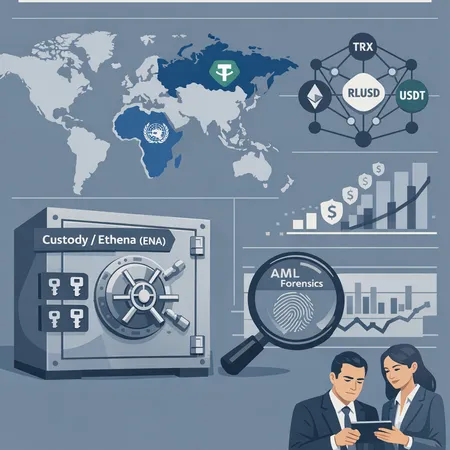
In late-stage 2025 and into 2026 the market noticed a small but meaningful move: Tether filed a trademark in Russia for its Hadron tokenization platform. That administrative step is more than paperwork. Trademark registration is often a prelude to localized product support, marketing and legal positioning in a market. For compliance teams the implication is that major issuers are readying localized rails rather than only global, neutral issuance. See reporting on the trademark action for the specifics of that filing Cryptopolitan.
Why should treasurers care? Because localized tokenization or licensing can signal: (1) a willingness by an issuer to comply with, or at least adapt to, local regulatory nuance; (2) potential emergence of regionally branded stablecoins (think RLUSD as a conceptual label for locally tailored USD-pegged coins); and (3) a need for firms to run layered jurisdictional risk assessments even for the same ticker (USDT on Ethereum vs USDT-like products supported through local tokenization stacks).
Regulatory posture in Russia differs from Western regimes on AML, sanctions, and token oversight. A localized Hadron presence could mean additional compliance windows (e.g., local KYC/registration obligations, reporting to Russian authorities) or conversely offer regulated rails that some counterparties prefer. That duality forces treasury teams to be explicit about which network and which legal framework underpins any stablecoin balance.
Tether in Africa: UN partnership and AML/forensics implications
At the same time Tether publicly expanded its non-commercial AML and forensic posture through a partnership with a UN agency to address illicit crypto flows in Africa. The move is strategically important: it signals a desire from a dominant issuer to align with international AML capacity-building and to reduce friction with global compliance frameworks. The partnership announcement and its framing are covered in detail in reporting on the initiative Bitcoin.com.
For compliance officers this development has three practical readings: first, a large issuer investing in forensic partnerships improves traceability and evidence-sharing channels that investigations rely on; second, it raises expectations of enhanced transaction monitoring and suspicious activity reporting from service providers that use that issuer’s rails; third, it complicates vendor neutrality — counterparties may prefer assets issued by actors that proactively support AML capacity-building.
That last point matters for cross-border treasury: choosing rails that correspond to issuers engaged in AML partnership programs can reduce friction when banks or correspondent services perform enhanced due diligence. In short, issuer behavior now affects counterparty acceptance.
Institutional custody and the maturation of treasury-backed models
Stablecoin models that tie to treasury assets — or aspire to commercial-grade custody for issuer reserves — have moved from boutique custody arrangements to a mainstream institutional stack. A clear signal: Ethena added Kraken, Anchorage and Zodia as custodians to manage large stablecoin holdings tied to its ENA token, a move that institutionalizes reserve custody and reduces single-custodian concentration risk Blockonomi.
For treasury teams evaluating support for treasury-backed stablecoins, custody is now a first-order consideration. Institutional custodians offer: insured cold storage options, formal custody SLAs, clearer legal recourse, and stronger reporting frameworks. They also bring standardized onboarding that traditional finance counterparties understand — a key factor when a corporate wants to move fiat to on-chain stablecoins with auditability and corporate governance intact.
But custody alone is not sufficient. The composition of treasury reserves (commercial paper, T-bills, gold, cash equivalents) and the legal architecture linking reserves to issued tokens must be auditable and contractually transparent. From a compliance viewpoint, you should prefer stablecoins where custodial arrangements and reserve attestations are visible, repeatable and performed by recognized institutional partners.
Multichain management: TRON liquidity and Zerion’s integration
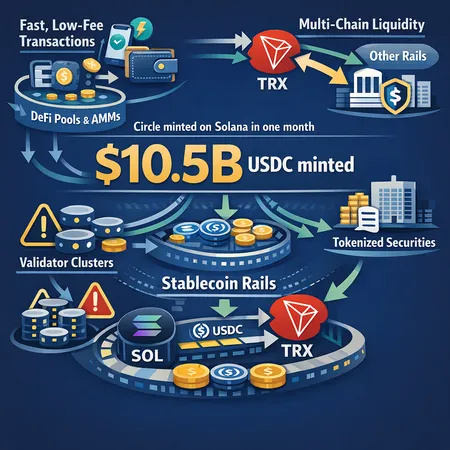
Liquidity is more than a balance sheet problem; it’s a network problem. Zerion’s move to add TRON network support for unified stablecoin management is a practical response to that reality: fiat-equivalent liquidity is fragmented across EVM chains, TRON’s TRC-20 pools, and other non-EVM rails Blockonomi.
This matters because USDT liquidity on TRON remains meaningful for settlements in Asia and many high-frequency payment flows. Multichain access creates both opportunity and complexity. Opportunity because you can route funds where liquidity is deepest and fees lowest; complexity because each chain implies different AML tooling, wallet hygiene, confirmation models and smart contract risk. Supporting TRC-20 USDT (or analogous RLUSD constructs on local chains) means you need controls adapted to TRON’s mempool, explorers and analytics vendors.
Operationally, firms now need consolidated visibility across chains (on-chain reconciliation, gas cost forecasting, cross-chain bridge risk assessments). Provider integrations like Zerion reduce UX friction, but do not remove the compliance requirement to monitor per-chain flows and to be able to tie on-chain activity back to corporate KYC.
What this all means for stablecoin-backed rails: practical risk synthesis
Putting the threads together: issuers are localizing product footprints, institutional custody is professionalizing reserve stewardship, and multichain access is turning liquidity into a distributed architecture. For treasuries and exchanges the headline risks are:
- Jurisdictional exposure: supporting a token in one country can create reporting obligations in another, especially when issuers seek local trademarks or partnerships.\n- Custody and counterparty concentration: single-custodian models create systemic counterparty risk; multiple institutional custodians mitigate that but introduce operational overhead.\n- AML complexity: the issuer’s commitments (like Tether’s UN partnership) improve traceability but do not substitute for your transaction monitoring and SAR processes.
In practice, rails will continue to fragment. A corporate might prefer ENA for institutional treasury exposure, USDT on TRON for low-cost regional payouts, and a locally issued RLUSD-equivalent where local legal acceptance or regulatory clarity exists. That multi-rail posture demands more sophisticated treasury tooling and clearer compliance playbooks.
Practical compliance and treasury checklist: what to do next
Below are actionable steps for compliance officers and treasury managers evaluating which stablecoin rails to support in 2026. These are pragmatic items you can use to build or refine your vendor and asset selection policy.
1) Map issuer and custody relationships
- Require documentation on custodians and prove multi-custodian or insured custody where possible (look for names like Kraken, Anchorage, Zodia).\n- Document whether the issuer runs local legal entities or has trademarked/localized platforms (e.g., Hadron moves).
2) Evaluate AML/forensics posture
- Favor issuers with active forensic collaboration or public AML programs — these partnerships improve investigatory outcomes. Review Tether’s recent UN-linked initiative as an example of issuer-level engagement.\n- Ensure your transaction monitoring vendors cover the chains you will support (EVM, TRON/TRC-20, and others).
3) Define per-rail operational playbooks
- Set settlement windows, confirmations and on-chain reconciliation rules per network (Ethereum vs TRON have different finality and explorer tooling).\n- Maintain a “rail readiness” checklist covering wallet hardening, hot/cold split, and bridge risk. Zerion-style integrations can help UX but don’t replace chain-specific controls.
4) Test legal and accounting implications
- Confirm reserve audit frequency, legal recourse in the issuer’s domiciles, and accounting treatment for on-chain cash equivalents. Institutional custody and transparent reserve attestations should be required reading for your auditors.
5) Design fallback and liquidity routing
- Maintain access to at least two rails for outgoing fiat conversions. If USDT on TRON is cheap and liquid for your corridor, keep a TRC-20 channel operational, but also maintain an EVM lane for counterparties that require it.
6) Continuous monitoring and escalation
- Run scenario drills for sanctions, local regulatory changes, and issuer governance events. Trademark filings or partnership announcements can presage material changes in how a coin is treated locally (Tether’s Hadron trademark is an example).
Final thoughts for treasury and compliance leaders
Stablecoins in 2026 are not a single, fungible instrument — they are a menu of rails with differing legal, custody and AML characteristics. Firms that treat them like homogeneous USD proxies will get surprised when a local rule, a custody default or a chain-specific exploit disrupts settlement. Instead, build explicit rail policies: map issuers and custodians, require forensic-friendly issuer practices, instrument per-chain monitoring, and keep diversified liquidity channels.
A practical first action: update your stablecoin vendor policy to include custody proofs and issuer AML programs as mandatory checklist items; then run tabletop scenarios for each rail you plan to support. Tools and integrators (and platforms such as Bitlet.app in the payments space) can simplify rails, but the ultimate responsibility for compliance and treasury resilience sits with you.
For many treasurers, Stablecoins are now as important as cash; for orchestration and developer-minded teams, the intersection with DeFi integrations is unavoidable; and when macro flows matter, don’t forget incumbent market signals such as Bitcoin liquidity corridors when you choose which rails to prioritize."}