Why Solana‑Linked ETFs Are Diverging from Bitcoin and Ethereum This Month
Summary
Executive snapshot
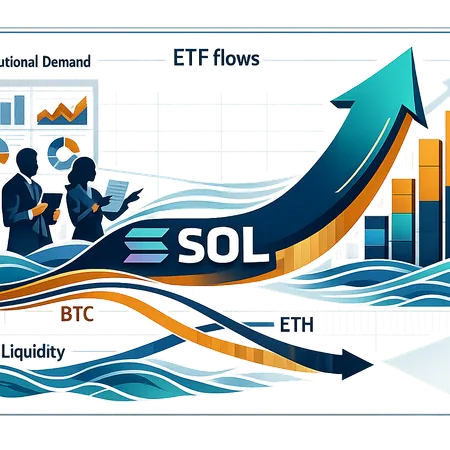
This month institutional ETF flows have painted an unusual picture: while demand signals for BTC and ETH ETFs cooled and only recently turned positive in aggregate, Solana‑linked ETFs have exhibited steadier inflows. That divergence matters because ETF inflows are both a demand signal and a mechanical source of market pressure on the underlying token. Below I unpack the data, the structural reasons behind the split, how it affects SOL price action and index‑tracking risk, and what allocators should watch as more altcoin ETFs launch.
What the flow data is telling us
Market reports show a clear behavioral split. Broadly, spot Bitcoin ETF demand softened in recent weeks before turning modestly positive again, reflecting rotation and short‑term profit taking among institutional investors. Cointelegraph notes spot BTC ETFs recently registered positive inflows as price recovered toward the mid‑60k range, signaling episodic return of capital to BTC exposure. At the same time, coverage of Solana ETF flows points to a steadier accumulation pattern, a divergence from the cooling seen in BTC/ETH funds.
Those differences aren’t just headlines. Flows are an input to on‑exchange liquidity and can amplify price moves: when ETFs buy or sell, they alter spot order books and create arbitrage opportunities for authorized participants. The Solana flow story has coincided with bouts of upward price pressure for SOL, including the sharp daily moves highlighted in market writeups that tied inflows and on‑chain activity to SOL’s recent jumps.
Structural reasons Solana ETFs can attract steadier flows
Below are the main, interlocking structural explanations for why institutional allocations to Solana ETFs may look steadier than BTC/ETH this month.
1) Application‑layer growth and narrative freshness
One reason is narrative and product momentum. Solana’s application layer—games, NFTs, some DeFi—has periodically produced bursts of activity that create distinct use‑case narratives for allocators seeking growth exposure within crypto. Institutional allocators who want targeted exposure to application layer risk may view SOL as a differentiated bet from base‑layer stores of value like Bitcoin or broad smart‑contract exposure via ETH. That narrative can keep flows more consistent when funds that target “app‑layer upside” remain in accumulation mode.
2) Perceived yield prospects (staking and developer incentives)
SOL is a stakable asset and has a visible yield component in the ecosystem, which contributes to a perception of income‑plus‑growth exposure. Even when ETFs do not pass staking rewards directly to NAV (and providers differ on how rewards are handled), the existence of staking and liquid programs outside the ETF can make SOL a more attractive allocation for managers seeking yield harvesting strategies alongside capital appreciation. In short: perceived yield prospects can sustain demand even when pure beta allocations to BTC or ETH pull back.
3) Liquidity and market microstructure differences
Smaller market cap relative to BTC/ETH means Solana’s market is structurally different. On one hand, that implies greater price sensitivity to fund flows—so modest inflows look robust compared to the liquidity scale of BTC ETFs. On the other hand, some institutional allocators view this as an opportunity: a smaller, more reactive market can be easier for funds to exit at targeted prices if AP networks and custodians are ready. That dynamic can create a steady baseline of demand from allocators that prefer active management at the altcoin layer.
4) Correlation and portfolio construction utility
When BTC and ETH allocations are already large in an institutional wallet, allocators often look for uncorrelated or semi‑correlated alpha sources. Solana’s price moves, sometimes decoupled from BTC/ETH in the short run, provide that kind of portfolio diversification. That portfolio‑construction utility can sustain inflows even during periods when BTC/ETH ETF demand cools.
How the divergence affects SOL price action
ETF inflows are mechanical and psychological drivers of price.
- Mechanically, purchases by a Solana ETF must be sourced in the spot market (or via swaps), tightening bids and potentially creating short‑term upward pressure on SOL. Reports linking SOL’s jumps to inflows and on‑chain activity reinforce this feedback loop.
- Psychologically, steady inflows signal conviction. That attracts momentum traders, creating a second wave of demand that can exaggerate short‑term moves.
The price action observed recently—where SOL staged noticeable intraday gains even as BTC/ETH looked more muted—reflects these combined forces. That said, smaller markets are a double‑edged sword: while inflows lift prices faster, outflows can depress them more quickly, which raises tracking and liquidity risk for ETF holders.
Index‑tracking and operational risks specific to altcoin ETFs
Altcoin ETFs face several index‑tracking pitfalls that institutional allocators must consider:
- Slippage and tracking error: When creation or redemption units are large relative to on‑chain liquidity, ETF NAV can drift from secondary market prices. SOL’s smaller order book makes this a realistic near‑term risk if flows accelerate or reverse.
- AP and custody readiness: The authorized participant network and secure custody solutions for SOL are less mature than for BTC/ETH. That can increase latency in arbitrage and widen spreads.
- Staking/rewards accounting: If an ETF doesn’t or can’t capture staking rewards directly, the implied yield investors expect from SOL may not materialize inside the fund, creating a mismatch between investor expectations and realized ETF return.
- Concentration and correlated tokenomics: Many alt tokens have concentrated holdings among early backers or foundations. Large ETF buys can bump into those supply walls, and large exits can trigger forced selling events.
These operational risks are why some allocators prefer to wait for proven AP performance, transparent staking policies and robust custody before scaling allocations to altcoin ETFs.
Historical caution: ETF launches can pull back after initial euphoria
ETF launches often create a rush of capital, then a cooling or pullback as short‑term participants exit. The SUI spot ETF example and coverage of its launch dynamics underline this pattern: initial flows can be front‑loaded and followed by choppiness once momentum wanes. That historical tendency is a useful lens: steady Solana inflows today don’t guarantee uninterrupted gains tomorrow—fund flows can reverse rapidly and create outsized volatility in smaller cap tokens.
(See a cautionary note on post‑launch pullbacks for SUI ETFs in coverage of recent alt ETF launches.)
What institutional allocators should watch next
If you’re an allocator or ETF strategist, here are the practical signals to monitor:
- AP liquidity and spread behavior: Track bid/ask spreads on SOL and ETF premiums/discounts for signs of widening tracking error.
- Staking policy disclosures: Read ETF prospectuses on whether staking rewards are captured and how they’re accounted for.
- Flow persistence vs one‑off allocations: Distinguish between recurring institutional purchases and tactical allocations from macro funds chasing momentum.
- On‑chain activity and real usage: Continued application‑layer growth (transactions, TVL in DeFi, NFT activity) is a healthier base for sustained institutional interest than pure narrative trades.
- Cross‑market correlation: Watch correlation shifts between SOL, BTC and ETH—if SOL re‑couples to BTC during risk‑off periods, the diversification case weakens.
Bitlet.app users and allocators should treat inflow signals as one input among many; execution, custody and governance details matter as much as headline numbers.
Practical implications and recommended checklist for allocators
- Confirm custody and AP robustness before scaling into an altcoin ETF.
- Factor in potential tracking error in price‑sensitive allocations and stress‑test scenarios for large redemptions.
- Prefer funds with transparent staking/rewards policies or model off‑ETF staking returns conservatively.
- Use order‑sizing rules that account for the underlying token’s on‑chain liquidity profile.
Conclusion
This month’s divergence between Solana‑linked ETF inflows and the cooling demand for BTC and ETH ETFs is a multifaceted story. It reflects narrative and application‑layer momentum for SOL, perceived yield prospects, and liquidity‑driven dynamics that make SOL more sensitive to sustained flows. But sensitivity cuts both ways: the same mechanics that lift SOL on inflows amplify downside risk on outflows, increasing tracking and operational risks for ETF holders.
For institutional allocators, the right approach is not a knee‑jerk rotation but a careful evaluation of fund mechanics (custody, APs, staking policies), market depth and flow persistence. These are the practical gauges that will separate short‑term momentum trades from durable institutional allocations during the next wave of altcoin ETFs.
Sources
- Solana ETF inflows diverge from Bitcoin/Ethereum ETF trends — BeInCrypto
- Spot Bitcoin ETFs recent inflows and price context — Cointelegraph
- SOL jumps amid inflows and on‑chain activity — CryptoPotato
- Spot SUI ETF launches and the history of post‑launch pullbacks — Blockonomi