Reading Ripple’s Treasury Moves: RLUSD $40M, Gemini Rails, and Evernorth’s Institutional Play
Summary
Why onchain treasury moves deserve close attention
For institutional treasury managers and market-structure analysts, a five- or six-figure transfer from a project treasury isn’t a curiosity — it’s a data point that can reveal intent, counterparty choice, and short-term market pressure. Stablecoin treasuries such as RLUSD are not neutral pools of value: they perform liquidity operations, market-making, redemptions, and custodial routing. The destination and label of an address — for example a Gemini-labelled address — materially changes the tradeoffs and likely downstream actions.
At the same time, emerging institutional plumbing on the XRPL changes how those flows behave. New relationships between third-party custodians, liquidity providers, and XRPL-native protocols create options for large-scale on/off ramps and programmatic liquidity that simply weren’t available a few years ago.
Decoding the RLUSD $40M transfer to a Gemini-labelled address
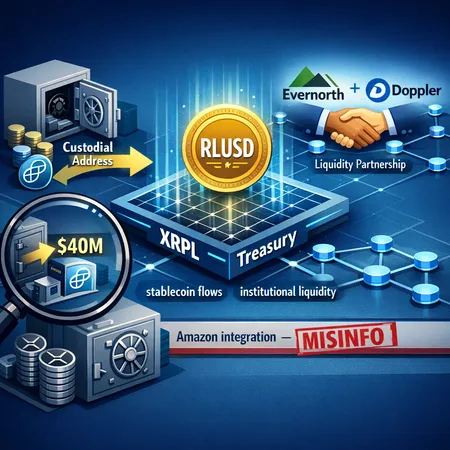
Onchain observers identified a roughly $40M movement from the RLUSD treasury into an address labeled as associated with Gemini. Reporting that flagged this transfer can be found here: RLUSD Treasury moved $40M into the market via a Gemini-labelled address.
What the transfer likely signifies
- Custodial routing: Moving funds to a Gemini-labelled address strongly suggests the treasury is routing stablecoins through a custodial exchange or custodian-operated hot wallet rather than a decentralized pool. That implies intentions such as converting RLUSD into fiat or other assets, executing block OTC trades, or depositing into an orderbook for distribution.
- Market access and speed: Custodial rails like Gemini provide immediate access to fiat rails, prime brokerage relationships, and institutional counterparties. For a treasury that wants fast execution and settlement, custodial routing is the pragmatic choice.
- Liquidity footprint: A $40M entry point is large enough to show up in orderbooks and OTC desks; depending on depth, it can cause slippage and transient price moves for XRP pairs.
It’s important to be cautious: a transfer from a treasury to a custodial address is not an incontrovertible sell signal. It could be movement between treasury compartments, short-term liquidity provisioning, or a mechanical step before internal rebalancing.
Why the Gemini label matters
Gemini is both an exchange and a regulated custodian in certain jurisdictions, so funds arriving at a Gemini-labelled address imply a route that ties onchain activity to offchain custody and compliance controls. That linkage makes it easier for counterparties and analysts to infer the next steps (e.g., fiat conversion, OTC execution). For treasury managers, this highlights two points: first, custodial routing reduces counterparty execution risk but introduces custody counterparty risk; second, the moment funds hit a known exchange/custody label they become more visible and potentially market-moving.
Evernorth and Doppler Finance: stitching institutional rails into XRPL
The reported strategic relationship between Evernorth and Doppler Finance is a sign that institutional-grade tooling is being built around XRPL. Coverage of the collaboration details is available here: Evernorth and Doppler Finance strategic relationship to explore institutional liquidity on XRPL.
What this partnership enables
- Programmatic liquidity and custody integration: Evernorth brings institutional custody, compliance processes, and client onboarding experience; Doppler brings XRPL-native liquidity infrastructure. Together they can offer programmatic access to liquidity pools, automated settlement, and larger block trades executed with XRPL settlement characteristics.
- Cleaner treasury operations: For corporate treasuries that hold XRP or RLUSD, having an institutional middleware layer reduces the operational friction of settlement, reconciliation, and compliance reporting.
- Improved pricing and depth: Institutional counterparties and custodians can route larger RFQs or internalize flow, which may deepen markets and reduce slippage for large trades.
These developments signal a maturation of XRPL from purely retail or developer-driven activity toward a venue where institutional treasury operations — including hedging, rebalancing, and structured liquidity provision — are realistic and operationally supported.
How stablecoin treasury behavior and custodial rails interact
Stablecoin treasuries operate along a spectrum: algorithmic adjustments, mint/redemption cycles, and deliberate market-facing liquidity operations. When a treasury relies on custodial rails (like Gemini), the following dynamics appear:
- Transparency vs. ambiguity: Onchain movement is transparent, but custodial rails blur the final counterparty unless exchange disclosures are available. That can produce apparent selling even when funds are being routed for custody or internal settlement.
- Speed and settlement certainty: Custodial rails let treasuries instantly access offchain fiat and counterparties, enabling large trades without awaiting decentralized settlement finality.
- Counterparty concentration risk: Routing large treasury flows through one custodial partner concentrates risk; counterparties and treasury teams need contingency plans and multi-custodian strategies.
For market-structure analysts, the presence of custodial rails means onchain flows must be interpreted alongside known exchange activity, OTC desk sizing, and custodial disclosures.
Why debunked partnership rumors still sway markets
A recent analyst rebuttal that there is no Amazon–Ripple AWS integration illustrates how quickly narratives can distort expectations and flows; see the debunk here: Ripple–Amazon partnership myth shut down by XRP analyst.
Even when a rumor is debunked, it can leave a trace: liquidity providers may move to position, retail traders may chase headlines, and treasuries may be pressured to act defensively. The practical effects include:
- Misinterpreted flows: Large onchain movements that coincide with rumor cycles get misattributed to an imminent partnership or product launch, leading to incorrect narrative-driven trading.
- Volatility amplification: Rumors compress decision timelines; counterparties may refuse to provide liquidity until clarity arrives, increasing realized volatility.
- Reputation and communications risk: Treasury teams must manage stakeholder expectations and avoid giving inadvertent signals that could be misread as partnership confirmation.
Misinformation is not harmless: for institutional-grade actors, it complicates routing decisions, counterparties’ risk appetite, and the timing of large trades.
Actionable recommendations for treasury managers and analysts
- Combine onchain analytics with custodial confirmations: When you see RLUSD or other stablecoin flows to labeled custodial addresses, cross-check with custodial dashboards, notices, or direct counterparty confirmation before treating the move as a market exit.
- Maintain multi-custodian rails: Avoid single-point concentration of large treasury flows. Multi-custodian strategies reduce operational and counterparty risk, and give negotiable routing options.
- Model liquidity impact before executing: Use orderbook data, historical slippage metrics, and OTC desk quotes to size trades. A $40M ingress on a given pair will have different market impact depending on depth and time-of-day.
- Stress-test communications: Have a playbook for how to respond to market rumors. Quick, factual confirmations (or a short silence policy coordinated with counsel) reduce the chance your treasury movements get misread as corporate endorsements.
- Track institutional plumbing developments: Partnerships like Evernorth–Doppler change the set of available counterparties and can materially improve execution quality on XRPL. Engage early to understand settlement windows, custody segregation, and fee structures.
Conclusion: read the rails, not just the headlines
Onchain transparency gives treasury managers and analysts powerful signals, but those signals are meaningful only when interpreted through the lens of custody, counterparty relationships, and institutional plumbing. The RLUSD $40M move into a Gemini-labelled address is a reminder that stablecoin treasuries use custodial rails to access rapid liquidity — and those rails change the market footprint of any transfer. Meanwhile, relationships such as Evernorth with Doppler Finance point to cleaner institutional flows on XRPL and greater tooling for treasury operations. Finally, the lifecycle of rumors like an Amazon–Ripple tie-up shows how quickly perception can decouple from plumbing; the prudent treasury manager will verify, collaborate with custodians, and design execution strategies that tolerate noise.
Bitlet.app users monitoring XRPL treasury behavior should combine labeled-address tracking with custodial confirmations and counterparty engagement to avoid costly misreads.
Sources
- https://u.today/did-ripple-just-reload-market-40000000-rlusd-move-says-yes?utm_source=snapi
- https://bitcoinist.com/institutional-xrp-infrastructure-evernorth-doppler/
- https://u.today/ripple-and-amazon-partnership-myth-shut-down-by-xrp-analyst?utm_source=snapi
For context on broader market behavior, institutional managers often compare XRPL flows against broader crypto trends where XRP and DeFi liquidity patterns diverge.