Uniswap’s Token Burn and Protocol-Fee Activation — What It Means for UNI and DeFi Governance
Summary
Quick primer: what changed
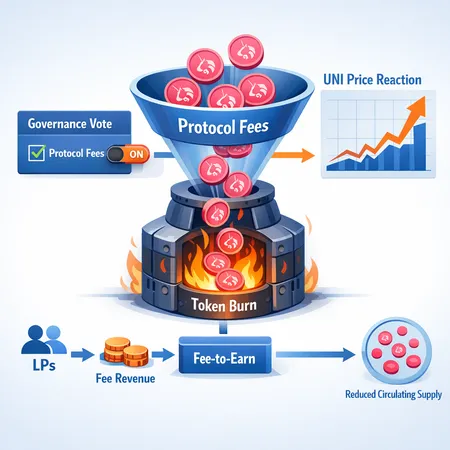
Last week Uniswap’s community voted to enable protocol fees and to route a portion of captured value toward token burns — and the protocol followed through with a large-scale UNI burn. The dual move is simple in concept: turn on a protocol-level fee that captures a slice of swap revenue, then use some of that captured value to reduce circulating UNI supply. The mechanics and consequences, however, are more complex.
For anyone watching the broader market, this is a signal. For many traders and token holders it’s a concrete shift from purely utility-focused governance toward a model that directly attempts to create scarcity and capture on-chain revenue — the so-called fee-to-earn model.
What the community voted for and how it was implemented
The governance vote authorized activating protocol fees (a toggle that redirects a portion of swap fees away from LPs and toward the protocol) and enabling token burns funded by those fees or by treasury-managed buybacks. The weekly recap covering the vote explains the outcome and community sentiment around activating fees and burns, noting broad support for testing revenue capture at the protocol level (weekly recap and vote details).
Mechanically, when protocol fees are turned on the DEX charges an extra fraction of each swap. Those collected fees can either accumulate in the protocol-controlled account or be converted into assets used for governance-directed actions — buybacks, grants, or in this case, burns.
Activation timeline and immediate steps
Once the vote passed, the team executed a token burn of roughly 100 million UNI. That execution and early market reaction were reported alongside price analysis and commentary on the burn’s scale and likely impact (UNI price and burn reaction). The burn was a one-off reduction of supply intended to demonstrate the mechanism and to create a scarcity effect that might support UNI price.
The scale of the burn and UNI price reaction
A 100 million UNI burn is material: it represents about 10% of the protocol’s original 1 billion token allocation, a big headline number. Markets reacted quickly — there was a price uptick as traders priced in short-term scarcity and the prospect of future fee-driven buybacks. But price moves around governance actions are often noisy; initial spikes can reverse if the community does not follow through with sustainable revenue capture.
Two things are worth noting in evaluations of price impact:
- Burns are a stock control measure. They change supply but not the underlying cash flow unless paired with a mechanism that consistently converts protocol economic activity into value for holders (the protocol fees).
- The credibility of long-term price support depends on how reliably fees will be captured and used. A single burn can be a strong statement, but repeated buybacks or persistent fee-to-earn flows are what convert protocol activity into sustained token value.
What this means for liquidity providers (LPs)
LPs are the most immediately affected cohort. Protocol fees are typically charged on top of AMM swap fees, and when a portion of fees is diverted to the protocol, LP returns are reduced unless the AMM fee structure is adjusted or overall volume rises sufficiently to offset the cut.
Key implications for LPs:
- Short-term yield compression: If total fees are fixed and the protocol takes a slice, LP APRs decline. That can push capital to competing venues with lower protocol cuts.
- Potential offset via price appreciation: If fees fund buybacks/burns that sustainably raise UNI price, LPs who hold UNI exposure could see net gains that offset lower fee income — but that’s speculative and dependent on governance discipline.
- Liquidity distribution changes: LPs may reallocate to pools where net returns remain attractive, increasing fragmentation or motivating novel incentives (boosts, concentrated liquidity perks) to retain liquidity.
Governance should be conscious of these trade-offs: extracting value for token holders is attractive, but doing so at the cost of core liquidity risks the platform’s product-market fit.
Fee revenue capture: mechanics, risks, and benefits
The core promise of activating protocol fees is to create a direct line from protocol usage to token-holder value. In practice that line can take many forms: accumulating fees in a treasury, converting fees to a protocol-native asset and burning, or distributing revenue to token holders via buybacks or dividends.
Benefits:
- Revenue alignment: Protocol fees make on-chain activity economically valuable to token holders, aligning users and governance.
- Deflationary pressure: Burns reduce circulating supply, which can create upward price pressure, especially when paired with steady or rising fee flows.
- Monetizable usage: Protocols can credibly claim users are paying for a service that benefits token economics, not just LPs.
Risks and open questions:
- Sustainability: If protocol fees meaningfully reduce LP incentives, trading volume could drop, shrinking the revenue base.
- Governance signaling vs. substance: One-off burns are popular PR moves. Repeated, transparent routing of fees to buybacks or burns is harder and requires governance maturity.
- Capital efficiency trade-offs: Diverting fees may reduce depth in certain pools; smaller spreads and deeper liquidity are core to Uniswap’s value proposition.
Governance incentives and power dynamics
Turning on protocol fees and executing burns gives governance a new lever to redistribute value. That increases the stakes of governance participation: decisions about fee rates, allocation of treasury assets, and burn schedules become central economic policy choices.
Potential governance impacts:
- More frequent economic votes: Rather than purely technical upgrades, token holders will vote on economic policy — a natural evolution but one that raises coordination costs.
- Concentration risk: If a small set of stakeholders control a large share of voting power, they can direct fee flows in ways that benefit themselves (e.g., grants to related parties), so safeguards and transparency matter.
- Incentive alignment vs. short-termism: Governance must weigh immediate price support against long-term ecosystem growth. Prioritizing regular burns can create short-term price lifts but may starve investments in growth initiatives.
How other DeFi protocols might respond
Uniswap’s move is likely to be a template for other projects that want to capture protocol-level value. Some protocols will be tempted to flip a fee toggle and run buybacks; others will design more nuanced splits between LPs, stakers, and a treasury.
We should expect a few patterns:
- Copycats on the same model: Protocols with liquid governance tokens and strong user demand may replicate fee-to-earn mechanics and burns to bootstrap token value.
- Hybrid approaches: Some projects may route fees partly to LPs, partly to stakers, and partly to an ecosystem fund — diversifying incentives and reducing LP churn risk.
- Regulatory and accounting scrutiny: As protocols explicitly monetize user activity for token holders, questions around securities laws and tax treatment will increase, pushing teams to formalize governance and treasury operations.
Practical checklist for governance participants and token holders
If you hold UNI or participate in governance, here are concrete points to evaluate:
- Ask for models: How much fee revenue is expected under realistic volumes, and how will that translate to buybacks/burns? Request stress tests and sensitivity analysis.
- Evaluate LP impact: Will LP APRs fall materially? Are there plans for compensatory incentives (boosts, emission tweaks)?
- Transparency and cadence: Are buybacks/burns executed on a transparent schedule, and is the conversion mechanism auditable on-chain?
- Governance safeguards: Are there caps, multi-sig controls, or timelocks to prevent opportunistic or opaque allocations?
Final assessment: durable value or governance theater?
A protocol-level fee plus burn mechanism can create a credible, recurring conduit from usage to token value — but only if executed with fiscal discipline and governance maturity. The 100 million UNI burn was a meaningful first step that signals intent, and the initial UNI price response reflects that. Yet long-run value accrual depends on sustainable fee capture without hollowing out LP economics, clear governance guardrails, and repeated, transparent actions rather than one-off headline moves.
For DeFi participants, the move shifts the calculus: token holders gain a clearer path to value capture, but LPs may face new trade-offs. Protocols that balance fee capture with incentives for liquidity and ecosystem growth will likely outperform those that pursue short-term scarcity without a durable revenue base.
Services that help users access and evaluate these dynamics — including aggregation and trading tools like Bitlet.app — will see greater demand as participants look to hedge exposure across fee changes and governance outcomes.
Sources
- Uniswap burns 100 million tokens and price reaction analysis — Invezz
- Weekly recap noting Uniswap community vote to activate protocol fees and token burns — Crypto.News
For further reading on protocol-level fee mechanics and governance design, see discussions in the broader DeFi community and threads analyzing Uniswap governance proposals.