UniswapX, Securitize and BlackRock’s BUIDL: What Tokenized Funds on DEXs Mean for Liquidity and UNI
Summary
Why this matters: a bridge between big institutions and DEX liquidity
The announcement that UniswapX will enable access to BlackRock’s $2.2 billion tokenized BUIDL fund through a Securitize partnership is more than a headline. It signals a practical blueprint for how institutional tokenized funds can appear on decentralized rails without abandoning compliance constraints. For DeFi traders and protocol analysts, that means new liquidity sources — but in unfamiliar shapes.
Institutional flows typically bring scale and more predictable order flow. But they also bring KYC/AML requirements, issuer controls and custodial settlement practices that clash with the pure permissionless ideal. The UniswapX + Securitize path stitches those worlds together: consumers on UniswapX can interact with a tokenized fund, while the fund manager and regulated issuer retain control over who ultimately settles shares.
For context about where mainstream markets are watching liquidity, many traders still view Bitcoin price action as a macro bellwether — but the microstructures that govern tokenized institutional assets are a different animal for on‑chain markets.
The technical path: UniswapX + Securitize + RFQ + allowlisted market‑makers
How the mechanics work in practice
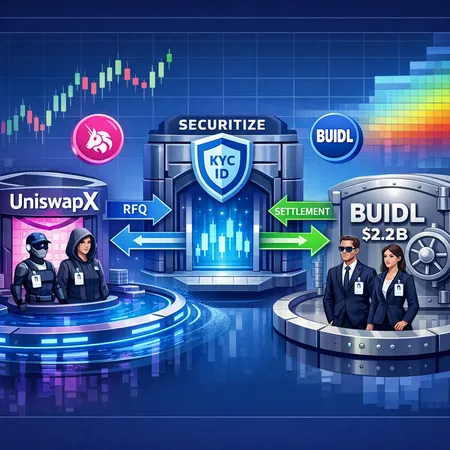
At a high level the pipeline looks like this: an issuer (Securitize, representing BUIDL) mints tokenized shares; UniswapX surfaces an interface to request trades; but execution for institutional‑grade instruments flows through request‑for‑quote (RFQ) channels and allowlisted market‑makers rather than open AMM pools.
- UniswapX acts as the trade router and UX surface. It can route user intent to traditional AMM pools, or to special RFQ endpoints when dealing with restricted tokenized products. CryptoSlate explains how the RFQ/allowlist architecture is used to let Uniswap bring BlackRock’s BUIDL into DeFi while imposing controlled counterparties and trade logic.
- Securitize performs the issuer role and enforces the allowlist and compliance rules — who can hold and who can settle the token. That means downstream settlement often requires off‑chain identity checks and custodial settlement paths rather than purely on‑chain free transfers.
- Allowlisted market‑makers provide liquidity via RFQ: they respond to quotes off‑chain (or semi‑on‑chain) and accept the trade, then settle with the issuer’s mechanics. This preserves price discovery while preventing unauthorized address‑to‑address transfers.
This is not a simple “create a pool and trade” rollout; it’s a hybrid: the DEX UX remains decentralized for discovery and price display, while the execution and settlement chain enforce issuer rules.
Why RFQ + allowlists are necessary
Regulated funds can’t allow arbitrary anonymous transfers. RFQ + allowlist lets liquidity be provided to the retail interface while preserving issuer control over final settlement. CryptoSlate lays out the architectural catch: you get DeFi reach, but not permissionless fungibility. That trade‑off is essential if mainstream asset managers want to put institutional products into the crypto ecosystem.
What this does to liquidity and market‑maker roles
Tokenized institutional assets change the topology of DeFi liquidity in three key ways:
- Concentration of liquidity in RFQ channels. Instead of many tiny LPs distributing inventory across AMM pools, liquidity becomes concentrated in fewer, professional market‑makers who are allowlisted and likely capitalized to warehouse positions.
- Quoted spreads and asymmetric depth. Market‑makers will price in execution, custody and regulatory settlement risk. Expect wider spreads initially and depth that depends on inventory rather than passive LP capital.
- New arbitrage patterns. Off‑chain settlement windows open short lived arbitrage opportunities between AMM pricing and RFQ quotes — but they also increase execution risk when trades must clear issuer checks.
Market‑makers now act not only as liquidity providers but also as compliance gatekeepers and inventory managers. Their risk models must include KYC friction, custody delays, and potential settlement fails.
UNI’s price reaction and short‑term liquidity dynamics
When trading access for BUIDL through UniswapX became visible, UNI experienced sharp, short‑lived moves. CryptoPotato reported a rapid UNI jump when Uniswap enabled trading via UniswapX integration, and Invezz documented a brief UNI spike to $4.50 following the Securitize partnership buzz. Those moves are instructive for how markets priced the news.
Short‑term dynamics to note:
- News squeezes and headline trades: announcements about institutional access often trigger speculative flows in the native governance token (UNI) as traders anticipate higher protocol usage and fee capture. That impulse is typically front‑loaded and can fade quickly.
- Liquidity crowding into RFQ windows: early trades in BUIDL were likely accommodated by allowlisted market‑makers with finite inventory. When retail or off‑exchange counterparties hit RFQ endpoints en masse, spreads widened and slippage increased.
- Fee and flow asymmetry: Uniswap’s traffic profile may shift as higher‑ticket RFQ trades generate less on‑chain AMM activity but more off‑chain settlement work. That can compress typical LP fee accruals while benefiting architected RFQ LPs.
In short: UNI’s spike was a classic ‘‘news‑supply’’ reaction. The deeper change — whether institutional tokenized funds will materially add recurring fee revenue and durable liquidity to Uniswap — depends on how many funds, how much turnover, and whether settlement mechanics scale.
Risks and limitations every trader and analyst must watch
Allowlist and KYC friction
Allowlists are the fundamental limiting factor. They keep unauthorized holders out, but they also throttle liquidity: every buyer must pass issuer checks, which can delay settlement or force trades to fail if the counterparty’s custody structure is incompatible.
Settlement mechanics and custody
Not all token transfers are equal. Some tokenized products require custodial settlement or whitelisted custodians. That means a trade that looks executed on‑chain may yet require off‑chain reconciliation — creating settlement risk and potential fails.
Counterparty concentration and market‑maker risk
When liquidity is provided by a handful of allowlisted market‑makers, counterparty risk and inventory constraints matter more. If one or two market‑makers withdraw or misprice, spreads explode and the UX degrades.
Regulatory spillovers and policy uncertainty
Tokenized institutional products sit squarely in regulator crosshairs. Changes to compliance expectations, secondary transfer rules, or custodial requirements could alter the viability of this model overnight.
MEV, front‑running and on‑chain frictions
Even with RFQ and allowlists, interaction points with on‑chain pools and relays permit MEV vectors. Traders should anticipate unusual MEV patterns around large institutional order flows.
Practical takeaways for DeFi traders and protocol analysts
- Monitor RFQ depth and market‑maker inventories: on‑chain AMM depth is not the full story for tokenized funds. Watch quote sizes and fills off‑chain when possible.
- Treat UNI price moves as sentiment signals, not durable revenue forecasts: a token listing drives attention, but protocol economics depend on sustained turnover and scaled settlement.
- Hedge settlement and counterparty risk: short‑dated hedges and options strategies can protect against sudden withdrawal of RFQ liquidity.
- Build operational readiness for KYC/custody constraints: desks and algos need to know which counterparties can ultimately settle certain tokens.
- Keep an eye on market‑maker concentration: regulatory or financial shocks to a few LPs can create outsized market dislocations.
For teams building products or liquidity strategies, platforms like Bitlet.app that combine P2P exchange functionality and custody-aware features may become part of the plumbing as tokenized products scale.
Final thoughts
UniswapX’s path to offering access to BlackRock’s BUIDL via Securitize is a useful case study in compromise: it proves tokenized institutional funds can reach decentralized order books, but they do so under a compliance envelope that reshapes liquidity. Traders should stop thinking about liquidity in purely AMM terms and start modeling RFQ dynamics, market‑maker inventories, and settlement rails.
In the near term, expect headline‑driven UNI volatility and idiosyncratic liquidity events around token listings. Over the medium term, durable benefits to DeFi depend on whether issuers, market‑makers and DEXes can scale compliant settlement without destroying the price discovery and low friction that makes DeFi attractive.