LayerZero's 'Zero' L1: What the Institutional ZRO Pump Signals for Omnichain Adoption
Summary
Why the Zero announcement mattered: a market reaction and a thesis
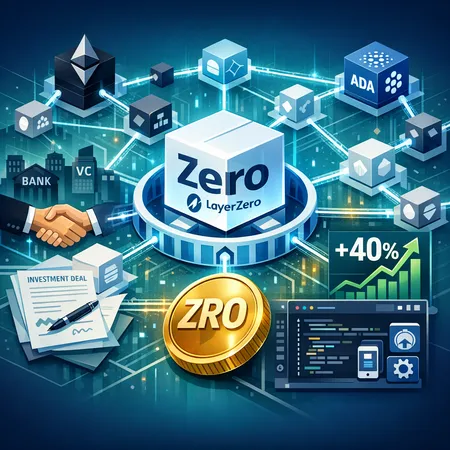
When LayerZero Labs announced plans for a native Layer‑1 called Zero and disclosed institutional backers, the ZRO token spiked by more than 40% in short order. That reaction is predictable: markets prize both product roadmaps and credible capital. Headlines matter because they change expectations about liquidity, ecosystem funding, and the odds of developer adoption.
But the price move asks a deeper question: what does Zero actually propose to solve, and can institutional support turn an omnichain vision into a working, widely used settlement layer rather than a speculative narrative? This piece walks through the technical pitch, the importance of institutional names, the short‑ and mid‑term tokenomics implications for ZRO, and how integrations like Cardano’s LayerZero hookup (and USDCx availability on Cardano) make the story more practical for developers and liquidity providers.
What Zero proposes to fix compared with existing L1s
Layer‑1 blockchains historically optimized for two of three immediate priorities: security, scalability, or decentralization — and ecosystems then build bridges and middleware to stitch them together. That model created a patchwork: token bridges, wrapped assets, cross‑chain oracles and bespoke messaging layers. The omnichain thesis argues that this layering adds latency, trust assumptions and UX friction.
Zero’s pitch (as positioned by LayerZero Labs) is to treat cross‑chain messaging and settlement as first‑class primitives baked into a new L1. Instead of relying on external bridges and ad‑hoc relayer networks, Zero aims to provide a more native messaging fabric that makes asset movement, composability and cross‑chain function calls feel seamless. Practically, that targets three common pain points:
- Liquidity fragmentation: projects waste capital across isolated pools. Native cross‑chain primitives can reduce duplicated liquidity and allow applications to route assets without wrapped intermediaries.
- Developer complexity: teams spend months engineering cross‑chain glue. A native omnichain message bus reduces integration friction and shortens product cycles.
- Security surface area: bridges are frequent attack vectors. Consolidating messaging and settlement in a well‑audited, formal design aims to reduce those ad hoc trust assumptions.
Zero does not have to beat every L1 on raw throughput to be meaningful. Instead, its value proposition is enabling unified application state and composability across chains — a different competitive axis. That said, there are tradeoffs: tight integration of message passing can create new consensus and attack surfaces, and any “native” approach must prove itself at scale.
Key technical differentiators to watch
LayerZero’s earlier work focused on lightweight cross‑chain messaging; the move to an L1 suggests a few concrete design choices that matter to builders:
- Native message bus: message primitives available at the protocol level (not an optional middleware) that let contracts call across chains with strong finality guarantees.
- Deterministic settlement paths: predictable fee and routing models for cross‑chain calls so developers and liquidity providers can estimate costs and latency.
- Built‑in liquidity rails or settlement factories: mechanisms to reduce wrapped asset overhead when transferring value.
- Permissioning and governance models tuned for cross‑chain state changes — governance must account for both local and remote effects.
Those features might resemble the modular‑chain thinking popular in rollups and interoperability stacks, but implemented with L1 finality and validator economics. Whether Zero can deliver all of them securely, and without centralization creep, will determine real adoption.
Why institutional backing matters for omnichain infrastructure
Institutional capital in infrastructure projects is more than a headline. The presence of well‑capitalized backers can accelerate an ecosystem’s early life in several ways:
- Capital and market‑making: institutions supply the liquidity and trading infrastructure that make a token usable and reduce spread—helpful when ZRO is expected to power fees or collateral rails.
- Talent and partnerships: strategic investors often bring integrations, enterprise relationships and engineering resources — speeding dApp launches.
- Credibility: for conservative teams and projects, institutional commitments lower the perceived risk of building on a nascent L1.
News coverage of Zero highlights exactly that dynamic: firms backing the launch helped drive confidence and the immediate market reaction in ZRO. The effect is real—projects with deep pockets can bootstrap liquidity pools, fund grants, and support stablecoin minting or market‑making operations that smooth early UX frictions.
But institutional backing also creates counter‑forces. Large backers typically receive token allocations with vesting schedules; once cliff and unlock dates approach, market participants often price in future selling pressure. And centralized capital can tilt validator economics or influence governance in ways that concern decentralization purists. The balance — capital that accelerates adoption without strangling decentralization or transparency — is delicate.
(Reporting on the surge and the backers is summarized in outlets covering LayerZero’s Zero debut.) NewsBTC covered the market reaction and the role of institutional names in driving sentiment.
ZRO tokenomics: short‑term pump vs mid‑term utility dynamics
Short term: the announcement caused a speculative re‑rating. Traders bought ZRO on two correlated stories: the promise of a native L1 product and the signaling value of institutional support. That immediate demand creates price momentum, but it’s fragile — tied to news flow and execution updates.
Mid term: tokenomics will determine whether price can be underpinned by real economic demand. Key token design questions investors and builders should monitor:
- Utility: Is ZRO required for gas, messaging fees, staking, or governance? Tokens that capture fee sinks and protocol revenue tend to align better with on‑chain demand.
- Distribution & vesting: how many tokens are circulating now vs locked for backers, team and ecosystem incentives? Large locked allocations create future supply shocks at unlock.
- Fee mechanics and burn: do cross‑chain messages burn ZRO, or is it paid to validators? Fee sinks materially change supply dynamics.
- Incentive alignment: are grants and liquidity mining structures designed to bootstrap sustainable usage or short‑lived TVL?
Institutional buyers can be a double‑edged sword here. They provide initial liquidity, but substantial allocations with scheduled unlocks can add medium‑term sell pressure if protocol adoption doesn’t convert to token demand. Conversely, if Zero achieves meaningful fee capture via cross‑chain traffic, token value can decouple from trading narratives and move toward usage‑driven appreciation.
How Cardano’s integration illustrates practical omnichain use cases
A useful real‑world signal is how existing blockchains adopt LayerZero primitives. Cardano’s move to integrate LayerZero — including support for token rails like USDCx — is an example of a mature chain enabling omnichain flows that would benefit applications and liquidity.
Cardano’s integration shows several pragmatic pathways:
- Cross‑chain DeFi composability: an AMM or lending protocol on Cardano can tap liquidity or price feeds from other chains without complex bridge stacks, reducing friction for ADA holders and projects.
- Stablecoin rails and payments: support for tokens like USDCx across chains enables consistent UX for payments and treasury operations. That matters for on‑ramps and real‑world adoption.
- Developer migration and tooling: easier message primitives reduce the cost of porting dApps to new chains or building multi‑chain features.
The Cardano integration is covered in reports that highlight how LayerZero can expand cross‑chain access on ADA. See coverage on the practical integration steps and the implications for USDCx on Cardano in Cryptopolitan’s reporting: Cardano secures LayerZero integration.
For builders, that means Zero’s success will correlate with how widely other L1s and large ecosystems — such as Cardano, Ethereum rollups, and L2s — allow native cross‑chain message flows to interoperate. Each major integration increases the value proposition of a unified omnichain settlement fabric.
When notable ecosystems interconnect, liquidity begins to behave differently: instead of isolated ADA pools, we can imagine cross‑chain pools that route liquidity based on latency and fees. That’s a clear boon to DeFi primitives aiming to aggregate depth.
Adoption signals investors and builders should monitor
Not every announcement translates into durable adoption. To judge whether Zero is a credible institutional L1 bet, watch the following measurable signals over the coming months:
- TVL and cross‑chain message volume: sustained growth in messages and value transferred is the clearest usage signal.
- Active developer count and dApp launches: more projects building with native messaging primitives indicates a cultural shift in tooling choices.
- Token unlock schedule and on‑chain flows: transparency around backer allocations and actual on‑chain selling or accumulation matters for supply pressure.
- Validator set composition and decentralization metrics: who runs the nodes? Institutional nodes can add stability but may concentrate power.
- Integrations with major ecosystems: every new supported chain (e.g., Cardano, major L2s) multiplies potential composability.
- Fee economics in practice: are users and protocols willing to pay for native messages, and does that revenue meaningfully accrue to ZRO holders?
Short‑term price charts will overreact to announcements. Mid‑term fundamentals require persistent usage.
Risk checklist
- Centralization: large backers and permissioned validator sets can create governance concentration.
- Sell pressure tied to vesting: token unlocks can reverse initial gains.
- Smart contract and cross‑chain attack surface: increased messaging complexity invites new classes of bugs.
- Regulatory scrutiny: institutional involvement may draw more regulatory attention to how tokens are distributed and marketed.
Investors should balance headline‑driven enthusiasm with these realities.
Verdict: a credible institutional L1 bet — if execution follows
Zero’s pitch is compelling on paper: elevate cross‑chain messaging to a protocol primitive and remove the frictions that trip up multi‑chain apps. Institutional backing speeds market confidence, liquidity provisioning and ecosystem funding — critical ingredients during launch.
But the announcement is a beginning, not an end. Convertibility of narrative into durable adoption requires clear token utility, transparent tokenomics, robust security audits, and demonstrable integrations that produce real, repeatable developer value. Cardano’s LayerZero hookup is an encouraging practical signal: it shows ecosystems are willing to test omnichain rails in production contexts, increasing the odds that a native omnichain L1 could attract real traffic.
For investors and builders watching ZRO, the near term will be noisy. Track the adoption signals above, read audits and vesting disclosures carefully, and consider how much of your thesis depends on durable fee capture versus momentary narrative momentum. If Zero can become the plumbing that reliably routes liquidity and application state across chains, institutional backers will have been an accelerant — not just a headline.
Bitlet.app users and builders should watch cross‑chain liquidity patterns and integration announcements closely; they’ll be among the earliest practical indicators that omnichain primitives are changing product design choices.